
Why We Disagree with Mr. Market
What Could the Arminius Order Mean for German Land Defense?
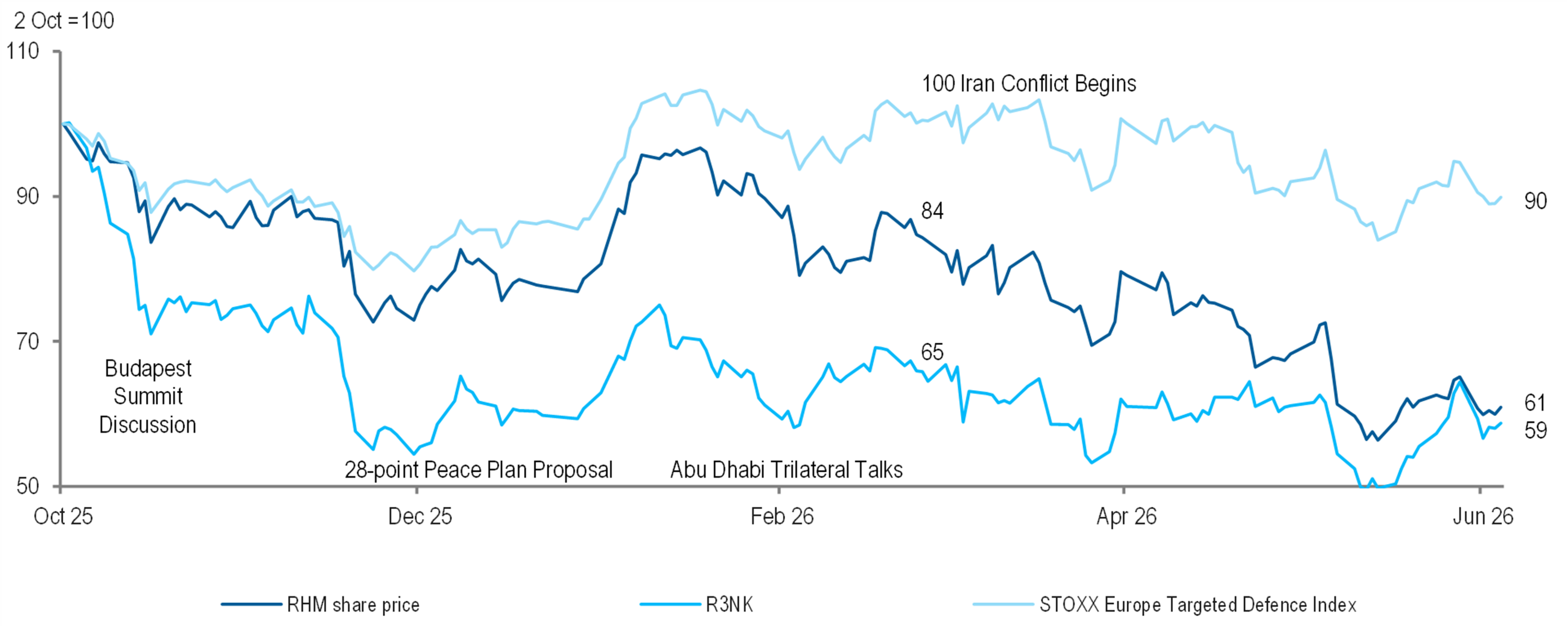
German land defense stocks, including the prime contractor Rheinmetall and one of its suppliers, Renk, reached a peak in early October 2025. The shares since experienced several periods of decline associated with Ukraine peace discussions, followed by partial recoveries. These included discussions surrounding a potential Budapest summit in mid-October, the 28-point peace draft in mid-November, and the Abu Dhabi trilateral talks that commenced in the final week of January 2026. Despite an initial positive price reaction, the shares came under additional pressure following the onset of the Iran conflict in early March. In addition, Rheinmetall’s shares were burdened by execution delays that surfaced in early May.
We do not believe the share declines associated with the Ukraine peace discussions were driven primarily by concerns over a potential reduction in equipment and ammunition demand in Ukraine. Instead, we believe they reflected broader concerns regarding commitment to the new defense spending targets laid out at the NATO summit in The Hague in June 2025. We do not believe these concerns are justified, as European rearmament is intended for deterrence rather than active conflict. As we explain in this note (see p.4), evidence from NATO’s three largest members over the past year suggests that defense spending is more likely to exceed than fall short of our working assumptions.
Exhibit 1 German Land Defense Share Price Trend Since October 2025
Sources: LSEG
The share price reactions associated with the onset of the Iran conflict did not occur uniformly across the sector. Instead, price reactions depended on the degree of product overlap with weaponry showcased in the Iran conflict. This means that shares with a product mix geared towards the air domain (particularly drones, missiles) and air defense fared better than those with portfolios geared towards the land domain. As an example, German Hensoldt actually saw its shares advance over this period. While we agree that the conflict underpinned the rising urgency of, e.g., air defense, we disagree with the extent of derating in land defense stocks, especially in the case of a multi-domain prime contractor such as Rheinmetall.
We believe that European rearmament will feature both conventional weaponry, including land-based systems, and more recent developments such as drones and anti-drone air defense. As we also explain in this note (see p.5), a large portion of the envisaged equipment expenditure will be spent locally, meaning prime contractors like Rheinmetall will naturally benefit regardless of the eventual allocation of specific program awards. That said, we appreciate that German land defense is now a prove-it story. We therefore expect large conventional land defense orders, including the so-called Arminius order, to act as catalysts for the shares.
Project Arminius is what the German military calls its large-scale Boxer armored vehicle program, representing Rheinmetall’s single biggest contract opportunity in the pipeline. The total potential for Rheinmetall from the program amounts to approximately €38bn, with an initial fixed order tranche of around €12.5bn expected to be placed in H2-26 (timeline updated in Q1), accompanied by down payments of 20-30%. The program covers a wide range of Boxer variants, from the Schakal infantry vehicle to air-defense and surface-to-air missile configurations, and is expected to run at least through 2035, with discussions extending as far as 2040.
Exhibit 2 Project Arminius Overview
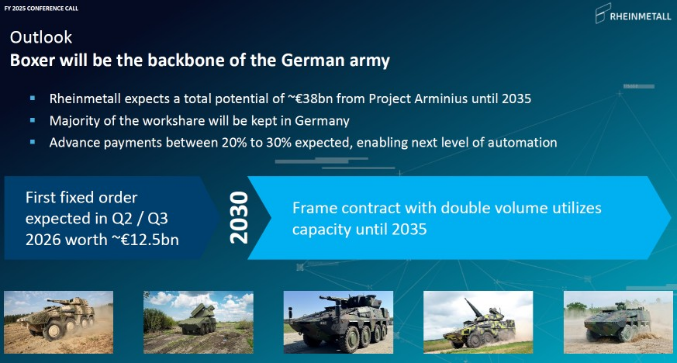
Note Rheinmetall updated the timeline to H2-26; Sources: Rheinmetall
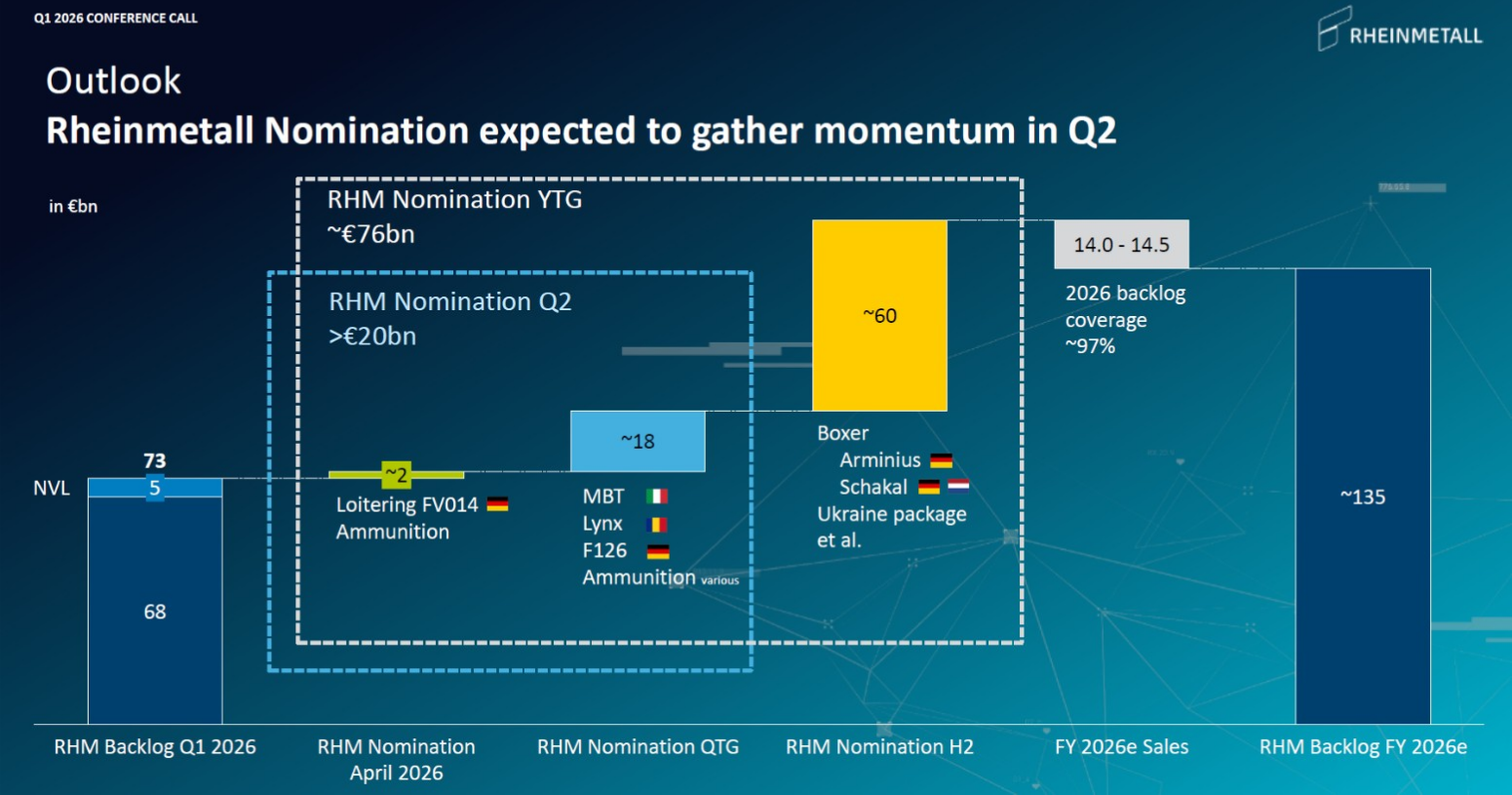
While Arminius is the largest vehicle order from Germany, we also expect Rheinmetall to receive other orders including for logistics trucks and ammunition. Overall, management guides for roughly €80bn of orders in 2026 (FY-25: €26.5bn), lifting backlog to €135bn (Q4-25: €64bn). Of this, €67bn stems from Germany, at least another €10bn is expected from Europe (Italy, Romania, SAFE financing), and €3bn from Ukraine. We also note recent reports indicating that Germany has agreed to take a 40% stake in Rheinmetall peer KNDS as part of its planned IPO in summer 2026. Taken together, we disagree with Mr. Market and consider the recent derating of German land defense stocks to be overdone.
Exhibit 3 Rheinmetall Guided Order Pipeline
Sources: Rheinmetall
WHERE IS TOTAL EUROPEAN DEFENSE SPENDING HEADED?
European NATO members’ defense expenditure in the ten years before the invasion of Ukraine stood at around 1.5% on average as a share of GDP. At the time, NATO members were expected to allocate at least 2% of their GDP to defense. That compares to circa 3.5% in the U.S., and 2.5% for NATO total, including the U.S. and Canada. NATO Europe, after the invasion of Ukraine in 2022, already substantially increased defense expenditure to about 2.0% as a share of GDP. In June of 2025, the NATO summit took place in The Hague, Netherlands. At this event, NATO members committed to a new set of spending and capability targets.
NATO members made the commitment to invest 3.5% as a share of GDP by 2035 to resource core defense requirements and to meet the NATO capability targets. In addition, they account for up to 1.5% as a share of GDP for investments that are less specific, e.g. investments to protect critical infrastructure and strengthen the defense industrial base. Overall, we estimate the European NATO members’ core defense expenditure in 2024 to be around $485bn. The three largest contributors are Germany with $95bn or around 20% of the total, followed by the U.K. with $85bn and France with $65bn. That compares with around $935bn spent by the U.S.

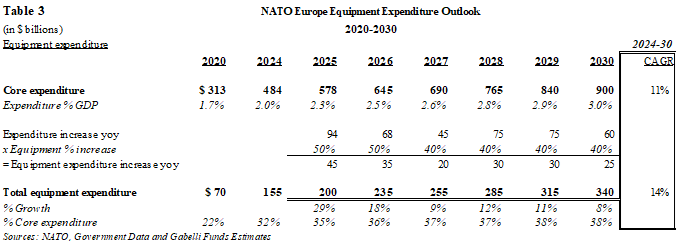
We have updated our European NATO members’ core defense expenditure outlook based on statements made by key nations since the NATO summit. We now estimate NATO Europe core expenditure to reach around 2.6% as a share of GDP, or $690bn by 2027 and 3.0% or $900bn by 2030. Key driver of this absolute growth with around 30% is Germany. This is explained by Germany’s firm commitment to lead NATO Europe spending and enabled by the taking on of an unprecedented level of debt. Based on official government statements, we now expect German core expenditure to reach 3.1% as a share of GDP by 2027 and 3.5% by 2029, i.e. 6 years ahead of the NATO targets.

Note, the U.S. is considering a further increase in defense spending, with the headline budget potentially rising from roughly $1.0 trillion to $1.5 trillion. Germany, meanwhile, already increased its defense spending ambitions as recently as May 2026 by around 17% for 2027 and 10% for 2028. As a result, it now aims to exceed NATO’s core defense spending target from 2030 onward, reaching 3.7% of GDP. The U.K. is also moving towards higher spending plans, which currently envisage 3.0% sometime between 2029 and 2034. Taken together, developments among NATO’s three largest members suggest that total defense spending is more likely to exceed than fall short of our updated assumptions.
HOW IS EUROPEAN TOTAL DEFENSE SPENDING BEING ALLOCATED?
Core defense expenditure can be divided into two main segments: equipment, which historically contributed around 20% to NATO Europe total spend, and others. Others mainly includes personnel and expenses for operations and maintenance. After the invasion of Ukraine, equipment expenditure has grown disproportionately strongly, to about 30% of the total. This growth is best explained by a more rapid availability of equipment versus, e.g., the hiring and training of personnel. The three largest equipment contributors are the U.K. with around $30bn, Germany with $28bn, and France with $18bn. Overall, we estimate the total addressable European defense equipment market in 2024 to be around $155bn.
That $155bn compares to around $290bn in equipment expenditure in the U.S., which has consistently explained close to around 30% of total U.S. defense expenditure over the past decade. While this 30% is likely a good guideline for a NATO Europe equipment share normalization long-term, we continue to expect a higher equipment share short- and medium-term in light of its more rapid availability. Based on conversations with industry participants, we continue to model a 40-50% share of the incremental annual defense spend to be allocated to equipment. As a result, we estimate NATO Europe equipment expenditure to grow at an around 15% CAGR to $340bn by 2030.
With regard to NATO Europe’s capability targets (the details are highly classified), statements since the NATO summit support our expectation of a growing emphasis on land-based operations, ammunition, and air defense. That said, a key observation is that governments have consistently encouraged the participation of local industry in large defense tenders to maximize local content and sovereignty. For example, Rheinmetall is cooperating with Leonardo and Indra on the Italian and Spanish armored vehicle programs. This observation means that a large portion of the envisaged equipment expenditure will be spent locally, regardless of the eventual allocation of program awards.
AND WHO WAS ARMINIUS?
Arminius (Hermann in German), was a Germanic leader who led a coalition of Germanic tribes to victory against Rome at the Battle of the Teutoburg Forest in 9 AD. In that engagement, three Roman legions commanded by Publius Quinctilius Varus were annihilated in a coordinated ambush. The defeat had major long-term consequences for Roman expansion, leading to the Empire’s strategic retreat from territories east of the Rhine and the abandonment of plans to fully incorporate Germania. Many historians regard this battle as one of Rome’s most severe military defeats, and some consider it a pivotal moment that shaped the course of European history by limiting Romanization in the Germanic regions.
Born into the ruling elite of the Cherusci, Arminius initially aligned himself with pro-Roman interests within his tribe. He was educated in Latin, served in the Roman army, and was granted Roman citizenship along with equestrian rank. During his military career, he distinguished himself in the Great Illyrian Revolt before being assigned to assist the Roman governor Publius Quinctilius Varus in consolidating control over Germanic territories. While acting in this role, he secretly organized resistance among Germanic tribes, ultimately orchestrating the ambush that destroyed three Roman legions in the Teutoburg Forest.
Exhibit 4 Arminius Monument, Teutoburg Forest, Germany

Sources: ChatGPT
FREQUENTLY ASKED QUESTIONS
Q: Why have German land defense stocks derated since October 2025?
A: The shares experienced several periods of decline associated with Ukraine peace discussions and came under additional pressure following the onset of the Iran conflict in early March.
Q: What could the Arminius order mean for German land defense?
A: We consider the recent derating as overdone. We expect large conventional land defense orders, including the so-called Arminius order, to act as catalysts for the shares.
Q: Will a peace in Ukraine soften the commitment to NATO spending targets?
A: We do not believe these concerns are justified, as European rearmament is intended for deterrence rather than active conflict.
Q: Where is total European defense spending headed?
A: Evidence from NATO’s three largest members over the past year suggests that defense spending is more likely to exceed than fall short of our working assumptions.
Q: Do the Ukraine and Iran conflict mandate a shift in focus on new technologies?
A: We believe that European rearmament will feature both conventional weaponry, including land-based systems, and more recent developments such as drones and anti-drone air defense.
Q: How is total European defense spending being allocated?
A: We expect a rising share of equipment expenditure, growing at a 2024–30 CAGR of roughly 15%. Statements since the NATO summit support our expectation of a growing emphasis on land-based operations, ammunition, and air defense. A large portion of the envisaged equipment expenditure will be spent locally, which means prime contractors like Rheinmetall will naturally benefit regardless of the eventual allocation of specific program awards.
Q: Will governments enforce lower defense contractor margins?
A: European defense is a sellers’ market with a shortage of production capacity. We expect governments, in price negotiations, to focus on equipment availability to meet capability targets.
Q: What is the Arminius program?
A: Project Arminius is what the German military calls its large-scale Boxer armored vehicle program, with a workshare worth €38bn for Rheinmetall alone.
Q: And who was Arminius?
A: Arminius led a coalition of Germanic tribes to victory against Rome at the Battle of the Teutoburg Forest in 9 AD. Many historians regard this battle as one of Rome’s most severe military defeats, and some consider it a pivotal moment that shaped the course of European history.
249 ROYAL PALM WAY, PALM BEACH, FL 33480 Gabelli Funds TEL (561) 671-2100
This whitepaper was prepared by Daniel Gleim, CFA. The examples cited herein are based on public information and we make no representations regarding their accuracy or usefulness as precedent. The Research Analysts’ views are subject to change at any time based on market and other conditions. The information in this report represent the opinions of the individual Research Analysts’ as of the date hereof and is not intended to be a forecast of future events, a guarantee of future results, or investments advice. The views expressed may differ from other Research Analyst or of the Firm as a whole.
As of March 31, 2026, affiliates of GAMCO Investors, Inc. beneficially owned less than 1% of all companies mentioned.
This whitepaper is not an offer to sell any security nor is it a solicitation of an offer to buy any security. For more information, visit our website at: www.gabelli.com or call: 800-GABELLI
800-422-3554 • 914-921-5000 • Fax 914-921-5098 • info@gabelli.com
Gabelli Funds, LLC is a registered investment adviser with the Securities and Exchange Commission and is a wholly owned subsidiary of GAMCO Investors, Inc. (OTCQX: GAMI).