Iranian and U.S. Missile Costs
What is the current situation in the Strait of Hormuz?
The United States and Iran continue to confront one another over control and security in the Strait of Hormuz. On Monday, 20 July, two Greek oil tankers attempted a nighttime transit through the Omani coastal passage. Despite U.S. air cover and military strikes on Iranian positions, both vessels were hit and damaged by Iranian missiles. Military officials and shipping executives argue that eliminating the missile threat would require weeks of strikes, and shipowners may still be hesitant to send vessels through the strait.
What are Iran’s goals, what effectors does it deploy?
Iran has primarily focused its attacks on oil tankers, employing low-cost Shahed drones, sea-skimming cruise and anti-ship missiles directed at vulnerable sections of vessels, as well as high-speed small boats. According to the Financial Times, Kevin Donegan, a former commander of the U.S. Fifth Fleet, argued that Iran only needs to create sufficient disruption to keep insurance costs prohibitively high for shipowners. He added that Iran continues to launch intermittent strikes against vulnerable targets to ensure that some vessels are damaged or set ablaze.
What are the economics of U.S.-made air defense?
Although publicly reported estimates of the cost for a Shahed drone vary considerably, we consider an estimate of approximately $20-30k per system to be reasonable. By comparison, U.S.-manufactured interceptors used by the U.S. and its allies are estimated to cost roughly $3.9 million for a Patriot and $5.3m for an SM-6 interceptor. Ballistic missile interceptors are even more expensive (compare Table 1). As a result, the economics of U.S.-made air defense remain unfavorable, reflecting both the large cost disparity and the difficulty of replenishing inventories.
Table 1: Status of U.S. Interceptors and Attack Missiles

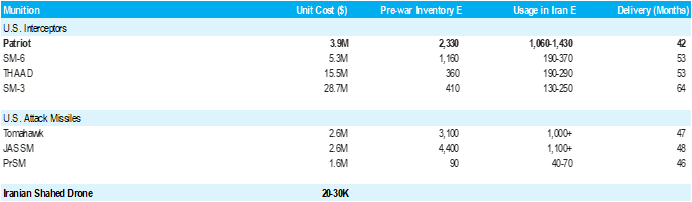
Note: Estimated as end of April 2026; Source: CSIS Study
Are there alternatives to U.S. interceptors?
It is important to note that many U.S.-made attack missiles have lower-cost alternatives capable of achieving broadly similar effects, albeit with trade-offs. These include reduced range, greater risk to aircraft, and lower survivability. In contrast, systems such as Patriot and SM-6 are designed for highly specialized defensive roles, detecting, tracking, and intercepting incoming missiles or aircraft before they reach their targets. Consequently, there are no straightforward low-cost alternatives that can provide an equivalent level of protection.
U.S. Missile Restocking Dynamics
What are the challenges for restocking of munitions?
Restocking of key munitions is constrained by limited production capacity, lengthy manufacturing lead times, and sustained global demand. Although production of critical missiles and interceptors is increasing, expanding output requires years as manufacturers build new facilities, qualify suppliers, and overcome shortages of essential components. At the same time, newly produced munitions must meet competing priorities, including rebuilding U.S. stockpiles, supplying partners such as Ukraine, and fulfilling foreign military sales commitments to allied nations.
Exhibit 1: Iran’s drone Shahed-136
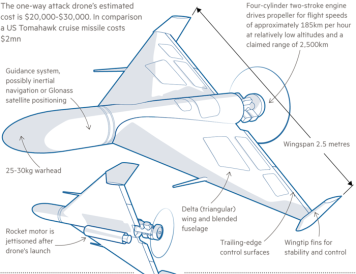
Source: Financial Times
How long will restocking take, especially for Patriot?
As a result, rebuilding inventories is expected to take several years. For example, according to CSIS, stocks of Patriot (PAC-3 MSE) interceptors are not expected to recover until early 2029. Although Lockheed Martin plans to increase annual production from roughly 650 to as many as 2,000 interceptors, output must replenish U.S. inventories, support Ukraine, and meet orders from 17 allies. Consequently, production constraints and competing demand, rather than funding alone, are expected to make Patriot restocking a prolonged, multi-year process.
Table 2: Key Munition Stockpiles and Restocking Timelines

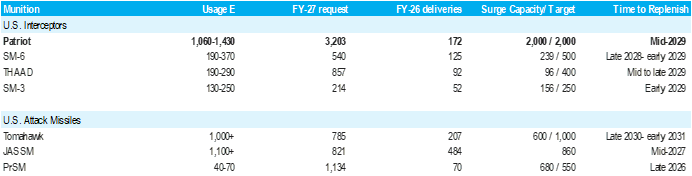
Note: Current maximum production rate represents the surge capacity achievable with existing facilities.; Source: CSIS Study
Frequently Asked Questions
Q: What is the current situation in the Strait of Hormuz?
A: The U.S. and Iran remain in conflict over the Strait of Hormuz, with ongoing Iranian attacks discouraging commercial shipping.
Q: What are Iran’s goals and what effectors does it deploy?
A: Iran aims to disrupt shipping and raise insurance costs by targeting oil tankers with Shahed drones, cruise and anti-ship missiles, and high-speed small boats.
Q: What are the economics of U.S.-made air defense?
A: U.S.-made air defense remains economically challenged, as low-cost drones can be far cheaper than interceptors such as Patriot and SM-6, which cost millions of dollars and are difficult to replenish.
Q: Are there cheaper alternatives to U.S. interceptors?
A: While some attack missiles have lower-cost alternatives, systems like Patriot and SM-6 perform specialized defensive roles with no equivalent low-cost substitutes.
Q: What are the challenges for restocking munitions?
A: Restocking is constrained by limited production capacity, long lead times, supply chain challenges, and competing demands from U.S. stockpiles, Ukraine, and allied partners.
Q: How long will restocking take, especially for Patriot?
A: Patriot (PAC-3 MSE) inventories are not expected to recover until early 2029, as production capacity remains constrained by competing global demand.
Q: What is the HYPOTHETICAL weekly production volume necessary to restock patriots in a year?
A: Assuming a 1,200-interceptor shortfall and that all newly produced Patriot interceptors are allocated to U.S. inventories, restoring stocks within one year would require producing approximately 23 interceptors per week, compared with the current actual output (not surge capacity) of roughly 12–13 per week. This would require nearly doubling current production rates.
THE GABELLI AEROSPACE AND DEFENSE ETF
As of December 31, 2025, affiliates of GAMCO Investors, Inc. beneficially owned less than 1% of all companies mentioned.
For investors seeking exposure to this evolving defense landscape, the Gabelli Commercial Aerospace and Defense ETF (GCAD) offers targeted access to companies developing the advanced capabilities that define modern military operations. GCAD focuses on defense technology companies at the intersection of building stealth aircraft, precision munitions, unmanned systems, and advanced sensors essential to maintaining strategic advantage in contested environments. As geopolitical tensions drive sustained defense spending and procurement modernization, GCAD provides a way to participate in the growth of the defense technology sector shaping military operations for decades to come.
Click here to learn more about GCAD and click here to schedule a meeting with a member of our team.
Semper Fi,
LtCol Tony Bancroft, USMCR
Important Disclosures
• Shares of this ETF are bought and sold at market price (not NAV) and are not individually redeemed from the fund.
• Buying or selling ETF shares may require additional fees such as brokerage commissions, which will reduce returns.
• These additional risks may be even greater in bad or uncertain market conditions.
You should consider the ETFs’ investment objectives, risks, charges and expenses carefully before you invest. The ETFs’ Prospectus and Summary Prospectus are available from G.distributors, LLC, a registered broker-dealer and FINRA member firm, and contains this and other information about the ETFs, and should be read carefully before investing. To obtain a Prospectus or Summary Prospectus, please call 888-GABELLI or visit https://www.gabelli.com/funds/etfs/documents.
Distributed by G.Distributors, LLC, a registered broker-dealer and FINRA member firm.
One Corporate Center, Rye, NY 10580