What We Have Learned from Our Meetings
Farnborough International Airshow Highlights
The Farnborough International Air Show, the largest aerospace & defense tradeshow in the world, was held July 20-24 this year at Farnborough International Exhibition and Conference Centre, Hampshire, UK. Over 100,000 participants attended, ranging from OEMs to suppliers to A&D investors. The Farnborough Air Show hosted 1,500 exhibit booths. The Air Show showcased the latest technology in aviation, such as the debut of the F-35 and A350 and all their capabilities. Over the course of two days, we met with the management teams of 11 different companies.
What is the civil aircraft demand outlook? Boeing and Airbus forecasts (2025 CMO/GMF) project demand for approximately 43,400-43,600 new passenger and freighter aircraft through 2044, with the global fleet nearly doubling to ~49,000-50,000 aircraft. Large carriers continue placing significant orders (e.g., Airbus’s strong May 2026 intake of 379 gross orders, including major A220 and A320neo deals) to secure delivery slots often extending into the 2030s. Fleet modernization remains a priority amid strong long-term passenger traffic growth projections of ~3.6% annually (RPKs).
What is the civil aircraft supply outlook? The industry remains demand-unconstrained, with the core challenge being OEM production ramp-up and on-schedule deliveries. Airbus and Boeing maintain massive backlogs (Airbus >9,000; Boeing ~6,700+), providing multi-year visibility. Recent monthly delivery records (e.g., strong May 2026 figures) show progress, but consistent execution at higher rates (e.g., Airbus targeting 75 A320-family/month, Boeing scaling MAX and widebodies) is key to unlocking operating leverage. Farnborough will serve as a key “show me” moment for production momentum.
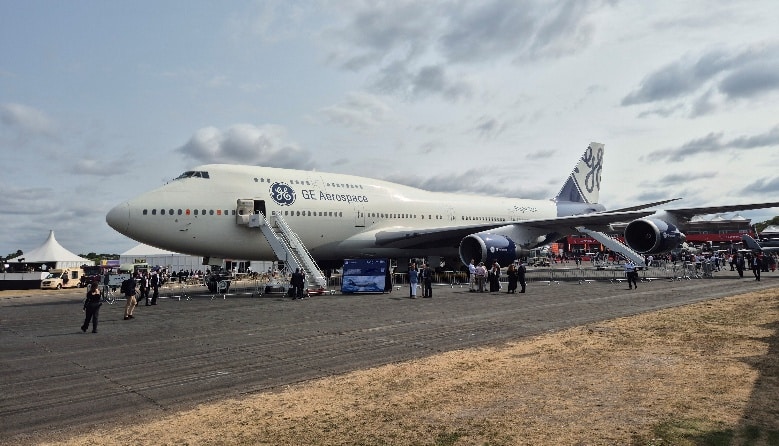
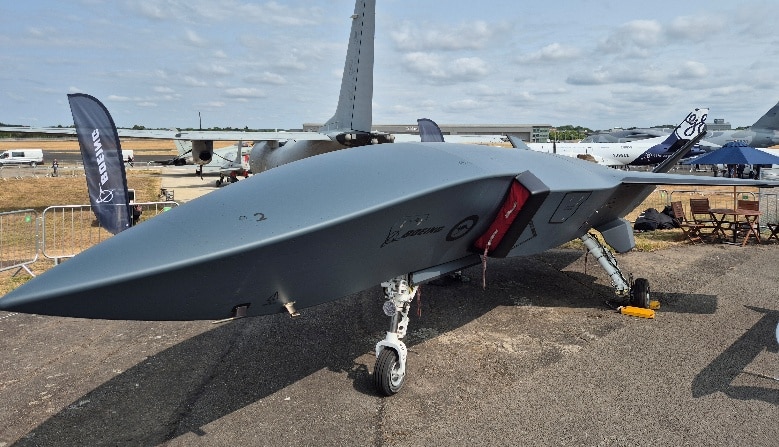
| Exhibit 1 GE Aerospace Flying Test Bed | Exhibit 2 Boeing MQ-28 Ghost Bat Uncrewed Aircraft | ||
 |
 |
||
| GE Aerospace uses this aircraft to test engine designs; Source: Gabelli Funds | Length 38 feet, wingspan 24 feet, speed up to Mach 0.9; Source: Gabelli Funds |
Can supply chains keep up with the airframers? Normalization toward pre-pandemic (2019) levels is underway, but persistent bottlenecks in engines, specialty alloys, and certain systems continue to constrain monthly output. Supply chain resilience, diversification, and scalability are major themes at Farnborough 2026. Over the next 1-2 years, further stabilization is expected to support higher, more efficient build rates and act as a tailwind – though near-term pressures remain evident in delivery pacing.
What is the outlook for the aftermarket? Strong growth is projected, with the aircraft aftermarket parts/MRO segment expected to expand at a high-single-digit CAGR (roughly 6-8% in various forecasts) through the early 2030s, driven by rising revenue passenger miles (returning to long-term above-GDP trends), fleet expansion/renewal, and sustained high utilization. Travel demand has proven resilient. Boeing’s Services Market Outlook underscores a multi-trillion-dollar opportunity in support services over the period.
Who are the preferred targets for M&A? Large operators, lessors, and private equity remain active, with an attractive environment due to strong air traffic, resilient operations, and valuation dynamics. Companies offering highly engineered parts with significant aftermarket exposure (e.g., engines, rotable components) are particularly sought after amid supply chain and modernization tailwinds.
EUROSATORY HIGHLIGHTS
Eurosatory is one of the world’s leading defense and security trade shows. Held June 15-19, 2026, in Paris, France, the event brought together more than 2,000 exhibitors from over 60 countries and highlighted developments across conventional land defense, emerging technologies including autonomous systems, and air defense. Over the three days we attended the event, we met with management and IR teams from 10 companies across the European land-defense value chain.
Will tanks remain relevant compared to drones? We remain confident in the planned build-up of European conventional land forces: conventional and emerging technologies are complementary, and European countries need to meet their NATO capability targets. We see evidence for this in Leonardo’s commentary on the Italian Army’s tank and IFV programs and Rheinmetall’s commentary on the German Arminius program. We also note that Saab and Elbit Systems continue to expand production capacity in land defense, which remains their largest contributor to absolute EBIT.
Will the future battlefield be manned or unmanned? The technology debate is already shifting from tanks versus drones to manned versus unmanned including vehicles, naval vessels, and aircraft. That said, we expect the impact on product mix to materialize primarily over the medium-to-long term, as both new platforms and retrofit solutions are still under development. We note that autonomy does not eliminate the need for physical platforms. As a result, we do not expect autonomy to have a negative impact on system integrators such as Rheinmetall or drivetrain suppliers such as RENK.
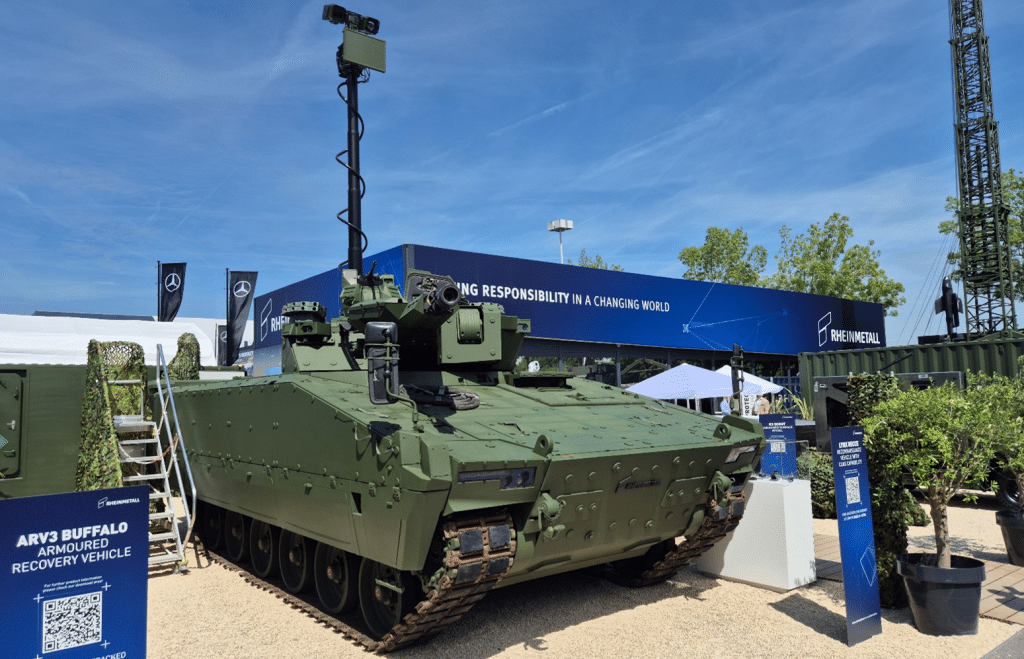
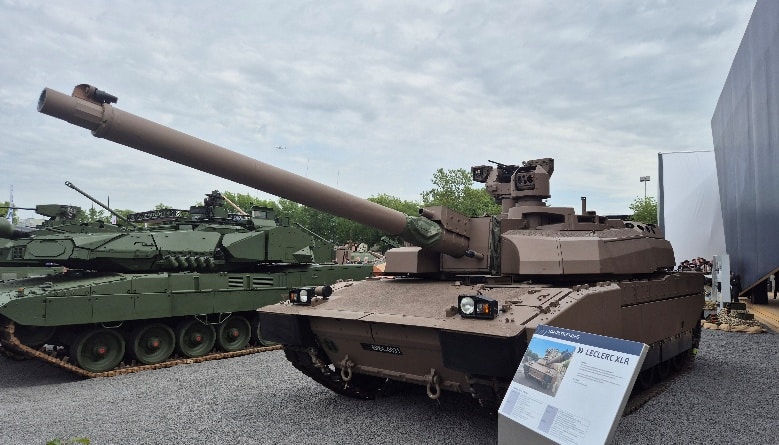
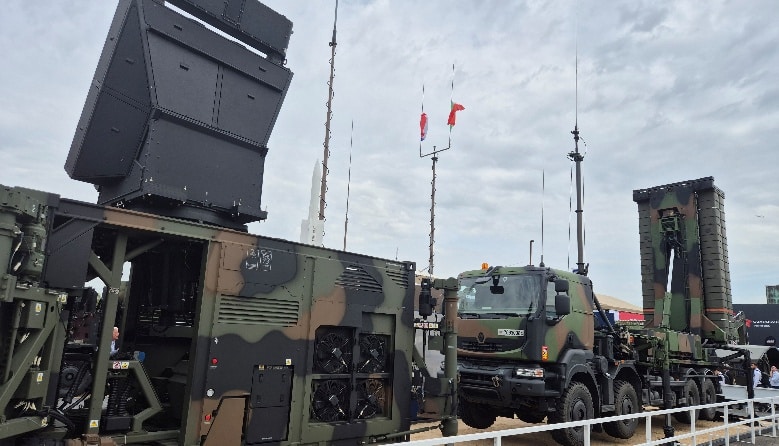
| Exhibit 1 KNDS German and French Main Battle Tanks | Exhibit 2 EUROSAM Missile-based Air Defense | ||
 |
 |
||
| Left: German Leopard 2, right: French Leclerc; Source: Gabelli Funds | SAMP/T NG radar and launcher; Source: Gabelli Funds |
Will spending shift towards counter-drone systems? Rather than a seismic shift, we see this as an incremental reallocation within the existing NATO capability targets, with the focus remaining on land-based operations, ammunition, and air defense. Immediate revenue impact should be limited, as capacity is fully booked and key effectors remain under development. We agree with Elbit and Thales that drones are unlikely to become a major standalone revenue driver.
What is the market potential from the Middle East? The Iran conflict created incremental market potential in Israel and beyond, with one focus on ammunition replenishment and air defense. That said, order books were already full despite initial ad-hoc support. This means major orders for European contractors are likely to materialize only in 2027-28, with deliveries at the end of the decade and into the beginning of the next decade, as indicated by Leonardo and Hensoldt.
Albany International (AIN – $ 63.02 – NYSE) Farnborough Airshow Highlights
COMPANY OVERVIEW
Albany International, headquartered in Rochester, New Hampshire, operates in two business segments: Machine Clothing and Albany Engineered Composites. The Machine Clothing segment supplies consumable permeable and impermeable belts used in the manufacturing of paper products. The Engineered Composites segment provides highly engineered, advanced composite structures to customers in the commercial and defense aerospace industry.
REASON FOR COMMENT
On July 17, we met with CEO, Gunnar Kleveland, CFO Will Station, and Director of IR Karen Blomquist at the Farnborough Air Show in Farnborough, UK. Meeting highlights include:
How has your board and governance evolved? The board is now heavily aerospace-oriented, with the CH-53K program having improved the board’s aerospace expertise. Directors include former executives from Boeing, Lockheed Martin, and other aerospace companies, and the company is fully public with no remaining family control; the longest-serving board member has 13 years of tenure.
What is your strategic shift toward aerospace composites? Roughly 90% of strategic focus is now on Aerospace Engineered Composites (AEC) rather than Machine Clothing. Albany has closed five Machine Clothing facilities as part of a broader focus on cost reduction and operational efficiency.
What is your carbon fiber value proposition and program content? Albany’s carbon fiber value proposition emphasizes weight reduction as more important than strength alone, and Airbus is closely monitoring its next-generation composite developments. The company has content on both the 737 MAX and A320neo and is working with the U.S. Army, though details remain undisclosed.
What is constraining your missile opportunity? The missile opportunity is currently constrained by a shortage of high-temperature composite products.
What is your strategy for building customer trust with OEMs? Albany takes on small development programs that often solve major customer problems, which builds trust for larger future contracts. The company works closely with Pratt & Whitney, GE Aerospace, Safran, and Rolls-Royce.
INVESTMENT CASE SUMMARY
Albany International is a tale of two stories: the attractive and fast growing aerospace segment and the stodgy, slow machine clothing business. On the bright side, AIN has been able to consolidate market share within the machine clothing industry at inexpensive prices. Additionally, these are cash flow generative businesses which can be used to reinvest in the aerospace business, which is set to perform strongly with the OEM production ramp.
Astronics (ATRO – $ 74.91 – NASDAQ) Farnborough Airshow Highlights
COMPANY OVERVIEW
Astronics Corporation, headquartered in East Aurora, NY, is a leading provider of advanced technologies to the global aerospace, defense and electronics industries. Products and services include high-performance electrical power generation, distribution and seat motion systems lighting and safety systems, avionics products, systems and certification, aircraft structures and automated test systems.
REASON FOR COMMENT
On July 16, we met with CEO, Peter Gundermann at the Farnborough Air Show in Farnborough, UK. Meeting highlights include:
What is driving connectivity growth and market penetration? Astronics has a significant growth outlook, with high churn in in-flight connectivity (IFC) and entertainment, and the broadest aircraft connectivity hardware portfolio in the industry, allowing easier integration than its competitors. Its Starlink relationship benefits from Elon Musk’s preference for vertically integrated suppliers, and passenger expectations for connectivity continue to increase.
How much room is left for connectivity penetration to grow? Narrowbody penetration is expected to rise from ~35% today to over 50%, and widebody from ~67% today to over 80%, with Amazon Leo expected to become another major opportunity. The CCA program is expected to become a major contributor, and Astronics maintains a strong niche in the small-aircraft market.
What is the outlook for the radio testing program? The radio testing program represents a $44 million opportunity just beginning, with a strong ramp expected in 2H26 and roughly $10 million in annual contribution at approximately 50% incremental margins.
What is your margin expansion opportunity? The company is targeting EBITDA margin expansion from mid-single digits to approximately 20%, representing a multiple expansion opportunity.
How is your defense technology business growing? Astronics is also growing its work with defense technology companies.
INVESTMENT CASE SUMMARY
Astronics has attractive exposure to the impending commercial OEM monthly production rate ramp, which can generate significant operating leverage. Additionally, ATRO stands to benefit from strong spending trends in the defense industry, with key positions providing electronics for the FLRAA program. Furthermore, we think as technology advances, it will become a more embedded aspect of the flight experience, and create opportunity for Astronics to further interconnect different systems.
Crane (CR – $ 220.56 – NYSE) Farnborough Airshow Highlights
COMPANY OVERVIEW
Crane Company, headquartered in Stamford, CT, is a diversified manufacturer of highly engineered industrial products. Operations are comprised of two segments: Aerospace & Electronics and Process Flow Technologies. Primary end markets include aerospace, defense and space, process industries, non-residential and municipal construction, and a wide range of general industrial end markets.
REASON FOR COMMENT
On July 17, we met with CEO, Alex Alcala, CFO Richard Maue, VP IR Jason Feldman, VP IR Allison Poliniak-Cusic, and Senior VP John Higgs at the Farnborough Air Show in Farnborough, UK. Meeting highlights include:
What is your focus on execution and new program wins? Crane’s focus remains on reliability, production rates, and execution on the NGSA program. The company recently won open-rotor pump work with GE and added new content on the RISE engine program.
What is your missile exposure and growth outlook? Crane manufactures proprietary silicon for pressure sensors and has missile exposure across virtually every platform, expecting 2-4x growth as the industry focuses on reducing interceptor costs.
Do you have capacity or supply chain constraints? There are no major manufacturing capacity constraints, though supply chain licensing is still being worked through at companies like Crane.
What is your legacy platform backlog and FMS opportunity? The F-16 brake control backlog remains substantial, and Crane sees an FMS opportunity of at least approximately $30 million.
INVESTMENT CASE SUMMARY
Crane spun-off its defense and valves business in 2023, which has generated significant shareholder returns. Under a strong management team, Crane is set to benefit from the strong demand tailwinds in the commercial aerospace and defense markets. Additionally, Crane has an attractive portfolio of proprietary aerospace components, which warrants strong pricing power in the aftermarket. The company has further upside with its ability for tuck in M&A within avionics and other niche defense businesses.
Ducommun (DCO – $ 197.26 – NYSE) Farnborough Airshow Highlights
COMPANY OVERVIEW
Ducommun, headquartered in Santa Ana, CA, is a leading global provider of engineering and manufacturing services for high-performance products and high-cost-of-failure applications used primarily in the aerospace and defense, industrial and medical industries. The company operates through two primary segments: Electronic Systems and Structural Systems.
REASON FOR COMMENT
On July 17, we met with CEO, Stephen Oswald and CFO, Suman Mookerji at the Farnborough Air Show in Farnborough, UK. Meeting highlights include:
Do you have capacity to support the production ramp? Ducommun has the capacity and capability to support the current production ramp and maintains a diversified aerospace portfolio. Electronics products provide missile exposure, including Tomahawk missile harnesses, and SMT capacity is readily available.
How is pricing power translating into margin expansion? A strong competitive moat is driving pricing power, with margins up roughly 700 basis points under the current CEO. Significant expansion opportunities remain while maintaining growth, supported by limited CapEx requirements, and engineered projects are improving profitability.
What is your growth strategy – organic versus M&A? Organic growth remains the priority even as the company increases its focus on M&A. Acquisition multiples are rising as competition increases, and high-volume, low-cost parts remain difficult for competitors to replicate.
What is your radar and FMS growth outlook? Ducommun is seeing growing radar exposure with strong demand and is supporting lower-cost PAC-3 solutions while maintaining margins. Foreign Military Sales are a major business driver, with Japan’s Tomahawk orders highlighted as notable.
INVESTMENT CASE SUMMARY
Ducommun has an attractive portfolio of proprietary, highly engineered products within the Electronic Systems segment. We think the earnings power and value of this business could be masked by the lower margin, more commoditized Structural Systems Segment. The recent equity offering created an opportunity to own DCO at depressed levels with strong tailwinds from the commercial aviation and defense markets. Additionally, we do not anticipate further financing needs in the interim.
HEICO (HEI – $ 366.92 – NYSE) Farnborough Airshow Highlights
COMPANY OVERVIEW
HEICO Corporation, headquartered in Hollywood, FL, is the world’s largest manufacturer of FAA approved jet engine and aircraft component replacement parts, other than the original equipment manufacturers and their subcontractors. The company is also a leading producer of various types of electronic equipment for the aviation, defense, space, medical, telecommunications and electronic industries.
REASON FOR COMMENT
On July 16, we met with Co-CEO, Victor Mendelson at the Farnborough Air Show in Farnborough, UK. Meeting highlights include:
How is pricing power evolving amid strong demand? Higher oil prices are an industry accelerant for HEICO, and customers are increasingly willing to pay premium prices given limited alternatives. Airfares are roughly 25% higher while demand remains at all-time highs, and some suppliers are requesting price increases of 2x, 4x, or even 10x.
What growth are you seeing in defense and AI? Defense replacement demand remains extremely strong, with new AI-related growth opportunities also emerging.
What is your M&A strategy? HEICO maintains a disciplined M&A strategy, paying reasonable prices and focusing on businesses with attractive aerospace characteristics and high switching costs. The Sherwood acquisition is a good example, bringing a strong local relationship along with strong defense exposure.
What is your outlook? Defense growth is providing near-term upside on top of an already attractive long-term outlook.
INVESTMENT CASE SUMMARY
HEICO is operated by a top tier management team and is one of the best pure play opportunities for aftermarket exposure to the A&D industry. HEICO has attractive positions in both PMA and avionics, with many opportunities for growth. Additionally, HEICO can continue executing tuck in acquisitions, such as Sherwood Avionics and Southwest Antennas, which provides upside to our current EBITDA estimate. With all of this in mind, the shares trade at a sky-high ~30x EBITDA, leaving little room for error going forward.
Hexcel (HXL – $ 100.51 – NYSE) Farnborough Airshow Highlights
COMPANY OVERVIEW
Hexcel Corporation, headquartered in Stamford, CT, is a global leader in advanced lightweight composites technology. Products include carbon fiber, specialty reinforcements, prepregs and other fiber-reinforced matrix materials for use in commercial aerospace, space and defense and industrial applications. The company has two reportable segments: Composite Materials and Engineered Products.
REASON FOR COMMENT
On July 17, we met with CFO, James Coogan and VP IR, Kurt Goddard at the Farnborough Air Show in Farnborough, UK. Meeting highlights include:
How is the commercial production ramp progressing? The commercial production ramp is primarily an execution challenge. Rates are stabilizing, though the pace of future ramp remains the key open question; roughly $500 million in incremental revenue opportunity lies ahead with strong drop-through margins, and about 60% of the business operates under contracts that are regularly repriced.
How are you managing customer relationships and contracts? Hexcel signed a roughly $1 billion Airbus LTA immediately prior to COVID and is maintaining customer relationships to support next-generation aircraft. Airbus has been more consistent with schedules, while Boeing timing continues to fluctuate.
Is Boeing’s supply issue a demand or constraint problem? Management noted Boeing’s supply issues stem from constraints rather than demand. Existing fleet relationships remain valuable, and Hexcel continues investing in material science regardless of new program launch timing. The company believes it has enough business to support long-term growth.
Where do you see composite growth opportunities? Toray remains the primary competitor. Hexcel is well positioned for eVTOL adoption and sees composite growth opportunities in space and next-generation propulsion, with GE leading composite adoption. Composite-intensive engines include the GE9X and potentially future A350 engines if stretched.
What is your defense and missile growth outlook? Hexcel sees broad growth across fixed-wing and rotorcraft, with the CH-53K and Black Hawk providing recurring aftermarket demand. Missiles carry lower-value content per shipset, but Hexcel is ready to supply, and management emphasized that long-term demand visibility matters more than short-term spikes, with production lines remaining flexible (fungible).
INVESTMENT CASE SUMMARY
Hexcel stands to realize significant operating leverage with OEM build rates rising. As such, we think HXL can get back to 2019 operating margins of 18%. Furthermore, Hexcel’s carbon fiber structures are differentiated and superior to metal wings and are only on 10% of commercial aircraft. As a result, we think the company has a large penetration opportunity. Lastly, the low annual maintenance capital expenditures allow for M&A options that HXL can use to expand their offering.
Moog (MOG.A – $ 416.98 – NYSE) Farnborough Airshow Highlights
COMPANY OVERVIEW
Moog Inc., headquartered in East Auror, NY, is a worldwide manufacturer of precision control components and systems. Moog’s control systems are on military and commercial aircraft, satellites, space and launch vehicles, missiles, automated industrial machinery, marine application, and medical equipment. Aircraft Controls manufactures and integrates primary and secondary flight controls for military and commercial aircraft as well as providing aftermarket support.
Space Controls specializes in complex motion and fluid controls systems for difficult operating environments. Its markets include satellites and space vehicles, defense controls, launch vehicles, strategic missiles, missile defense and tactical missiles. Industrial Controls serve the plastics making machinery, simulation, power generating turbines, test, metal forming, and heavy industries. Components’ primary products are slip rings, fiber optic rotary joints and motors.
REASON FOR COMMENT
On July 16, we met with CEO, Pat Roche and Director of IR, Aaron Astrachan at the Farnborough Air Show in Farnborough, UK. Meeting highlights include:
What is your outlook on production rates and aftermarket strength? There are no new production rate increases, with stability around Boeing’s production schedule (787 at ~10/month), and the A350 and 787 remain Moog’s largest commercial programs. Aftermarket is a record 53% of sales, the Middle East conflict has had minimal impact on the business, and airlines continue to favor fuel-efficient aircraft programs.
How are you gaining share and simplifying the business? Moog is gaining share through operational efficiency, including its Salt Lake City facility operating at 100% efficiency. The company is simplifying the business and reducing complexity to free up resources for investment in growth programs.
What is your growth framework and target? Moog operates under a 7-year DOW framework and is expected to grow roughly 4x over that period.
Where do you see the largest growth opportunities? Space and missiles represent the largest opportunities. The space business is focused on defense avionics capabilities. Defense spending is increasing regardless of the macro environment, with missiles and space remaining the primary defense focus.
How are you preparing for future production demand? Moog is preparing for a future widebody production ramp and hiring additional talent; the main execution risk is simply keeping pace with Boeing’s production schedule.
Are you seeing opportunities outside core aerospace? Moog’s data center cooling business has grown, with cooling capacity increasing from roughly 500 kW to 1,000 kW per installation.
What is your M&A strategy? Rob Mullins is leading Moog’s M&A strategy, with a philosophy of building around core businesses that is deliberate rather than reactive. Clearer M&A priorities are expected by year-end.
INVESTMENT CASE SUMMARY
Moog is a market leader in Motion Control Systems, which should help it generate considerable earnings growth going forward. Additionally, we see upside to growth in the Defense & Space and Commercial Aerospace businesses, in which value-added solutions are paramount. The Industrial Systems business should see growth in major markets, while the company continues to execute portfolio shaping activities.
Textron (TXT – $ 88.21 – NYSE) Farnborough Airshow Highlights
COMPANY OVERVIEW
Textron Inc., headquartered in Providence, Rhode Island, is a multi-industry company that leverages its global network of aircraft, defense, industrial and finance businesses to provide customers with various solutions and services. The Company’s segments include Textron Aviation, Bell, Textron Systems, Industrial, and Finance. Textron Aviation segment manufactures, sells and services Cessna and Beechcraft aircraft, and services the Hawker brand of business jets. Bell segment supplies military and commercial helicopters, tiltrotor aircraft, and related spare parts and services in the world.
Textron Systems segment offers electronic systems and solutions, advanced marine craft, piston aircraft engines, and others. Industrial segment designs and manufactures a variety of products within the Kautex and Specialized Vehicles product lines. The industrials segment is currently in the process of separating, making Textron a pureplay aerospace company.
REASON FOR COMMENT
On July 16, we met with CFO, David Rosenberg and VP IP, Scott Hegstrom at the Farnborough Air Show in Farnborough, UK. Meeting highlights include:
What is the status of the Industrials separation? The separation process is progressing with Goldman Sachs advising. Management is evaluating a sale versus a spin-off, with a preference toward a sale given the greater simplicity, and is working with major European and North American OEMs. Leadership described the intent to “rip the Band-Aid off” on Industrials and remains focused on growth following the separation.
How healthy are your end markets? End markets remain healthy, and Textron continues investing in productivity. King Air continues to dominate its market share, and the company continues to generate strong capital returns.
How are production rates trending across platforms? Production is running at roughly 30–40 SkyCouriers, 70–90 King Airs, 40 Caravans, and 35–40 Ascends per year, and Gen 3 systems are rolling out across Citation Jets.
What is your outlook for defense programs? MV-75, Black Hawk replacement, in FY27 and related defense programs look favorable, with Army funding already identified. The Systems segment is seeing meaningful growth, with the XM30 and ARV programs in development. General Dynamics remains the primary competitor; Textron is not pursuing high-volume Class 1 & 2 products, while Bell continues to pursue additional vertical integration.
What is your M&A and valuation outlook? Leadership highlighted advanced materials as an attractive M&A opportunity and is targeting a re-rate from ~9x EBITDA today to 11–13x over time, while continuing to pursue bolt-on acquisitions.
INVESTMENT CASE SUMMARY
Textron offers a compelling long-term growth story anchored by its lead role in the U.S. Army’s MV-75 program, which is progressing ahead of expectations. While legacy platforms like the V-22 and H-1 are entering mature phases, they provide stable aftermarket revenue that supports a balanced commercial and defense income mix. Management’s positive long-term view is reinforced by steady order visibility, extended sales cycles that reflect normal procurement rhythms, and improving sell-side recognition of its defense positioning. With ongoing share buybacks, selective M&A, and a willingness to divest non-core assets, Textron is deploying capital strategically to scale next-gen defense programs while maintaining industrial optionality.
Woodward (WWD – $ 356.58 – NYSE) Farnborough Airshow Highlights
COMPANY OVERVIEW
Woodward Inc., headquartered in Fort Collins, CO, is a manufacturer and service provider of control solutions for the aerospace and industrial markets. The company operates in two segments: Aerospace and Industrial. Woodward products include fuel pumps, metering units, actuators, air valves, specialty valves, fuel nozzles, and thrust reverser actuation systems for turbine engines and nacelles, as well as flight deck controls. These products are used on commercial and private aircraft and rotorcraft, as well as military fixed-wing aircraft and rotorcraft.
REASON FOR COMMENT
On July 17, we met with Manager, Market Analysis Scott Davis at the Farnborough Air Show in Farnborough, UK. Meeting highlights include:
How is the LEAP fleet and aftermarket evolving? The LEAP fleet is growing rapidly, and airlines need higher production rates to support their networks. The LEAP aftermarket is entering a new phase in which spare parts are becoming the primary growth driver.
What is driving China repair demand? China repair demand has been pulled forward, possibly for tariff-related reasons, and there are no meaningful repair differences between short-life and extended-life products; CFM56 engines average roughly 18,000 miles before shop visits.
How does LEAP compare on cost and maintenance? LEAP delivers fuel burn savings while also reducing maintenance costs.
What is your services revenue outlook? Services revenue is expected to remain strong given Woodward’s larger installed base and first access to replacement parts.
How are you managing the production ramp and next-gen investment? Current challenges include managing the production ramp, obtaining parts for engine restoration, and investing in next-generation programs simultaneously, though Woodward continues to invest regardless of launch timing alongside GE and other OEMs.
INVESTMENT CASE SUMMARY
Woodward is a leading provider of aerospace components in the high margin commercial aerospace and defense aftermarket. Additionally, the company stands to benefit from OEM production ramps. In our opinion, the supply chain and labor issues will begin to alleviate soon and allow for a more efficient operation. There is further upside to WWD’s value-based pricing strategy, which should prove to be effective given the company is the sole source provider for many components.
Elbit Systems (ESLT – $ 776.08 – NYSE) Eurosatory Highlights
COMPANY OVERVIEW
Elbit Systems, headquartered in Haifa, Israel, ranks among the top 25 defense contractors globally. Its sales are primarily to governmental entities and prime contractors under defense and homeland security programs. In 2025, Elbit generated approximately 30% of its sales in Israel, 25% in Europe, 20% in the Americas, and 20% in APAC and the rest of the world.
The offerings include systems and products for military vehicles, artillery and mortar systems, protection systems, and munitions across land, air and sea applications (Land segment, 36% of FY-25 EBIT adj); systems and products for airborne platforms (Aerospace, 21%); a wide range of electronic warfare solutions (ISTAR and EW, 18%); Elbit’s U.S. business (ESA, 17%); and command, control, communications, computers, intelligence, surveillance, and reconnaissance systems (C4I and Cyber, 8%).
REASON FOR COMMENT
On June 15, we met with Daniella Finn Head IR at the Elbit Systems booth at the Eurosatory in Paris, France. Meeting highlights include:
What was your most recent guidance? Elbit Systems targets mid-teens revenue growth for both 2026 and 2027. For margins, the company guides to an EBIT adj margin of 10% or slightly above. In terms of investments, for 2026 the capex target sits at 3% of sales, or $300m, up from $225m in 2025. Elbit does not provide additional mid-term guidance.
What is your view on the conventional versus new technologies debate? Elbit is very active in the drone market. That said, at the end of the day, this would not be a major business but rather one in the range of a few hundred million dollars. In contrast, Elbit is increasing investments in its land-domain facilities and expects this business to be a key driver of sales and EBIT.
What potential will arise from the Middle East conflict? As a result of the conflict with Iran, Elbit expects a major replenishment cycle in the Middle East. In addition, there would be equipment demand in its home market, Israel. After the attacks by Iran, Western ties in the region would strengthen, which would extend to defense procurement and create additional market potential.
What is your update on laser-based drone defense? A ground-based anti-drone defense system is already deployed. Elbit is currently working on an airborne solution. The challenge with airborne is cooling, stabilization, and power supply. Once the solution is market-ready, this will be a gamechanger.
What is your update on the portfolio? Elbit is looking for M&A opportunities from both a regional and a technological perspective. A key region would be Europe, with Germany being a focus.
INVESTMENT CASE SUMMARY
We expect Elbit Systems to continue to benefit from higher defense spending globally, supporting sustained earnings revisions:
- NATO Europe equipment spending continues to increase significantly, with our estimates assuming circa 15% CAGR through 2030. Capability targets focus on land-based operations, ammunition, and air defense.
- With its ESA segment, Elbit is well positioned to benefit from an expanding US market. Procurement, including RDT&E, within the US defense budget is expected to increase by 25–30% y/y in 2027.
- Land segment sales in Q1-26 were up 27% y/y, supported by ammunition and munitions sales in both Europe and Israel. We expect the segment to continue to be a key driver of sales and EBIT.
RENK (R3NK – € 50.16 – XETR) Eurosatory Highlights
COMPANY OVERVIEW
RENK, headquartered in Augsburg, Germany, ranks among Europe’s top ten defense contractors by market cap. Of RENK’s defense revenues (FY-25: around 74%), about half are generated from European NATO members, and its civil sales (26%) stem from marine and other industrial applications. Germany is the largest customer, accounting for more than €150m in sales.
The defense offerings include drivetrain components and suspensions for tracked and wheeled military vehicles, along with aftermarket services (Vehicle Mobility Solutions segment, around 72% of FY-25 EBIT adjusted); drivetrain components for naval vessels (Marine & Industry, 18%); and naval slide bearings (Slide Bearings, 10%).
REASON FOR COMMENT
On June 17, we met with Alexander Sagel CEO, Anja Mänz-Siebje CFO at the RENK booth at the Eurosatory in Paris, France. Meeting highlights include:
What was your most recent guidance? RENK guides FY-26 sales of more than €1.5bn, with a more H2-weighted sales profile, including €80-100m of sales to Israel (from Q2), and the upper end of its adjusted EBIT guidance range of €255-285m (consensus: €273m, i.e., mid-point). For 2026, RENK expects around €2bn in orders, of which €400-500m is guided for Q2, depending on program timing.
Are you on track to achieve your Q2 guidance? RENK expects a major order for more than 300 transmissions from an unnamed prime contractor. Should this materialize in Q2, order intake would exceed the guided range of €400-500m. RENK expects to recover the more than €10m of Q1 sales that were pushed out, in Q2 or, at the latest, Q3. All guidance metrics were confirmed.
What is your update on the introduction of modular production? RENK introduced modular production in final assembly at its headquarters in Augsburg, supporting margin expansion in 2026. While the financial impact was driven by the high volumes in Augsburg and therefore cannot be fully replicated across other facilities, RENK is also implementing improvements elsewhere.
What is your view on manned versus unmanned vehicles? Unmanned vehicles will be less expensive, which means customers can order more vehicles. That said, the drivetrain, including the transmission, is the same in both variants. In other words, RENK does not expect to sell fewer transmissions.
What will result from the end of the Ukraine conflict? RENK currently has very little direct business in Ukraine, as the transmissions need to remain in the field and therefore cannot be OEM serviced. After a truce, RENK expects a rearmament process, as well as orders for transmission servicing.
INVESTMENT CASE SUMMARY
The German 2025-26 defense equipment budget approvals should now enable accelerating order momentum and act as an ongoing catalyst:
- In Germany, all purchases of more than €25m require parliamentary approval. Parliamentary sessions for defense procurement approvals have gained momentum since September, many of which involve Rheinmetall or KNDS.
- We expect RENK to serve as a key supplier (through Rheinmetall and KNDS) for vehicle platforms aligned with Germany’s firm commitment to NATO spending and capability targets. RENK also targets another acquisition in the U.S. in the naval domain (with sales up to the low triple digits).
- RENK’s high margin and FCF profile mandate a premium to other defense names and Industrial sub-sectors. That said, after the recent derating, RENK now trades at a discount, which we feel is not sustainable.
Leonardo (LDO – € 58.90 – XMIL) Eurosatory Highlights
COMPANY OVERVIEW
Leonardo, headquartered in Rome, Italy, is Europe’s fourth-largest defense contractor by market cap. Of Leonardo’s defense revenues (FY-25: 71%), around half are generated with European NATO members, and, of that, an estimated 20% from Italy. Other sales (29%) mainly stem from the civil aerospace industry.
The defense offerings include electronic sensors, apparatuses, and complete systems for air, land, and naval applications (Defence Electronics & Security segment, around 50% of FY-25 EBIT adjusted); complete training aircraft, fuselage, and wing production for the Eurofighter and F-35 programs (Aeronautics, 15%); and multi-role, combat, and training helicopters (Helicopters, 25%).
REASON FOR COMMENT
On June 16, we met with Giuseppe Aurilio CFO, Claudia Introvigne Head IR at the Leonardo booth at the Eurosatory in Paris, France. Meeting highlights include:
What was your most recent guidance? Leonardo guides FY-26 sales of €21bn (FY-25: €19.5bn), EBIT adjusted of €2.03bn (FY-25: €1.75bn; consensus: €2.09bn, i.e., 3% below), and order intake of €25bn (Q1-26: €9bn). Leonardo’s previous CEO commented that, while Q1 was strong across all metrics, any further updates would be left to his successor. We also note this outlook does not yet reflect the consolidation of Iveco Defence (FY-26: sales €1.1bn, EBIT €120m).
Are you on track to achieve 2026 guidance? Management commented that Q1-26 order intake was exceptionally strong but should not be viewed as a sustainable run rate. The company plans to provide a scope update in Q2 to include Iveco Defence for the remainder of 2026. We were left with the impression that Leonardo also feels optimistic about the underlying guidance.
Does the Italian Army remain committed to armored vehicles? Leonardo partners with Rheinmetall on armored vehicles for the Italian Army. There would be no change in the Army’s commitment to Panther Main Battle Tank and Lynx Infantry Fighting Vehicle units. That said, the Italian government has so far only committed to the initial units, as planned.
What is the potential in the Middle East? The Middle East accounts for 8% of Leonardo’s group revenues. While there is strong demand, management expects the region to grow in line with group revenues.
What is your update on the portfolio? Management commented that the June window for the Aerostructures JV has been extended to end 2026. The gentlemen’s agreement with Rheinmetall on the sale of Iveco trucks still holds.
INVESTMENT CASE SUMMARY
With visibility into European NATO defense spending improving, we expect Leonardo to raise guidance, which should act as a catalyst for the shares:
- NATO Europe equipment spending continues to increase significantly, with our estimates assuming a 15% CAGR by 2030. Capability targets are likely to focus on land-based operations, ammunition, and air defense.
- Leonardo’s defense business specializes in large, integrated platforms and systems of systems, with more than 60% exposure to the air domain. That said, in light of current conflicts, we expect the market to continue to view this exposure favorably.
- The updated mid-term guidance implies growth below the pace of the NATO defense equipment market (€30bn in sales by 2030, 9% CAGR). That said, Leonardo continues to surprise on the positive: we expect an FY-26 guidance raise, most likely in Q2-26.
Hensoldt (HAG – € 90.50 – XETR) Eurosatory Highlights
COMPANY OVERVIEW
Hensoldt, headquartered in Taufkirchen, Germany, is a specialist in sensor technology and ranks among Europe’s top ten defense contractors by market cap. Hensoldt’s defense revenues (FY-25: more than 90% of sales) are mostly generated from European NATO members. In FY-25, Hensoldt generated about 65% of sales in Germany.
The Sensors segment (around 90% of FY-25 EBIT adjusted) mainly includes ground, naval, and airborne radars, solutions for the analysis and use of electromagnetic signals (electronic attack and self-protection) and after-sales services. The Optronics segment (10% of EBIT adjusted) offers opto-electronic equipment (e.g. sights, periscopes, targeting systems) for land, air, and sea applications.
REASON FOR COMMENT
On June 16, we met with Tim Schmid IR at the Hensoldt booth at the Eurosatory in Paris, France. Meeting highlights include:
What was your most recent guidance? Hensoldt guides FY-26 sales of €2.75bn (FY-25: €2.46bn; consensus: €2.77bn), EBITDA adjusted margin range of 18.5-19.0% (consensus: 19.0%), and implied order intake of €4.13-5.50bn (FY-25: €4.71bn). We note, FY-25 sales were held back by the rollout of a new logistics center and we expect a €50-100m catch-up in FY-26.
Are you on track to achieve 2026 guidance? The company had a very strong start to 2026 (Q1-26 orders €1.5bn), driven by the Optronics segment. While large orders can be lumpy, Hensoldt continues to expect large orders in the Sensors segment, including €900m for PEGASUS and €300m for TRML-4D radars. All other guidance metrics have also been confirmed.
What is the potential in the Middle East? The Middle East currently represents a mid-single-digit percentage of sales. It is one of the regions with strong demand, and Hensoldt has strong customer relationships. While the company is currently fully booked, it expects orders in 2027-28 and to double the percentage of sales by the mid-2030s.
What is your latest update on Leonardo’s Hensoldt stake? Leonardo initially built its Hensoldt stake (23%) before the invasion of Ukraine, with the intention of acquiring more than 25% and gaining a controlling stake. Now, after the invasion of Ukraine, Germany will ensure Hensoldt remains independent. If Leonardo were to reduce their stake, Hensoldt would expect a step-by-step placement.
What is your update on the portfolio? Hensoldt closed the acquisition of Nedinsco in early June, a former supplier. Hensoldt guided for the financial impact to be limited and the EV to sit in the high double-digit EUR million range. Hensoldt would remain active in M&A but does not target a larger acquisition.
INVESTMENT CASE SUMMARY
We expect Hensoldt to announce additional guidance upgrades to act as a key catalyst for the shares:
- NATO Europe equipment spending continues to increase significantly, with our estimates assuming a 15% CAGR by 2030. Capability targets are likely to focus on land-based operations, ammunition, and air defense.
- Hensoldt’s sensor technology is used in a broad range of platforms and domains, including air, land, and sea. This will allow Hensoldt to adapt to the capability targets and raise the share of the land domain (FY-25: <50%).
- New mid-term guidance implies growth only slightly above the NATO equipment market (€5.7bn organic by 2030, 15-20% CAGR including M&A). We continue to expect a FY-26 sales guidance raise, most likely in Q2-26.
Rheinmetall (RHM – € 1,143.40 – XETR) Eurosatory Highlights
COMPANY OVERVIEW
Rheinmetall, headquartered in Düsseldorf, Germany, is Europe’s second largest defense contractor by market cap and ranks fifth by FY-25 defense sales. Rheinmetall generates most of its revenue from European NATO members. Germany is the largest customer, accounting for an estimated more than €3.5bn in sales.
The offering includes new armored tracked vehicles, wheeled tactical and logistics vehicles, and related maintenance (Vehicle Systems segment, estimated 25% of FY-26 EBIT adjusted); weapon systems and artillery and tank ammunition (Weapon and Ammunition, 55%); air defense systems and defense electronics (Electronic Solutions, 15%); and from 2026 new surface vessels and their maintenance (Naval, 5%).
REASON FOR COMMENT
On June 16, we met with Anika Marker IR, Carl-Philip Schniewind IR and Jillis Hansmann IR at the Rheinmetall booth at the Eurosatory in Paris, France. Meeting highlights include:
What was your most recent guidance? Rheinmetall guides FY-26 sales growth of 40-45% (of which organic 28-31%), a mid-point EBIT adjusted of €2.71bn (consensus: €2.70bn), and order intake of €80bn (Q1-26 orders: €4.9bn). Within this, €20bn of orders are expected in Q2, with more than €10bn attributable to the German F-126 frigate program. Rheinmetall expects the Arminius order (up to €38bn of total order volume) in H2-26.
What is your update on the Arminius order? Project Arminius is the German military’s designation for its large-scale Boxer armored vehicle program and represents Rheinmetall’s largest contract opportunity in the pipeline. The company confirmed that it is ‘absolutely on track’ to realize the €12.5bn fixed-order component in H2-26. There would be high confidence in the program, as Germany needs the vehicles to meet its NATO capability targets.
Are you also on track to reach Q2 guidance? Rheinmetall also expects to achieve 35-40% sales growth in H1-26 and more than 50% growth in Q2, in line with its guidance. Rheinmetall at that time commented, that the F-126 order is expected to be approved at the parliamentary meeting in the first week of July. This meant that, by the time of the Q2-26 results, Rheinmetall expected to have booked all orders included in its guidance.
What is your update on the portfolio? Rheinmetall announced the sale of its civilian Power Systems business (FY-25: sales €1.9bn, EBIT adjusted €57m) on June 3 to Munich-based industrial group AEQUITA for a purchase price of €350m. Closing is expected for Q4-26. The company also commented that, to expand capacity in the Naval segment, it intends to lease part of a shipyard in Romania, as acquiring the entire shipyard would be difficult to justify.
INVESTMENT CASE SUMMARY
The German 2025-26 defense equipment budget approvals should now enable accelerating order momentum and act as an ongoing catalyst:
- In Germany, all purchases of more than €25m require parliamentary approval. Parliamentary sessions for defense procurement approvals have gained momentum since September, many of which involve Rheinmetall.
- Management guides to €80bn in orders during 2026 (FY-25: €26.5bn), lifting backlog to €135bn (Q4-25: €64bn). Of the €80bn, around €67bn stem from Germany with one standout being the Arminius order (wheeled IFC on Boxer platform) with €12.5bn fixed (20-30% cash upfront) and €25bn frame contract (to be delivered 2030-35).
- Rheinmetall’s high-margin and FCF profile mandate a premium to other defense names and Industrial sub-sectors. That said, after the recent derating, Rheinmetall trades at a steep discount, which is not sustainable.
SAAB (SAAB – SEK 658.20 – XSTO) Eurosatory Highlights
COMPANY OVERVIEW
SAAB, headquartered in Stockholm, Sweden, is Europe’s fourth-largest defense contractor by market cap. SAAB’s defense revenues (FY-25: 93%) are mainly generated from European NATO members. Sweden, with an estimated >SEK 23bn in sales, is the largest customer.
The defense offerings include infantry support weapons (e.g. anti-armor), ground-based air defense, camouflage systems, and land force training (Dynamics segment, about 40% of FY-25 EBIT adj); the GlobalEye surveillance aircraft, surface and aerial radars, electronic warfare systems (Surveillance, 30%); the Gripen fighter jet and training aircraft (Aeronautics, 15%); and submarines, surface ships, and combat boats (Kockums, 10%).
REASON FOR COMMENT
On June 15, we met with Johan Andersson Head IR at the Saab booth at the Eurosatory in Paris, France. Meeting highlights include:
What was your most recent guidance? Saab has decided not to provide an outlook for the specific year 2026. Saab’s mid-term guidance implies FY 26-27 organic sales growth of 20%, and EBIT adj over FY 23-27 is expected to grow faster than organic sales. We estimate guidance for FY-26 implies sales of SEK 96.55bn and EBIT adj of SEK 10.10bn (consensus: SEK 10.03bn).
What is your latest update on the Gripen order from Ukraine? Ukraine is planning to order 20 Gripen aircraft. In a second step, Sweden plans to donate 16 aircraft. Saab expects a backfill order from Sweden after the donation, around early 2027. A key driver for Ukraine’s decision was the Gripen’s ability to carry the MBDA meteor missile. This is a key differentiator as a deterrent against Russia.
What is your view on the conventional versus new technologies debate? Saab expects a combination of both conventional and new technologies. These are complementary. In the long run, this assessment may change. That said, Saab points out that its solutions are effector-agnostic and that it will continue to execute its land-based systems capacity expansion plans.
What potential will arise from the Middle East conflict? Saab was able to deliver several Giraffe 1X lightweight surveillance radars to the Middle East, produced on speculation. There is more to come. Beyond the Middle East, Saab also expects more demand in Europe for air defense systems. The Saab radars are of high importance for anti-drone systems.
What are your updated targets for the Dynamics segment margin range? Saab comments that its guidance remains for a margin in the mid-teens. That said, operating leverage implies an underlying trend of margin expansion.
INVESTMENT CASE SUMMARY
We expect SAAB to benefit from higher NATO Europe equipment spending, but regard the potential for meaningful earnings revisions as limited:
- NATO Europe equipment spending continues to increase significantly, with our estimates assuming circa 15% CAGR through 2030. Capability targets focus on land-based operations, ammunition, and air defense.
- Our working assumptions are in line with SAAB’s updated mid-term guidance (implying FY 26-27 sales growth of 20% and margin improvement over FY 23-27).
- For meaningful revisions to guidance and earnings, we would need to model a significantly higher Dynamics FY 25-30 sales CAGR (working assumption 27%), which is not supported by the visible order pipeline.
THE GABELLI AEROSPACE AND DEFENSE ETF
As of June 30, 2026, affiliates of GAMCO Investors, Inc. beneficially owned 3.69% of Albany International, 3.60% of Ducommun, 3.52% of Park Aerospace, 2.35% of Moog Class B and less than 1% of Class A, 1.34% of Textron and less than 1% of all other companies mentioned.
For investors seeking exposure to this evolving defense landscape, the Gabelli Commercial Aerospace and Defense ETF (GCAD) offers targeted access to companies developing the advanced capabilities that define modern military operations. GCAD focuses on defense technology companies at the intersection of building stealth aircraft, precision munitions, unmanned systems, and advanced sensors essential to maintaining strategic advantage in contested environments. As geopolitical tensions drive sustained defense spending and procurement modernization, GCAD provides a way to participate in the growth of the defense technology sector shaping military operations for decades to come.
Click here to learn more about GCAD and click here to schedule a meeting with a member of our team.
Semper Fi,
LtCol Tony Bancroft, USMCR (Ret.)
Tbancroft@gabelli.com
914.921.5083
Important Disclosures
- Shares of this ETF are bought and sold at market price (not NAV) and are not individually redeemed from the fund.
- Buying or selling ETF shares may require additional fees such as brokerage commissions, which will reduce returns.
- These additional risks may be even greater in bad or uncertain market conditions.
You should consider the ETFs’ investment objectives, risks, charges and expenses carefully before you invest. The ETFs’ Prospectus and Summary Prospectus are available from G.distributors, LLC, a registered broker-dealer and FINRA member firm, and contains this and other information about the ETFs, and should be read carefully before investing. To obtain a Prospectus or Summary Prospectus, please call 800-GABELLI or visit https://www.gabelli.com/funds/etfs/documents.
Distributed by G.Distributors, LLC, a registered broker-dealer and FINRA member firm.
One Corporate Center, Rye, NY 10580