Reflections from the 2026 Annual Meeting
| (BRK.A | – | $699,965 | – | NYSE) |
| (BRK.B | – | $465.52 | – | ” ) |
Berkshire Hathaway Inc. (BRK’A – $699,965 – NYSE)

(a) One Class “A” Share can be converted into 1,500 “B” Shares. Class “A” Shares have 10,000 votes per share.
(b) Warren Buffett owns 206,539 of “A” Shares and 951 “B” Shares.
COMPANY OVERVIEW
Berkshire Hathaway Inc., based in Omaha, NE is a holding company for a diverse group of operating subsidiaries including insurance, freight rail transportation, utilities and energy, finance, services and retailing. The subsidiaries operate in an autonomous fashion, while investment and capital allocation decisions are managed by CEO Gregg Abel (63), Chairman Warren Buffett (95) and supported by investment manager Ted Weschler (63). Vice-Chairman, Ajit Jain (74) overseas risk capital for the insurance operations. As of December 31, 2025, since 1965, the firm had an annual compounded gain of 19.7%.
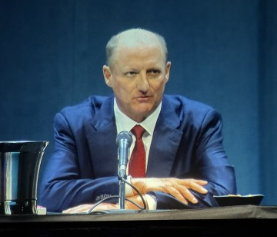
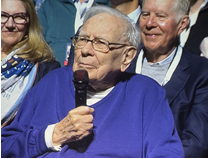
Berkshire Hathaway held its 61th annual meeting on May 2nd. There was a year-over-year decline in attendance following Warren Buffett’s retirement from CEO in 2025 and withdrawing from hosting the annual shareholder meeting. For 2026, there was a new format consisting of a one-hour business update by the CEO and two one-hour and fifteen-minute Q&A sessions. In years past, the annual feedback time was close to five hours and included the annual proprietary movie around the creativity of Warren Buffett. Greg Abel and Ajit Jain anchored the first panel, with rising corporate officers, Katie Farmer (CEO of BNSF) and Adam Johnson (CEO of NetJets and President of Consumer Products, Service and Retailing) hosting the second session. Based on design, the overall approach shifted from Mr. Buffett answering everything to a diversified mix of senior operating managers. Close followers of the business units appreciated the deeper dives, but clearly the entertainment value from Mr. Buffett was missing and therefore a major reason for the decline in attendance.
Exhibit 1 – 2026 Annual Meeting
Source: Gabelli Funds.
As for the tone and feedback, Mr. Abel was right on cue with respect to reiterating much of the doctrine built up over the years. Despite having a significant cash position, management will remain patient and disciplined with capital allocation. All the managers subscribe to the decentralized structure with fear of the “ABCs” – “arrogance, bureaucracy, and complacency.” The firm continues to have an incredible set of assets with “culture and values as bedrock.”
Ahead of #62 in 2027, we believe the meeting will continue to evolve into a more traditional corporate investor day as Mr. Abel’s legacy grows and the company moves further away from founder, Warren Buffett’s unique communication ability and charm. More than likely, this will narrow interest just like this year. However, while the corporate contributors may change, shareholders should still feel confident in the outlook due to the embedded culture and strong bench of operators. In short summary, it was another year, new schedule, some new faces, but the same old Berkshire that is just fine.
Annual Meeting Highlights:
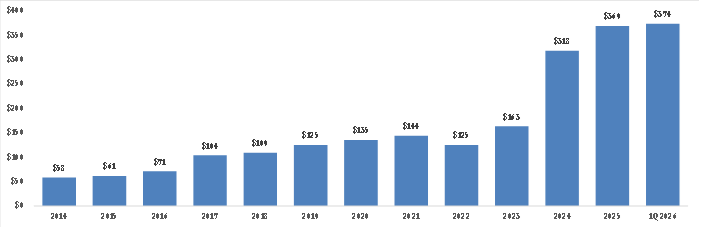
- Cash levels. As of 1Q, cash and equivalents were a record $373.5 billion. That balance understated the true movement this quarter due to closing the “OxyChem” purchase in January for close to $9.5 billion and capital expenditures of ~$5 billion. We estimate the firm is producing close to $900 million per week of operating earnings, so plenty of capital generation. Even with the growing cash position, Mr. Abel reiterated his mantra to stay patient and wait for very favorable opportunities to deploy capital. Despite the change in leadership, they still have the capacity to act quickly given their business knowledge and short-term cash instruments, which exceed the liabilities associated with the insurance float.
- AI/Cyber Risk. As expected, there was a lot of interest in the future of AI/cyber risk and how it might impact different business investments. Ajit stated that the insurance subsidiaries are using some tools to improve productivity and efficiency of processing. Will AI eventually replace senior underwriters with judgment? The tools are improving, but at the moment he remains “skeptical” that AI will replace underwriters. Across US industry, there is a lot of demand for cyber liability insurance. Despite significant insurance capital, he has guided Berkshire to go slow as there remains very little history of losses to make risk models. “How bad can bad be?” Additionally, with the corporate policy demand growth many competitors have increased competition, driving down pricing and worsening potential risk/reward dynamics. Away from insurance, AI is being used in other businesses like BNSF which will benefit from compute and data aggregation to manage its significant rail operations. With respect to disruption, AI is unlikely to change the physical benefits of the low costs of moving freight with cars and locomotives despite a future with autonomous trucks.
- Equities Portfolio. Greg Abel feels comfortable about leading the management of the ~$300 billion equities portfolio. He reminded the audience that he has a long history of understanding and investing in businesses so applying that to moving capital into opportunities in the stock market is no different. He was responsible for the $30 billion+ portfolio of Japanese Securities. As for personnel, Warren Buffett intends to still support the process by coming in five days a week under his role as Chairman. Ted Weschler manages over $20 billion and rounds out the team that really focuses on a “concentrated set of securities and with some relatively stable long-term positions” in Apple, American Express, Moody’s and Coca Cola. During the quarter, the firm continued a trend of being a net seller, by liquidating $24 billion against purchases of $16 billion. Within the three identification buckets, the managers sold consumer and financial stocks, while adding to the holdings of commercial & industrial companies. The exact holdings will come out in the 13F shortly and this release should be among the most watched because of the degree of trading in 1Q. It will also be the first period after Todd Combs departure.
- The insurance operations generated strong results this quarter but were helped by an easy comparable from a previous charge related to the West Coast wildfires as well as a benign environment for cat losses. Combined ratios for GEICO and Property/Casualty Underwriting were 87% vs. normalized historical levels of 90%+. Competition is intensifying and leading to “softer markets” and lower returns for a given set of risks. In response, Berkshire has been slowing down underwriting and waiting until more favorable conditions develop. “The hardest part of the industry is saying NO.” – Ajit Jain. On the more major capital front, Berkshire did a “layered deal” recently with Tokio Marine after many years of pursuing a partnership. “They have a great reputation and are hungry to grow outside of Japan.” Berkshire took a $1.8 billion equity stake in the publicly listed Japanese company. Secondarily, they “took a piece of their property/casualty book,” essentially compensating Tokio Marine for getting the business for several years down the road. The last part is a strategic alignment which is not specifically spelled out but represents a commitment to pursuing capital opportunities together with anticipation that the partnership will grow over time.
- The war in the middle east is pressuring the chemicals business, but the units are reacting well to the challenges. As far as running the businesses, there will continue to be a focus on long-term fundamental progress vs. getting too caught up in uncontrollable dynamics such as the spike in energy prices. The railroad is really a good view of the US economy because it touches so many different products. Given that diesel is the biggest cost associated with intermodal, the higher input is helping competitive dynamics with moving freight via traditional rail vs. trucking. If fuel prices stay too high for too long, that would impact demand across all the businesses, which would be impactful to earnings. CEO Katie Farmer, noted she is starting to see some impacts from the higher oil prices. Consumers are starting to make choices about spending. So far, NetJets demand has not been affected by the higher jet fuel costs, but it is a risk to operating results going forward based on previous time periods of elevated costs.
- Decentralized make-up at Berkshire Hathaway. “There is a great deal of ownership at the subsidiaries.” Management is closest to the clients, so they are the best positioned to run operations and drive results. There is a great amount of accountability too, which drives pride in execution. The primary engagement from corporate is around managing risk and helping with capital allocation. If there is a situation where there is underperformance corporate will speak to management to understand the issues. Most of the time the challenges are due to the operating environment. The reality is that with the limited number of corporate team members, there is just not the ability to drop-in to the subsidiaries to help run operations. However, there is a strong network of leaders within the conglomerate who can also be used to support other businesses and that sometimes happens.
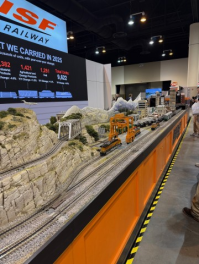
- BSNF continues to make progress on achieving operating margins closer to industry leaders. As part of the improvement, management needed to improve single car efficiency. Once there is an improvement at the micro level, that translates into better network and overall performance. In 1Q26, BNSF handled more loads than 1Q25 but with 260 less locomotives. That performance translates into better customer service and operational excellence. The second area of focus is around technological transformation. One example is the firm hiring data scientists to assist with running the network. Technology enhancements have led to a reduction in employees on the trains from 5 to 2 people. There are now some autonomous trucks on the road today. BNSF is also advocating for the development of regulations around railroad innovation to compete with the emerging driverless trucks.
- Potential for divestitures. There are certain circumstances where Berkshire is not the best owner of a business. If there is reputational risk the company does not belong in the portfolio. If there is a business that is unsustainable i.e. not generating cash from operations that would not work. “Berkshire can’t fund companies and realize losses.” Management takes seriously the obligation that capital is properly deployed. If capital is deployed, then it must generate a fair return. Recently, Berkshire sold an energy business that was impacted by challenges with regulations. Abel stated they will always take a forever approach to acquisitions. Would there ever make sense to separate the conglomerate? “Absolutely not.” The firm is highly efficient and with no unnecessary layers. A conglomerate with multiple layers of corporate groups, you could make the case for separation. Berkshire also has unique tax effectiveness allocating capital across the businesses. Some subsidiaries generate a lot of cash and have little need for capital expenditure. In that case, capital can be redeployed and ultimately in optimized fashion.
Exhibit 2 2026 Annual Meeting
Source: Gabelli Funds.
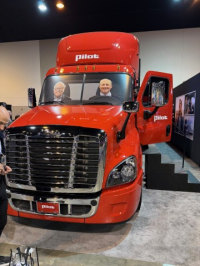
Exhibit 3 2026 Annual Meeting
Source: Gabelli Funds.
Cash Balances
Berkshire Hathaway has a long history of capital generation and productive capital allocation. In 2025, the firm generated $46 billion in cash flow from operations. Part of that was used for $21 billion of capital expenditures, mainly in the rail and energy subsidiaries. On the acquisition front, Berkshire deployed $1.1 billion in 2025 including adding private company, Bell Laboratories, in July. At the end of 1Q26, cash and equivalents had increased to $374 billion and included the outlay for closing the “OxyChem” acquisition in January for ~$9.5 billion. We would note that the total amount of Treasury Bills outstanding at the end of April 2026 was $6.6 trillion, according to The Bureau of the Fiscal Service. Therefore, Berkshire’s balance is both unique among corporate balance sheets and significant (~6%) relative to United States short-term issuance.
Exhibit 4 Berkshire Hathaway Cash
($, billions) 2014 – 1Q26
Source: Berkshire Hathaway Filings, Financial Condition Sections.
Valuation
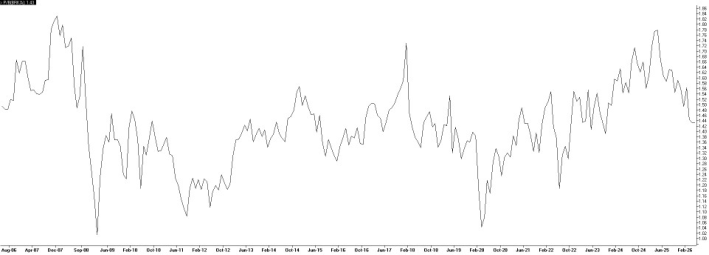
In the past, Mr. Buffett referred to Berkshire’s change in book value as one proxy for evaluating the progress against the S&P 500 Index. Since 2005, price-to-book (GAAP) value has fluctuated between 1.1x and 2.0x. At the end of March 2026, book value per Class A Share was $507,301 or about 1.3x the current price.
Exhibit 5 Berkshire Hathaway Class “A” Price-To-Book
(May 2005 – May 2026)
Source: Refinitiv.
Repurchase Levels
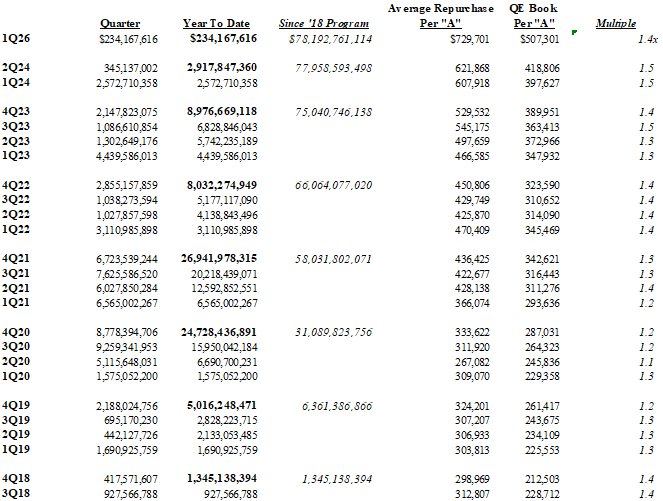
For many years, Berkshire had a common share repurchase plan based on buying shares at prices no higher than a 20% premium to book value. On July 17, 2018, Berkshire’s Board of Directors changed the program to when the shares are trading at a discount to intrinsic value, “conservatively determined.” Following that change, Berkshire was active quarterly repurchasing shares (see Table 1) and then paused after 2Q24. In March of 2026, Greg Abel gave an interview and indicated the firm had resumed repurchasing shares. During the 1Q, Berkshire repurchased both “A” and “B” shares for a total of ~$234 million, according to Berkshire’s 10-Q.
Table 1 Berkshire Repurchase History (2018 – 1Q 2026)
Source: Company data, Gabelli Funds.
249 Royal Palm Way, Palm Beach, FL One 33480 Gabelli Funds Tel (561) 671-2100 Fax 914-921-5098
This whitepaper was prepared by Macrae Sykes. The examples cited herein are based on public information and we make no representations regarding their accuracy or usefulness as precedent. The Research Analyst’s views are subject to change at any time based on market and other conditions. The information in this report represents the opinions of the individual Research Analyst’s as of the date hereof and is not intended to be a forecast of future events, a guarantee of future results, or investments advice. The views expressed may differ from other Research Analyst or of the Firm as a whole.
As of March 31, 2026, affiliates of GAMCO Investors, Inc. beneficially owned less than 1% of all companies mentioned.
This whitepaper is not an offer to sell any security nor is it a solicitation of an offer to buy any security.
Investors should consider the investment objectives, risks, sales charges and expense of the fund carefully before investing.
For more information, visit our website at: www.gabelli.com or call: 800-GABELLI800-422-3554 • 914-921-5000 • Fax 914-921-5098 • info@gabelli.com