Introduction: Alternative Models of Listed Sports & Entertainment Ownership
While our prior work has focused primarily on the major U.S. sport leagues, as well as more traditional single-club listed European teams, the public-market opportunity in sports extends well beyond these familiar ownership models. Professional sports ownership has long been associated with scarcity, prestige and attractive long-term asset appreciation. In the major North American leagues, closed structures, limited franchise supply and increasingly institutional ownership have helped turn teams into some of the world’s most valuable consumer assets. Yet outside the “Big Four,” listed companies provide exposure to sports through a much broader range of ownership structures.
In many cases, the opportunity is not simply ownership of a team, but ownership of an ecosystem built around sports, combining franchises with venues, real estate, leisure assets, technology, player development and capital allocation. These structures can create additional avenues for value creation while providing public-market investors with access to sports assets that are otherwise predominantly privately held.
In this report, we highlight three differentiated examples: Cannae Holdings, DeNA and Parken Sport & Entertainment.
- Cannae Holdings (CNNE): is increasingly transforming into a sports-focused holding company through Black Knight Football and its recent expansion into rugby.
- DeNA (Tokyo – 2432): has built a multi-sport ecosystem spanning professional baseball, basketball and soccer alongside venues and sports-led urban development.
- Parken (Copenhagen – PARKEN): combines F.C. Copenhagen and its stadium with a broader portfolio of leisure and physical assets.
While each model is distinct, all three demonstrate how public companies can use sports as more than a standalone franchise investment, creating broader platforms with multiple avenues for value creation. Cannae does so through capital allocation and portfolio construction; DeNA through local market density and integration across teams, venues and development; and Parken through the combination of football, stadium ownership and leisure assets. Together, they provide a useful framework for evaluating alternative models of listed sports ownership. In this report, we examine each platform’s structure, sources of value creation and key investment implications.
Exhibit 1 Three Models of Listed Sports & Entertainment Ownership
| Cannae | DeNA | Parken | |
|---|---|---|---|
| Model: | Sports capital allocator | Regional sports ecosystem | Asset-backed sports & leisure |
| Core Sports Assets: | Black Knight Football, Exeter Rugby | BayStars, Brave Thunders, SC Sagamihara | F.C. Copenhagen |
| Adjacent Assets / Capabilities: | Multi-club infrastructure, player development, capital allocation | Stadiums, technology, urban development | Parken Stadium, Lalandia |
| Primary Value Driver: | Acquisition + asset appreciation | Local density + fan monetization | Football upside + physical asset cash flow |
| Geographic Approach: | International | Regional / Japan | Denmark |
Cannae Holdings: Building A Sports Capital Allocation Platform
Cannae Holdings is repositioning itself from a diversified investment holding company toward a more concentrated portfolio of sports and entertainment assets, where management believes it has developed a differentiated sourcing and operating advantage. Central to that strategy is Vice Chairman Bill Foley, whose experience building businesses through acquisitions and operational improvement has increasingly extended into professional sports. Foley founded the NHL’s Vegas Golden Knights, which reached the Stanley Cup Final in its inaugural season and won the Stanley Cup in 2023, before bringing that experience into Cannae’s sports investments.
Building the Platform
The centerpiece of Cannae’s sports strategy is Black Knight Football Club (BKFC), a Foley led multi-club platform (MCO) in which CNNE owns ~42%. Since its formation in 2022, BKFC has raised more than $560 million and assembled controlling interests in AFC Bournemouth, FC Lorient and Moreirense FC, alongside numerous strategic relationships. BKFC’s strategy extends beyond just owning multiple clubs. The platform shares capabilities across scouting, recruitment, analytics, coaching and player development, with the goal of identifying talent earlier, creating pathways across the network and capturing value through both improved sporting performance and player trading. For Cannae, the model provides diversified exposure across clubs and geographies while leveraging a common operating playbook and the flexibility of permanent capital.
Exhibit 2 Black Knight Football Holdings at a Glance (~42% Owned by CNNE)
| Club | Country | League | BKFC Ownership |
| AFC Bournemouth | England | Premier League | 100% |
| FC Lorient | France | Ligue 1 | 100% |
| Moreirense FC | Portugal | Primeira Liga | 70% |
AFC Bournemouth: Crown Jewel and Proof of Concept
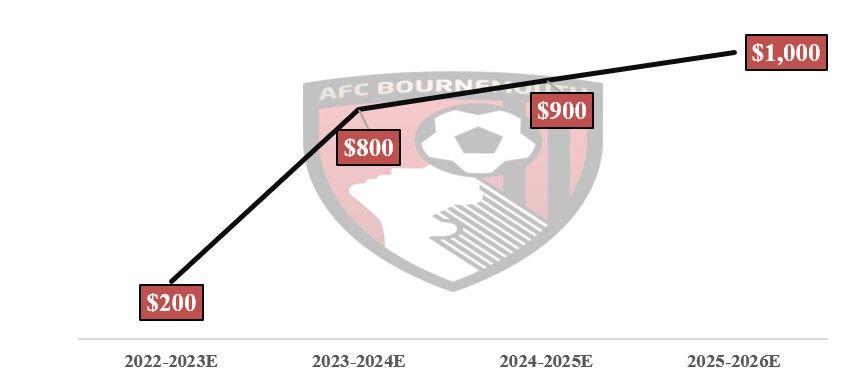
AFC Bournemouth is BKFC’s crown jewel and the clearest proof of concept for the strategy. BKFC acquired the club for £120 million in December 2022 at less than 1.0x revenue and has since invested across football operations, commercial capabilities and infrastructure. Revenue increased roughly 40%, from £143 million in 2022/23 to approximately £199 million in 2024/25, while sponsorship, advertising, hospitality and events revenue each more than doubled. On the field, Bournemouth followed a ninth-place finish in 2024/25 with a sixth-place finish and club-record 57 points in 2025/26, qualifying for the UEFA Europa League for the first time in club history. Bournemouth has also demonstrated the value of BKFC’s recruitment model, generating significant profits from players acquired, developed and subsequently sold. At the same time, BKFC has invested heavily in infrastructure, including a £45 million training facility, the £10 million acquisition of Vitality Stadium, and a planned redevelopment that would increase capacity from roughly 11,300 to 20,300 seats. Taken together, Bournemouth illustrates the BKFC playbook: acquire at an attractive valuation, improve operations and sporting performance, develop and monetize talent, expand commercial revenue and reinvest in infrastructure to drive long-term franchise value.
Exhibit 3 AFC Bournemouth Enterprise Valuation Growth (Millions, Estimates)
Source: Gabelli Funds Estimates, Cannae Filings, Sportico
Replicating the Playbook
The next test is whether Cannae can replicate Bournemouth’s success across the broader platform. BKFC acquired the remaining 60% of FC Lorient in January 2026, giving it full ownership of the Ligue 1 club and allowing for deeper integration into the group’s scouting, recruitment and player-development infrastructure. Lorient has an established history of developing and monetizing talent, but the opportunity from here is straightforward: determine whether the operating and commercial playbook demonstrated at Bournemouth can translate to another club and market.
Beyond Soccer: Exeter Rugby
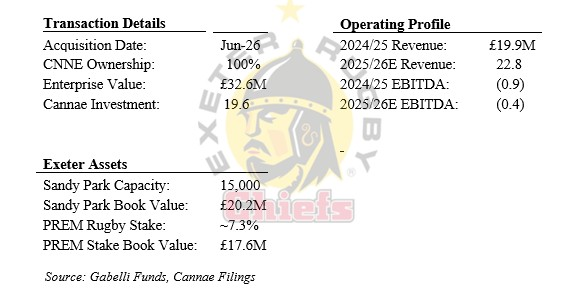
Cannae took the strategy beyond soccer in June 2026 with the formation of Black Knight Rugby and acquisition of 100% of Exeter Rugby Group for £32.6 million of enterprise value. Exeter offers many of the characteristics Cannae has targeted in sports: a historically successful franchise, a loyal fan base, meaningful owned infrastructure and an opportunity to improve the business through additional capital and commercial execution. The club also returned to the PREM Final in 2025/26 after several rebuilding years. More importantly, Exeter provides another test of whether the Bournemouth playbook is transferable. Cannae is deleveraging the club, providing growth capital and targeting improvements across commercial operations, facilities and sporting performance. If successful, Exeter would help demonstrate that Cannae’s edge extends beyond football and can be applied across a broader portfolio of under-monetized sports assets.
Exhibit 4 CNNE Black Knight Rugby: Exeter Chiefs Acquisition Summary
Recycling Capital into Sports
Importantly, Cannae appears increasingly willing to fund this transition by monetizing legacy, non-core assets. In July 2026, the company sold its interest in The Watkins Company, an $80 million investment made in 2024, generating approximately ~1.2x MOIC. Management explicitly described the sale as part of its portfolio transformation and said the proceeds could be redeployed into future investments or returned to shareholders. Cannae also agreed to sell its 87% interest in Brasada Ranch at an estimated $40 million enterprise value, while eliminating a related Foley put right and freeing at least $47 million of capital. Management again tied the transaction directly to its effort to monetize non-core holdings and reposition the portfolio toward sports and entertainment assets. Taken together, these transactions may mark the beginning of a broader divestiture of non-core assets, creating meaningful dry powder for additional sports-related investments.
CNNE Sum-of-the-Parts (August 10, 2026)
Cannae’s transition remains a work in progress, with sports representing an increasingly important but not yet dominant portion of the portfolio. As of August 10, 2026, management estimated illustrative NAV of approximately $1.05 billion, or $24.27 per share, led by a $280 million value (or $6.46/share) for Cannae’s approximately 42% interest in BKFC. Exeter is currently carried at Cannae’s $26 million investment cost (or $0.59/share). The balance of NAV remains spread across JANA, Alight, SpaceX, AmeriLife, CSI, Minden Mill and other investments.
DeNA Co: Building A Sports-Led Regional Ecosystem
DeNA’s sports strategy began with the Yokohama DeNA BayStars but has evolved into something much broader than ownership of a single team. The company now operates across baseball, basketball and soccer in Kanagawa Prefecture and increasingly uses those sports properties as anchors for venues, entertainment and urban development. DeNA describes this strategy as its “Delightful City” concept, extending the excitement generated inside a stadium or arena into the surrounding community and creating additional opportunities for fans to visit, spend and engage throughout the year. DeNA is not a pure-play sports company, its Game business remains the company’s largest revenue segment and by far its largest profit contributor, while sports represent a smaller but increasingly strategic part of the portfolio.
Yokohama BayStars: The Foundation (Nippon Professional Baseball)
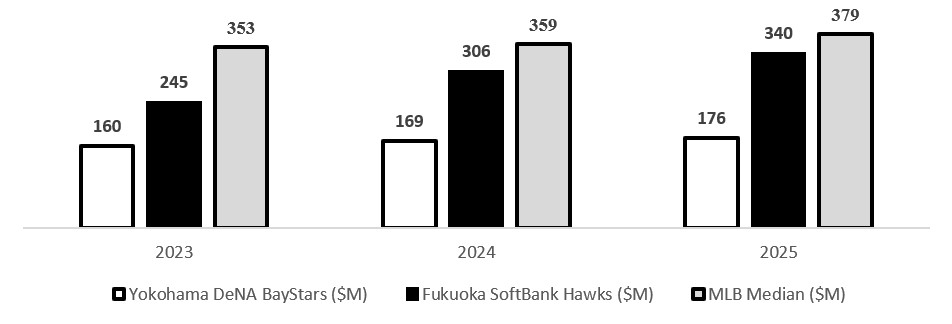
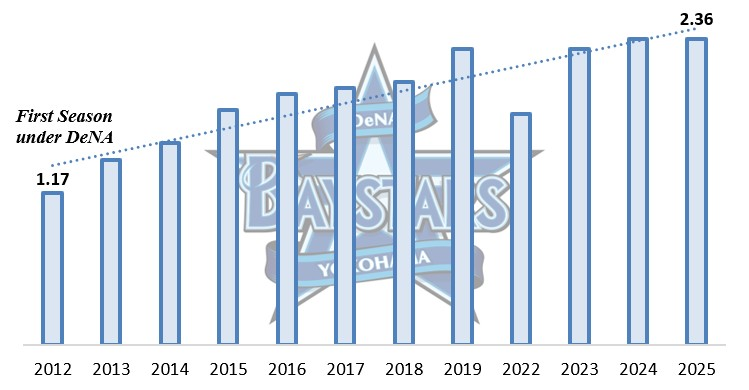
DeNA entered professional sports in 2011 through the acquisition of a controlling stake in the Yokohama BayStars, which compete in Nippon Professional Baseball (NPB), Japan’s 12-team top professional baseball league. NPB remains one of Japan’s most popular live sports properties, drawing a record ~27 million regular-season attendees in 2025, yet monetization still varies significantly by club. The Fukuoka SoftBank Hawks illustrate the potential upside, generating approximately $340 million of revenue in 2025, more than 12 MLB clubs, along with $53 million of operating profit, driven largely by ticketing, premium seating, sponsorship, food and beverage and venue-related revenue.
Exhibit 5 BayStars & Fukuoka Hawks vs MLB Median Revenue ($, Millions)
Source: Gabelli Funds, Sportico, DeNA Filings
A major inflection point for the BayStars came several years after DeNA’s acquisition when the club gained control of Yokohama Stadium, bringing the team and venue under integrated management. DeNA has credited that structure with improving attendance, commercial operations and ultimately turning the standalone baseball club profitable. The Hawks’ success provides a useful benchmark for the additional monetization potential of the BayStars as DeNA continues to expand revenue opportunities around the team, venue and surrounding entertainment ecosystem.
Exhibit 6 BayStars Total Stadium Attendance Growth (Millions)
Source: Gabelli Funds, DeNA Filings – BayStars revenue converted from reported JPY revenue to USD; Hawks and MLB figures sourced from Sportico. Fiscal periods and currency methodologies differ; comparison intended to illustrate relative scale.
Expanding Across Sports – Concentrated in Kanagawa
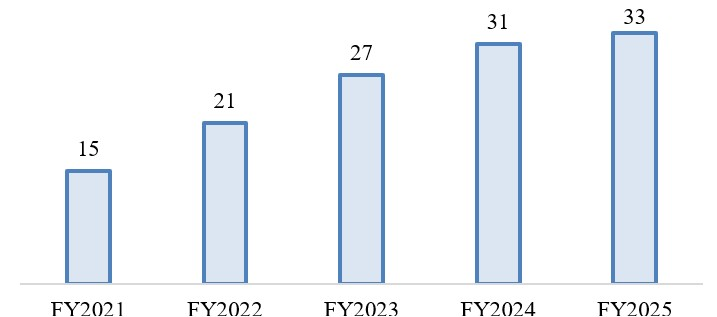
Rather than replicating the BayStars model across distant geographies, DeNA has deliberately concentrated its sports portfolio within Kanagawa Prefecture. The company assumed operations of the Kawasaki Brave Thunders basketball club in 2018 and subsequently expanded into professional soccer through SC Sagamihara, increasing its ownership to 93.2% in 2023. Together, the three teams provide year-round exposure to different sports and fan bases across Yokohama, Kawasaki and Sagamihara. The strategic advantage is local density rather than global scale. DeNA can leverage common technology, marketing expertise, corporate relationships and operating talent across multiple teams, while using sports to deepen relationships with municipalities and local consumers. The company’s 2025 Integrated Report specifically highlights the opportunity to share expertise across baseball, basketball and soccer while using DeNA’s broader IT capabilities to create new businesses and synergies.
Exhibit 7 DeNA Sports & Smart City Revenue (¥B)
Source: Gabelli Funds, DeNA Filings
From Stadium to City – BASEGATE Yokohama Kannai
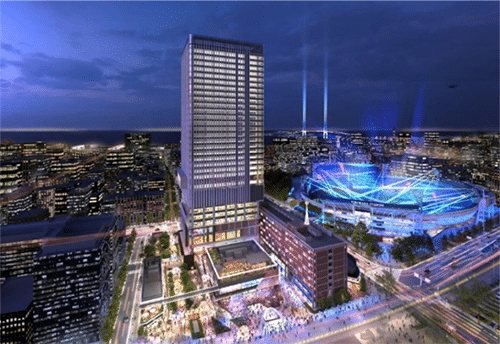
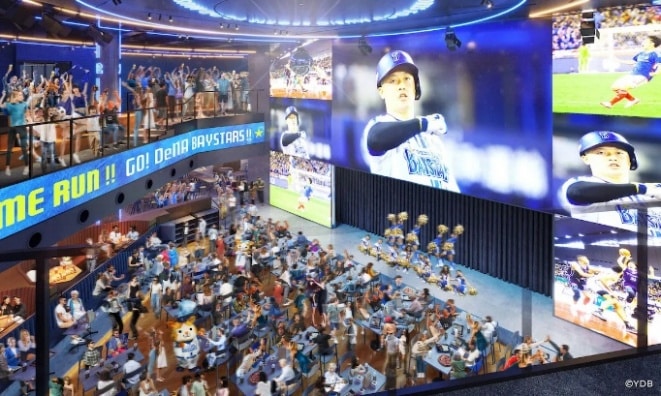
The next stage of the model moves beyond team and venue ownership. In March 2026, BASEGATE Yokohama Kannai opened directly adjacent to Yokohama Stadium as a large mixed-use development involving DeNA and seven other corporate partners. The ~128,500-square-meter complex includes offices, retail, restaurants, a hotel and entertainment facilities. DeNA directly operates two major attractions within the project: Wonderia, an approximately 4,200-square-meter immersive entertainment facility, and The LIVE, an ~2,800-square-meter permanent live-viewing arena operated by the BayStars.
Exhibit 8 BASEGATE Yokohama Kannai & The Live
Source: Mitsui Fudosan, Yokohama.net
The strategy is designed to increase monetization of the existing fan base beyond matchday through hospitality, food and beverage, events and other venue-related revenue streams. DeNA is pursuing a similar model in Kawasaki through the planned Kawasaki! Arena City Project, which is expected to include a new multi-purpose arena with capacity of up to 15,000, including ~12,000 seats for Brave Thunders games. DeNA therefore represents a fundamentally different model of listed sports ownership. Rather than acquiring teams primarily for standalone franchise appreciation, the company uses sports as anchor content for a broader regional entertainment ecosystem, combining teams, venues, technology and urban development to increase engagement and create additional revenue opportunities around the same fan base.
Parken Sport and Entertainment: Diversified Sports, Leisure and Property Platform
PARKEN Sport & Entertainment represents a different model of listed sports ownership, combining Denmark’s dominant soccer club with destination leisure, hospitality and property assets. The group is anchored by FC Copenhagen, but its corporate structure extends well beyond the club through Lalandia, Parken Stadium and related real estate, as well as additional football investments. The result is a diversified platform in which sports provides much of the strategic upside, while leisure and property contribute a broader and more recurring earnings base.
FC Copenhagen – The Anchor Asset
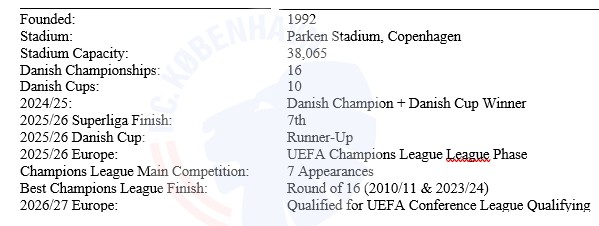
FC Copenhagen is the centerpiece of the group and the dominant club in modern Danish football. Founded in 1992, Copenhagen has won a record 16 Danish championships and 10 Danish Cups and has become a regular participant in UEFA competition, including two Champions League Round of 16 appearances. Its domestic success and recurring European participation make the club one of Denmark’s most valuable and strategically important sports assets.
Exhibit 9 FC Copenhagen Overview
Source: Gabelli Funds, Public Data
Lalandia – Diversifying the Earnings Base
Lalandia is PARKEN’s market-leading destination leisure business, operating holiday and activity centers in Rødby, Billund and Søndervig. The business generates revenue from the operation of its resorts as well as the rental, development and sale of associated holiday homes, creating multiple revenue streams across accommodation, leisure and real estate. In 2025, Lalandia generated DKK 1.05 billion of revenue and DKK 178 million of segment profit, while recording approximately 2.1 million overnight stays. The segment provides PARKEN with a sizable and more recurring earnings base that is largely independent of FC Copenhagen’s sporting performance.
Exhibit 10 FC Copenhagen Revenue & Seg. Profit
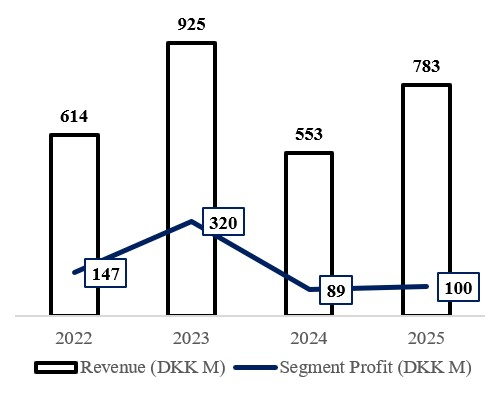
Exhibit 11 Lalandia Revenue & Seg Profit
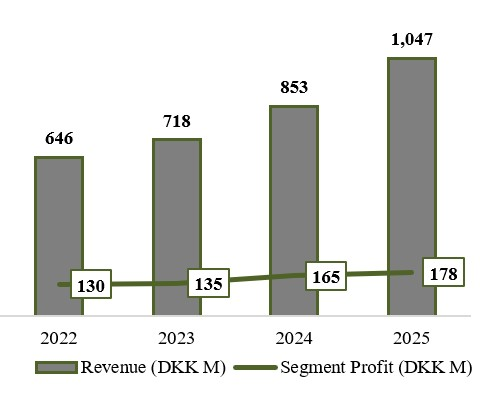
Source: Gabelli Funds, Sportico, Parken Filings
Parken Ejendomme – Owning the Venue and Surrounding Real Estate
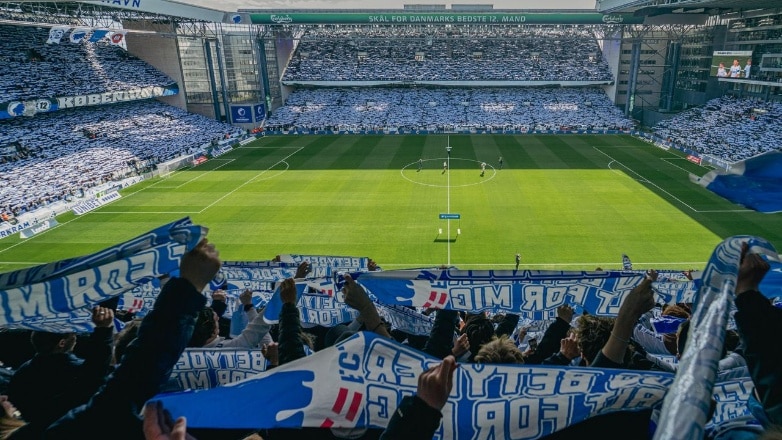
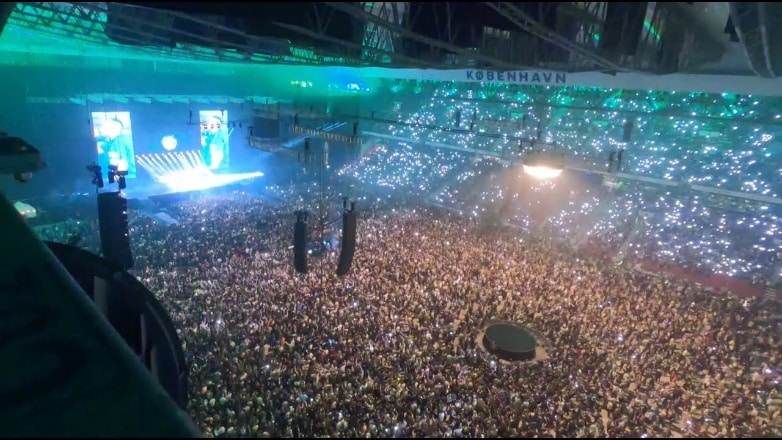
Parken Ejendomme owns Parken Stadium, the home of FC Copenhagen and Denmark’s national soccer team, as well as the four commercial office towers surrounding the stadium. The stadium has a football capacity of 38,065 and can accommodate approximately 50,000 spectators for concerts, allowing the asset to generate activity well beyond Copenhagen home matches. In addition to club matches, Parken hosts Danish national-team fixtures, major concerts and other events; approximately one million guests attended football matches and concerts at Parken in 2025. Stadium-related revenue also benefits from food and beverage, hospitality and other event activity.
The surrounding real estate provides an additional recurring earnings stream. Parken Ejendomme owns approximately 31,600 square meters of commercial space across the four stadium towers, which were 95% occupied at year-end 2025. The segment generated DKK 49.1 million of external revenue and DKK 27.5 million of segment profit in 2025, while the properties received a DKK 10.2 million positive revaluation, primarily reflecting improved expected rental income.
For PARKEN, stadium ownership is strategically important because the group controls both its core football franchise and the physical asset in which much of that franchise’s economic activity takes place. Combined with the surrounding commercial real estate and the ability to monetize Parken through national-team matches, concerts and other events, the segment adds an asset-backed component to the group that is largely absent from most publicly listed football clubs.
Exhibit 12 Parken Stadium Overview
| Parken Stadium -Quick Stats | |
| Soccer Capacity: | 38,065 |
| Concert Capacity: | ~50,000 |
| 2024 Soccer & Concert Guests: | ~1.1M |
| National Stadium: | Denmark Men’s National Team |
| National Team Agreement: | Through Summer 2028 |
| Recent National Team Sellouts: | 16 of Last 18 Matches |
| Commercial Office Towers: | 4 |
| Commercial Space (sqm): | 31,595 |
| 2025 Office Occupancy: | 95% |
| 2025 External Revenue (DKK M): | 49.1 |
| 2025 Segment Profit (DKK M): | 27.5 |
Source: Gabelli Funds, Parken Filings, Public Data
Conclusion
Cannae, DeNA and PARKEN show three different ways public companies can build around sports: through multi-club ownership and capital allocation, regional sports ecosystems, and the combination of teams with leisure and property assets. The models are different, but each goes beyond simply owning a single franchise. We expect to see more sports platforms come to the public markets over time, using both similar structures and new models as the sports industry continues to grow and attract more institutional capital.
249 ROYAL PALM WAY, PALM BEACH, FL 33480 Gabelli Funds TEL (561) 671-2100
This whitepaper was prepared by Alec Boccanfuso. The examples cited herein are based on public information and we make no representations regarding their accuracy or usefulness as precedent. The Research Analyst’s views are subject to change at any time based on market and other conditions. The information in this report represent the opinions of the individual Research Analyst’s as of the date hereof and is not intended to be a forecast of future events, a guarantee of future results, or investments advice. The views expressed may differ from other Research Analyst or of the Firm as a whole.
As of June 30, 2026, affiliates of GAMCO Investors owned less than 1% of all other companies mentioned.
This whitepaper is not an offer to sell any security nor is it a solicitation of an offer to buy any security. Investors should consider the investment objectives, risks, sales charges and expense of the fund carefully before investing.
For more information, visit our website at: www.gabelli.com or call: 800-GABELLI
800-422-3554 • 914-921-5000 • Fax 914-921-5098 • info@gabelli.com