
A Half Century of Insights at Our 50th Annual Automotive Symposium
November 2-3, Encore at Wynn
Presenting Companies/Agenda
| DAY 1: Monday, November 2nd | DAY 2: Tuesday, November 3rd |
| 11:00 AM Opening Remarks, Gabelli Auto Team | 7:50 AM Opening Remarks, Gabelli Auto Team |
| 11:20 Garrett Motion Inc. (GTX) | 8:00 Strattec Security Corporation (STRT) |
| 11:50 Sonic Automotive, Inc. (SAH)* | 8:30 MP Materials Corp. (MP) |
| 12:20 PM Lunch Break | 9:00 Experian plc (EXPN) |
| 12:30 Gentex Corporation (GNTX) | 10:00 Standard Motor Products, Inc. (SMP) |
| 1:00 AutoNation, Inc. (AN) | 10:30 Genuine Parts Company (GPC) |
| 1:30 PHINIA, Inc. (PHIN) | 11:00 Dorman Products, Inc. (DORM) |
| 2:00 Motor & Equipment Manufacturers Association (MEMA) | 11:30 AutoZone, Inc. (AZO) |
| 3:00 Donaldson Company, Inc. (DCI) | 12:00 PM Lunch Break |
| 3:30 Rush Enterprises, Inc. (RUSHA/B) | 12:15 Murphy Automotive Partners (Private) |
| 4:00 NN, Inc. (NNBR) | 1:00 Dana Incorporated (DAN) |
| 1:30 O’Reilly Automotive, Inc. (ORLY) | |
| 2:00 Monro, Inc. (MNRO) | |
| 2:30 Motorcar Parts of America, Inc. (MPAA) |
*Indicates virtual presentation. All times Pacific Standard Time.
We cordially invite interested investors to register for our 50th Annual Automotive Symposium, either in-person or virtually, by clicking the link here or contacting Miles McQuillen (mmcquillen@gabelli.com) at 914-921-5112.
Las Vegas Auto Symposium 2026
“Fabulous at Fifty”
When the first Gabelli Auto symposium convened in Las Vegas in 1977, the car business looked very different, and yet some of the conversation would sound familiar today. Inflation was running above 6%, the Federal Reserve was about to lose its patience, and within two years upheaval in Iran would send oil prices soaring and put Americans back in gas lines. The average car on the road was about half as old as it is now. Fifty years later, on November 2nd and 3rd, investors will gather at the Encore at Wynn for the Gabelli Funds’ 50th Annual Automotive Symposium, and we suspect a few of those 1977 themes will come up again.
Held alongside the Automotive Aftermarket Products Expo (AAPEX) and the Specialty Equipment Market Association (SEMA) show, the Symposium has given investors a chance to hear from leading company executives and industry operators in a very short window of time for five decades. What began as an aftermarket conference now includes auto dealers, commercial truck dealers, light vehicle and commercial vehicle suppliers, and, now, a supplier of domestic rare earth magnets for electric motors. That mix is deliberate. The pieces of this industry are tied together more closely than most investors appreciate, and two days in one room at Encore at Wynn is a good way to see how.
In this preview we lay out the issues we expect to dominate the conversation in Las Vegas. Twelve months ago the debate was mostly about tariffs. Tariffs haven’t gone away, but they now share the stage with an oil shock, a Federal Reserve that has started raising rates again, a consumer who is still spending but showing some wear, and a truck market that is running hot for reasons that have little to do with freight demand. Our job over the two days is to work out, with the help of our presenters, which of these pressures will pass and which will shape earnings for years.
What’s Ahead at the Encore?
Quite a lot. Over our two days, we expect presenters to spend most of their time on the following topics.
- Inflation, Interest Rates and Affordability: Headline CPI is running at 3.4% and the Fed raised rates in September for the first time since 2023. How long can all-time highs for average monthly new vehicle payment hold up?
- Tariffs and Trade: The Supreme Court threw out the IEEPA tariffs in February, but the Section 232 duties on vehicles, parts and trucks remain, the USMCA is now under annual review, and certain Canadian vehicle imports face a 50% tariff. Who is absorbing the cost, and who can pass it on?
- Health of the Consumer: Spending is holding up, but subprime delinquencies, longer loan terms and negative equity tell a more complicated story.
- The Aging Vehicle Population: The average vehicle on the road is at all-time highs at 13 years old. That is good for parts and service, but high gasoline prices may cut into miles driven.
- Politics: Our second day falls on Election Day. Trade, emissions rules, EV policy and the price of oil all run through Washington.
- The Auto Cycle and Dealer Inventory: Sales are running near a 16 million annual pace, but incentives are rising and inventory is piling up at some brands.
- The Class 8 Truck Cycle and Freight: A pre-buy ahead of EPA 2027 and a crackdown on driver licensing have filled order books. What does 2027 look like?
- M&A and Financial Engineering: Penske Automotive won’t be with us this year as it weighs a take-private bid, Genuine Parts is splitting in two, and Dana is a smaller and simpler company than it was a year ago.
- The Two “A”s – Artificial Intelligence and Autonomous Driving. Last but certainly not least, we suspect AI and AVs will be a topic that will dominate Q&A in Vegas.
The cast of characters has changed a lot since 1977, but the reason to make the trip hasn’t.
INFLATION, INTEREST RATES AND AFFORDABILITY
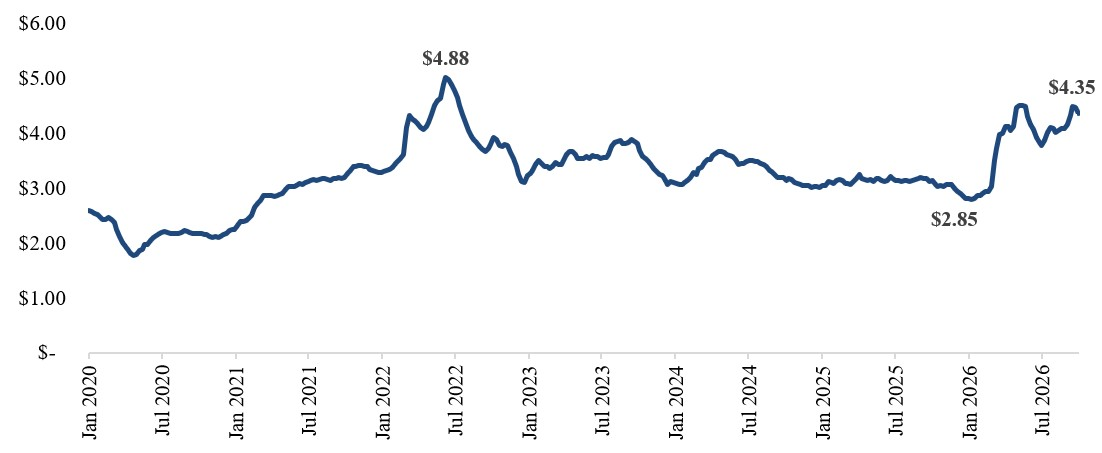
For most of 2025, broader expectations held that rates would keep drifting lower and car buyers would eventually get some relief. That isn’t how 2026 has played out. U.S. and Israeli military operations against Iran beginning in February led to the effective closure of the Strait of Hormuz in March, and crude went from roughly $60 a barrel at the start of the year to more than $115 by May. Gasoline moved back above $4 a gallon nationally. Headline CPI was 3.4% in August, with gasoline up more than 27% from a year earlier, even as core inflation cooled to 2.4%. On September 16, the Federal Reserve, now led by Chair Kevin Warsh, raised its target range by a quarter point to 3.75-4.00%. It was the first hike since 2023, and 16 of 19 policymakers expect at least one more before the end of the year.
Exhibit 1 Average U.S. Regular Gas Price per Gallon
Source: U.S. Energy Information Administration
That backdrop matters a great deal for our presenters, with an already stretched new vehicle buyer. According to J.D. Power, the average new vehicle monthly payment hit $821 in September, a record for the month, even though the average interest rate of 6.7% was the lowest September reading since 2022. Automakers are leaning harder on incentives, which reached $3,574 per unit, and lenders are stretching terms. Nearly 14% of loans now run 84 months or longer. A Fed that is raising rates takes away the one piece of relief buyers had been getting.
Table 1 Affordability Snapshot: September 2026
| September 2026 | Change vs. Sept. 2025 | |
| Average transaction price | $45,915 | +0.7% |
| Average monthly payment | $821 | +3.2% |
| Average new vehicle loan rate | 6.66% | -4 bps |
| Incentive spending per unit | $3,574 | +7.3% |
| Loans of 84 months or longer | 13.9% | +2.0 pts |
| Trade-ins with negative equity | 29.4% | +0.3 pts |
| Subprime share of loans | 11.2% | +2.2 pts |
Source: J.D. Power-GlobalData
We will be asking dealers like AutoNation (AN) and Sonic Automotive (SAH) how they are managing floorplan costs that are moving the wrong way again. We will also be asking the aftermarket names whether affordability pressure is pushing more people to repair the car they have rather than replace it. Historically, it has.
THE HEALTH OF THE CONSUMER
On the surface, the consumer looks fine. September new vehicle sales ran at a 16.1 million annual pace, and J.D. Power estimates buyers spent $48.7 billion on new vehicles in the month, up 6.6% from a year ago. Looking a little closer and the picture is mixed. Fitch’s subprime auto ABS delinquency index hit a record 6.82% in January and was still at 6.13% in July. Almost three in ten trade-ins carry negative equity. The subprime share of new vehicle loans is up more than two points in a year, which suggests lenders are once again reaching for volume.
None of this means a credit event is around the corner. It does mean the cushion is thinner than the headline sales numbers suggest. A year ago, the collapse of Tricolor and First Brands had investors asking about hidden leverage in auto credit and in supplier finance. Twelve months later, we want to know whether those were isolated blowups or early warnings. Experian (EXPN) sees as much consumer credit data as anyone, and we look forward to hearing from Melinda Zabritske again (Head of Automotive Financial Insights, Experian) where she sees stress building and whether it is spreading beyond the subprime borrower.
THE AGE OF THE VEHICLE POPULATION
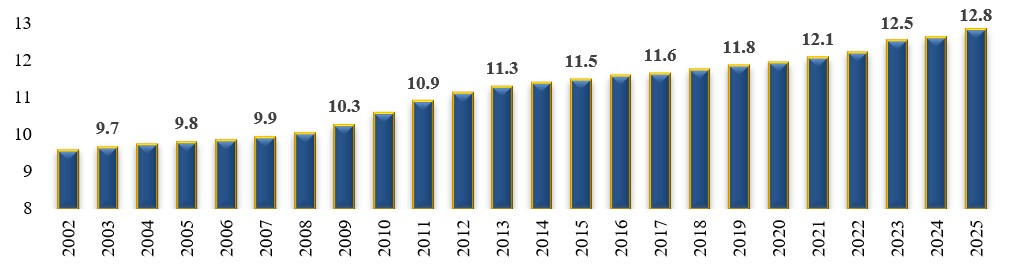
If there is one number every aftermarket executive in Las Vegas will mention, it’s the age of the car in your driveway. S&P Global Mobility put the average age of U.S. light vehicles at a record 12.8 years in its 2025 study, with passenger cars alone averaging about 14.5 years. Every year a car stays on the road past its warranty is another year of brakes, batteries, filters, sensors and, eventually, the expensive repairs. With new vehicle payments where they are and rates moving up, the aging of the auto population will continue as an enduring theme for our presenting aftermarket companies.
Exhibit 2 US Light Vehicle Age (Years)
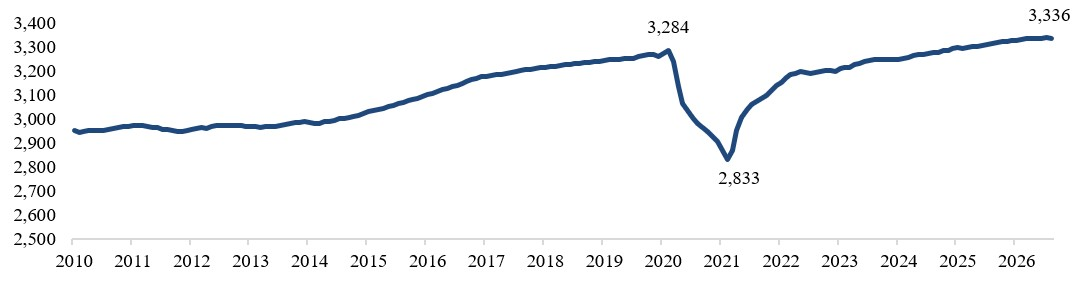
That’s the good news for AutoZone (AZO), O’Reilly (ORLY), Genuine Parts (GPC), Dorman (DORM), Standard Motor Products (SMP), Motorcar Parts of America (MPAA) and Monro (MNRO). The less obvious question this year is miles driven. When gasoline goes above $4, people drive less, and cars that sit in the garage don’t wear out as quickly. Used vehicle prices are also softening. The Manheim Used Vehicle Value Index slipped to 206.2 in mid-September, its first year-over-year decline of 2026, which makes trading out of an old car slightly easier than fixing it. We will be hearing whether any of the above is showing up in order patterns.
Exhibit 3 TTM U.S. Miles Driven (Jan 1, 2010 – Aug 31, 2026)
Source: Federal Highway Administration
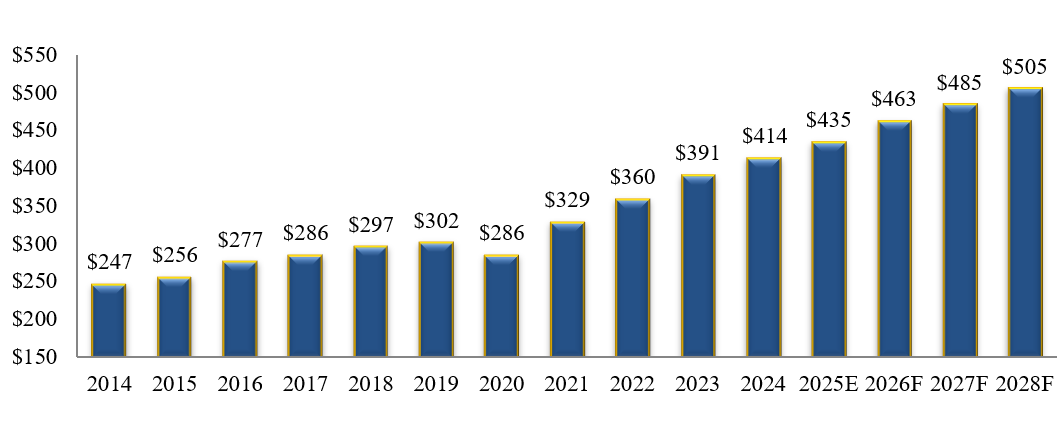
Over the longer run the direction is still favorable. MEMA, which presents Monday afternoon, projects the U.S. light vehicle aftermarket will grow to from $460 billion to roughly $505 billion by 2028 (Exhibit 4).
Exhibit 4 United States Light Vehicle Aftermarket (2014 – 2028F)
In billions
Source: MEMA
OF TARIFFS AND TRADE
A year ago we wrote that virtually no company in Las Vegas would escape the need to adjust to tariffs. That still holds, though the rules have changed. On February 24, the Supreme Court ruled 6-3 that the country-by-country tariffs imposed under IEEPA were unlawful. The administration put a temporary 15% global tariff in their place the same day under Section 122, which carries a 150-day limit. For our group, the more important point is that the ruling did not touch the Section 232 tariffs on autos, auto parts, steel, aluminum and copper, or the 25% tariff on medium and heavy-duty trucks and their parts that took effect last November. Whether importers get refunds on the IEEPA duties they already paid is still being sorted out in court.
North America’s outlook is more opaque. On July 1, the U.S. declined to extend the USMCA for another 16 years, which puts the agreement into annual reviews. Washington has been pushing Mexico for higher regional content, and the next round of talks has been postponed. Relations with Canada do not appear to have improved. Since August 22, certain Canadian motor vehicle imports have faced a 50% tariff under Section 338 of the Tariff Act of 1930. It stacks on top of Section 232, there is no exemption for USMCA-qualifying goods, and some products moved to an outright import ban at the end of September. For any supplier with plants on both sides of the border, this is not an abstract issue.
Trade is not only about tariffs. In June, China added MP Materials (MP) to its export control list, a reminder of how much leverage Beijing still has over the rare earth magnets used in EV motors and a long list of other vehicle components. MP has been ramping magnet production in Texas, with commercial deliveries to General Motors targeted for the fourth quarter. Its presentation Tuesday morning should be one of the more interesting of the conference.
POLITICS
Our second day, November 3, happens to be Election Day. Not long after our last presenter wraps up Tuesday afternoon, polls will start closing on the East Coast and investors will begin to get a read on who controls the House and Senate for the next two years. That matters for this industry more than usual.
Almost every major issue our presenters face runs through Washington right now. Trade policy, as discussed above. Emissions rules, where the EPA has proposed easing the warranty requirements in its 2027 heavy-duty engine rule while keeping the underlying standards, and truck buyers are still waiting on the final version. EV policy, where the end of the federal tax credit has cut the EV share of new vehicle sales to 7.9% in September from roughly 14% a year ago, while hybrids have climbed to 17%. And the conflict with Iran, which has become a monetary policy story as much as a foreign policy one. We do not expect our presenters to make political predictions (nor will we!), but we will ask how they are planning for a range of outcomes.
THE AUTO CYCLE AND INVENTORY ON DEALER LOTS
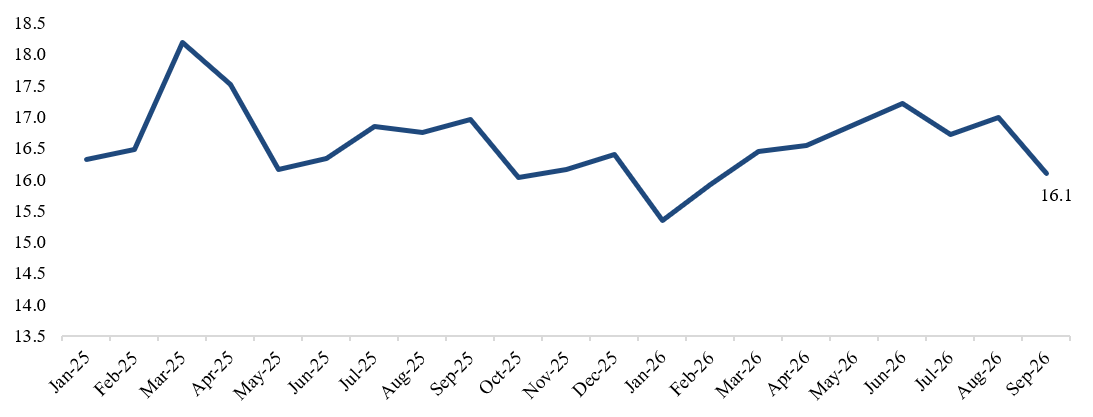
Given everything above, light vehicle demand has been steadier than most expected. The seasonally adjusted selling rate was 16.8 million units in August and 16.1 million in September. Pricing has held too, with the average transaction price of about $45,900 up slightly from a year ago. But some of that stability is being bought. Incentives are up 7.3% year over year, and on gasoline and hybrid vehicles specifically they are up more than 30%.
Exhibit 5 U.S. Monthly SAAR (Jan 2025-Sep 2026)
Source: Omdia
Inventory is where we will spend our time with the dealers. National days’ supply was around 55 in August, but the average hides a wide gap between brands. Toyota was at 33 days while Ram was at 127. Dealers with heavy exposure to overstocked brands will be fighting for margin into year end, and floorplan rates are going back up. We are interested in how AutoNation and Sonic think about new vehicle gross profit per unit, used vehicle sourcing, and how much of the load their parts and service businesses can carry. Further, both can provide terrific windows into the health of the consumer.
Suppliers that live on production volumes, such as Gentex (GNTX) and Strattec (STRT), should give us a read on how automakers are setting build schedules for early 2027 with inventory where it is.
THE CLASS 8 TRUCK CYCLE AND FREIGHT
The heavy truck market is the oddest part of the cycle right now. Freight demand is soft, with Cass shipment volumes down 5% from a year ago in July. Yet truckload spot rates excluding fuel were up more than 32% year over year in the second quarter, and truck orders have boomed. The explanation is on the supply side. Tougher federal enforcement of English proficiency rules and a crackdown on non-domiciled commercial driver licenses could remove close to 200,000 drivers from the market, roughly 5% of interstate CDL holders. Fewer drivers means less capacity, and less capacity means higher rates even when there is not more freight to haul.
Fleets that are suddenly making money buy trucks, and this year they had an extra reason to do so. EPA 2027 compliant powertrains are expected to add $8,000 to $12,000 to the price of a Class 8 truck, so some fleets pulled purchases forward. FTR reported orders through August were up 111% from 2025, and second-half 2026 build slots were oversubscribed by roughly 35,000 units. September orders came in at 18,700 units according to ACT and 21,300 according to FTR, as some manufacturers have yet to fully open their 2027 order boards while the final EPA rule remains up in the air.
The obvious question is what does 2027 look like once the muted pre-buy is over? Rush Enterprises (RUSHA), which runs the largest network of commercial vehicle dealerships in North America, has a front-row seat. Suppliers such as Dana (DAN), PHINIA (PHIN), and Donaldson (DCI) will each have a view on how much of this year’s strength was borrowed from next year. The aftermarket side of trucking is a different story. Older trucks working harder tend to need more parts, which is a helpful offset if new equipment demand cools.
ARTIFICIAL INTELLIGENCE: FROM THE DATA CENTER TO THE SERVICE BAY
AI is touching our presenters in at least three ways, and the first one is a cost. Chipmakers would much rather sell high-bandwidth memory to AI data centers than automotive-grade DRAM to carmakers, and pricing shows it. DRAM spot prices rose roughly 450% between September 2025 and January 2026, and Ford and GM both raised their 2026 procurement forecasts by several hundred million dollars. As of July, no major automaker had cut production, but Samsung, Micron and SK Hynix control close to 90% of global DRAM supply and none of them are rushing to add capacity for the auto market. We will be asking suppliers with a lot of electronics in their products, Gentex and Standard Motor Products among them, whether they can pass those costs along or are eating them.
The second is productivity. A survey of nearly 1,200 dealership executives by Spyne found that 76% plan to increase AI spending in 2026, with AI voice agents for service scheduling and lead response at the top of the list. Anyone who has tried to book a service appointment by phone understands why. Parts distribution may be an even better fit. AutoZone, O’Reilly and Genuine Parts manage millions of part numbers across thousands of stores, and getting the right part to the right store before the customer asks for it is a forecasting problem that machines are well suited for. Experian, for its part, sits at the center of the data that lenders use to decide who gets a car loan.
The third question is who keeps the savings. If AI lets a dealer run its call center with a third fewer people, or lets a parts retailer carry less inventory with better fill rates, does that show up in margins or get competed away in price? We do not think anyone has a confident answer yet, which is exactly why we want to ask.
AUTONOMOUS DRIVING AND THE ELECTRIC VEHICLE
Robotaxis are no longer a science project. As of September, Waymo was running paid service in 14 U.S. cities with more than 4,000 vehicles and over 500,000 paid rides a week, and its co-CEO has said the goal is more than a million weekly rides by the end of the year. Washington is starting to catch up. At the end of July, NHTSA granted Zoox the first commercial exemption for a driverless vehicle built without conventional controls, streamlined its exemption process, issued its first update to AV guidance since 2017, and launched an industry consortium to write the first national AV safety standards. Tesla began building its Cybercab in Texas in April, although its robotaxi service is still small and Elon Musk has said meaningful revenue is unlikely before 2027.
Autonomous trucking may matter even more for this group. Aurora has logged over 500,000 driverless miles in Texas and expects to have 200 driverless trucks on the road by year end, with a stated goal of 30,000 by 2030. Its trucks average more than 225,000 miles a year, roughly double a conventional truck. With the driver pool shrinking for the reasons discussed above, the economics of a truck that doesn’t need one look a lot better than they did two years ago. We would like to hear from Rush, Donaldson, Dana and PHINIA about what a high-utilization autonomous truck needs in the way of parts, service and filtration.
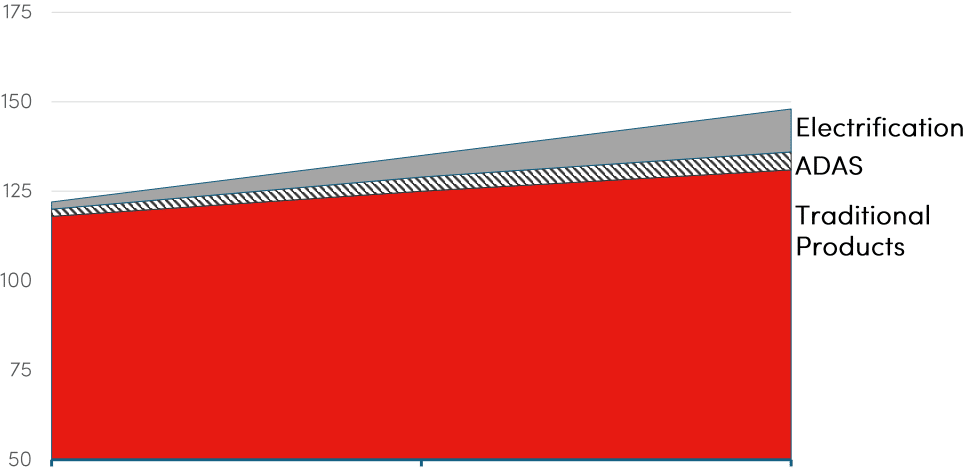
Exhibit 6 Aftermarket Growth by Product Category (2025-2035)
$Billions
2025 2030 2035
Source: MEMA/AASA Industry Overview
For the light vehicle aftermarket, the near-term impact is small. A few thousand robotaxis do not move the needle against just under 300 million vehicles on U.S. roads. Over time, though, the shift is real. Fleet vehicles that run around the clock wear out tires, brakes and suspension parts fast, but they are maintained by fleet operators rather than by DIY or typical professional installers. Fewer accidents should eventually mean less collision work, while every camera, radar and lidar unit needs calibrating after a repair. Last year we flagged Standard Motor Products and Motorcar Parts of America as companies to watch on this front, and we will follow up with both.
Which brings us to electric vehicles. With the federal tax credit gone, EVs made up 7.9% of new vehicle sales in September, down from roughly 14% a year earlier, even as automakers spent $8,829 per EV on incentives. Hybrids have picked up much of the slack at 17% of sales, which has been good news for suppliers with combustion and hybrid content such as PHINIA and Garrett. The irony is that nearly every robotaxi on the road is electric, so autonomy may end up being what keeps EV development funded in the U.S. while consumer demand catches its breath. Gasoline above $4 helps too. In mid-September, EVs and compact cars were the only major used vehicle segments with values above a year ago. Add MP Materials’ effort to build a domestic magnet supply, and the EV story in Las Vegas this year is less about how many get sold in 2027 and more about who will be ready when demand returns.
M&A AND FINANCIAL ENGINEERING
One familiar name is missing from the agenda this year. Penske Automotive Group (PAG), which presented in Las Vegas last year, is sitting out while it evaluates a take-private proposal. On July 22, Penske Corporation, which owns about 52% of the company, and Mitsui & Co., which owns about 20%, made a preliminary, non-binding offer of $210 per share for the roughly 28% of PAG they do not already own. A special committee is currently reviewing the bid. There is no guarantee a deal gets done. Still, the bid tells us something about how the people who know the business best value a diversified dealer group with large commercial truck and international operations, and that is a useful data point for public dealer valuations more broadly.
There is plenty of corporate activity elsewhere on the agenda. Genuine Parts plans to separate its Motion industrial distribution business from its automotive operations into a separate public company, with completion targeted for 2027. Dana closed the $2.7 billion sale of its Off-Highway business to Allison Transmission on January 2 and has used the proceeds to cut about $2 billion of debt and has committed to return $1 billion to shareholders through 2027. PHINIA is itself the product of a spin-off from BorgWarner in 2023.
Our presenters range from large caps like AutoZone and O’Reilly to smaller companies such as NN, Inc. (NNBR), Strattec and Motorcar Parts of America. For the smaller names, scale, portfolio cleanup and the right capital structure can matter as much as the cycle itself. We’ll be asking each of them where they see the most value, whether that means buying, selling or simply buying back their own stock.
A FINAL WORD
Fifty years is a long run for any conference, and we owe a great deal to the companies, industry groups and investors who have made the trip over the decades. In that time the industry has been through oil shocks, recessions, bankruptcies, a pandemic and more than one tariff fight, and it has always found a way to adapt. We expect this year to be no different, and we hope to see you at the Encore.
©Gabelli Funds 2026
249 ROYAL PALM WAY PALM BEACH, FL 33480 Gabelli Funds TEL (561) 671-2100
This whitepaper was prepared by Brian Sponheimer and Eddie Nakamura. The examples cited herein are based on public information and we make no representations regarding their accuracy or usefulness as precedent. The Portfolio Manager’s views are subject to change at any time based on market and other conditions. The information in this report represent the opinions of the individual Portfolio Manager as of the date hereof and is not intended to be a forecast of future events, a guarantee of future results, or investments advice. The views expressed may differ from other portfolio managers or of the Firm as a whole.
As of June 30, 2026, affiliates of GAMCO Investors, Inc. beneficially owned 19.63% of Strattec, 11.01% of Monro, 6.53% of Standard Motor Products, 6.37% of Rush Enterprises Class B and less than 1% of Class A, 2.13% of Dana, 1.68% of AutoNation, 1.43% of Garrett Motion and less than 1% of all other companies mentioned.
This whitepaper is not an offer to sell any security nor is it a solicitation of an offer to buy any security.
Investors should consider the investment objectives, risks, sales charges and expense of the fund carefully before investing.
For more information, visit our website at: www.gabelli.com or call: 800-GABELLI
800-422-3554 • 914-921-5000 • Fax 914-921-5098 • info@gabelli.com