Artificial intelligence has moved out of research labs and into commercial production across a growing number of applications. As this technology diffuses into the economy, investors are increasingly focused on understanding where durable value is being created across AI’s complex supply chain.
This primer organizes the AI investment landscape into five interdependent layers and explains why each matters, how they interact, and where Gabelli Growth is finding the most compelling opportunities today.
| Layer | Description | Why It Matters | Gabelli Growth Holdings |
| Power | Generates & delivers the electricity that runs AI systems | AI datacenters can require up to 10x more power per square foot than traditional datacenters | GE Vernova, Trane Technologies, Amphenol, Eaton, Howmet Aerospace, Caterpillar |
| Chips | Designs & manufactures the semiconductors that execute AI workloads | Breakthrough new architectures across processors, memory and networking silicon make AI technology possible | Nvidia, Broadcom, Advanced Micro Devices, ASML, Applied Materials, Cadence |
| Cloud | Operates datacenters and platforms that make AI accessible to users | Organizing, managing, and housing data is a prerequisite for enterprises to harness the power of AI | Amazon, Alphabet, Microsoft, Oracle |
| Models | Trains the systems & creates the algorithms that convert data into intelligence | A consolidating market which features two of the world’s most valuable private companies | Alphabet, Meta Platforms, Nvidia |
| Applications | Builds commercial products and services that deliver value to end users | The largest long-term opportunity, but a market in its earliest stages today. Winners are beginning to emerge. | Microsoft, Tesla, Apple, Alphabet, Meta Platforms, Amazon, Booking Holdings |
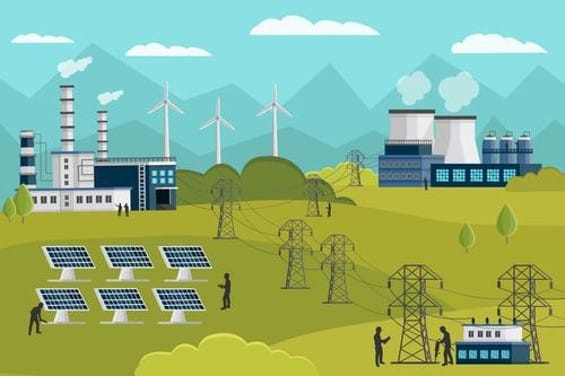
LAYER 1 POWER Generating and managing the electricity that fuels AI compute
A single ChatGPT query can consume 10x more energy than a Google search. At scale, this insight underpins the reason why, according to the IEA, many large AI datacenters use as much electricity as medium-sized cities. As the AI datacenter buildout unfolds, the US electric grid is faced with power demand which is inflecting positively for the first time in decades.
The key constraint is not power generation alone — it is the entire delivery chain. Electricity must be generated, transmitted across the grid, stepped up and down in voltage by transformers, and ultimately conditioned inside the datacenter to feed server racks.
Where Gabelli Growth sees opportunity:
- Behind-the-meter baseload power generation: due to multi-year grid interconnection queues, datacenter developers are increasingly turning to on-site industrial gas turbines as the fastest and most reliable way to bring incremental baseload power capacity online. Turbine manufacturers like GE Vernova and Mitsubishi Heavy carry order books extending well into the next decade, supporting highly visible, and profitable, growth for years to come.
- Electrical equipment: high-voltage transformers, switchgear, and power distribution equipment are an unsung bottleneck of the AI datacenter buildout. Lead times on large power transformers extend multiple years, manufacturers like Eaton and Schneider Electric are seeing revenue backlogs expand meaningfully.
- Cooling technology: power-dense AI processors generate intense heat that traditional air cooling cannot handle. Specialists like Trane Technologies are evolving to create systems which allow AI datacenters to operate as efficiently as possible.
LAYER 2 CHIPS Designing, manufacturing, and assembling the semiconductors that execute AI workloads
Since 2022, the modern computing industry has evolved on the back of two innovations. First, parallel processors have emerged as a preferred architecture, particularly across many AI workloads. Second, rack-scale systems interconnecting multiple processors, pools of memory, storage components, and high-speed networking fabrics operate as a new unit of compute.
Where Gabelli Growth sees opportunity:
- GPU accelerators: parallel processors designed by Nvidia, Broadcom, and Advanced Micro unlocked the generative AI era.
- Semiconductor Manufacturing: the world needs more semiconductors, and semiconductors themselves are becoming increasingly complex. These trends drive demand for more manufacturing lines, and more specialized manufacturing equipment.
- Networking: modern AI computers as factories, with thousands (in some cases millions) of individual processors networked together operating as a single system.
LAYER 3 CLOUD Creating the platform environment where AI becomes commercially useful
Most enterprises do not build their own datacenters or train their own models. Instead, they rent access through cloud platforms like Amazon Web Services, Microsoft Azure, and Google Cloud Platform. Cloud providers operate global datacenter networks and offer hundreds of services which allow their customers to store and organize data, run software, and access AI capabilities.
Where Gabelli Growth sees opportunity:
- Cloud infrastructure-as-a-service: AI has a twofold benefit for cloud hyperscale platforms. First, it is becoming strategically important for customers to migrate IT to the cloud to harness the power of AI. Second, AI cloud services are creating new revenue opportunities for cloud service providers.
- AI-native cloud: AI datacenter architectures are proving to be best managed by specialists well-versed in the newest infrastructure technologies.
- Data infrastructure & security: AI systems are as useful as the data they can access. Data infrastructure and cybersecurity therefore become essential “plumbing” for users of AI.
LAYER 4 MODELS AI systems that understand language, images and data
Foundation models are the intellectual core of AI capabilities. Given massive costs and technical requirements in training large models, this market has consolidated rapidly with a small handful of leaders separating from the pack in recent years. Many important questions remain for the providers and users of AI models: is this a winner-take-most market, or will there be opportunity for smaller domain-specific offerings? And how will model provider economics evolve as inference costs fall?
Where Gabelli Growth sees opportunity:
- Alphabet / Gemini: while Anthropic and OpenAI remain private, Alphabet’s Gemini has emerged as a credible #3 player. Gemini is driving meaningful Google Cloud acceleration: in 1Q 2026, Gemini Enterprise reported 40% quarter-over-quarter growth in paid seats; token generation grew 60% from year-end; and revenue from products built on Gemini models grew 800% year-over-year.
- Model orchestration: recently, enterprises using AI have started to look more closely at the costs of inferencing AI models and generating AI tokens. Orchestration platforms like Amazon’s Bedrock allow customers to intelligently route workloads across multiple models — using expensive frontier models where quality demands it, and cheaper open-source alternatives where it doesn’t.
- Custom silicon: the largest AI labs are building custom chips to train and inference their own models in efforts to optimize the price vs. performance tradeoff. Broadcom is the leading designer of custom AI accelerator programs and counts Google, Meta, OpenAI and Anthropic as customers.
LAYER 5 APPLICATIONS Where AI’s economic value is ultimately delivered, and captured
The first four layers — Power, Chips, Cloud, and Models — are the infrastructure of AI. Layer 5 is the economy built on top of that infrastructure. This is where AI translates into products that end users pay for: tools that save time, automate workflows, generate revenue, or create capabilities that simply did not exist before.
The application layer is the least developed but ultimately the largest opportunity. History suggests that infrastructure buildouts create the conditions for application explosions, and AI will likely follow a similar pattern. Five commercial waves are taking shape:
| Application | Key Players | What to Know |
| Digital Advertising | Alphabet, Meta | The first proven large-scale AI application. GOOG and META began significantly ramping up AI infrastructure investments in 2022. Since then, digital ad revenues across the two companies have nearly doubled and growth has durably accelerated at scale. |
| Data Processing | Alphabet, Amazon, Microsoft, Oracle | AI is a demand driver and a new product category for cloud platforms. Top-4 hyperscale cloud revenues have ~tripled since AI infrastructure investments took off, and growth rates across these businesses are now at multi-year highs. |
| Chatbot Intelligence | OpenAI, Anthropic, Alphabet | Revenue bases across OpenAI and Anthropic have grown rapidly over the last two years, as consumers and enterprises show demand for subscriptions to chatbot services. |
| Autonomous Driving & Robotics | Tesla, Amazon, Alphabet | End-to-end neural networks are replacing rules-based systems as an architecture of choice for self-driving. Tesla’s Full Self-Driving system recently surpassed 10bn miles driven. |
| Agentic Software | Salesforce, ServiceNow, Microsoft, Cursor | Recent model capabilities and agentic coding platforms have brought on the age of agentic AI. Always-on and long-running agents can perform multi-step tasks and call on third-party applications and tools autonomously. |
GABELLI GROWTH: HOW WE INVEST IN AI
Across the Gabelli Growth portfolios, this framework helps us distinguish between near-term infrastructure opportunities, emerging application winners, and companies positioned to compound as AI adoption broadens. We are fundamental-oriented growth investors focused on identifying industry leaders benefiting from secular growth tailwinds. We invest in companies with above-average revenue growth potential, proven unit economics, impressive track records, and strong returns on invested capital by overlaying bottom-up fundamental analysis with a top-down assessment of the business cycle.
| Strategy | Tickers | Vehicle | Mandate |
| Gabelli Growth Innovators ETF | GGRW | Active ETF | Active ETF investing in digital economy enablers and beneficiaries including the team’s best risk/reward ideas exposed to AI, cloud, and data-science tailwinds |
| Gabelli Growth Fund | GABGX / GGCIX / GGCAX / GGCCX | Mutual Fund
Sep. Account |
Diversified, earnings-driven portfolio of undervalued growth companies seeking capital appreciation |
| Gabelli Global Growth Fund | GGGIX / GGGAX / GGGCX / GICPX | Mutual Fund
Sep. Account |
Global mandate across market caps, investing in companies at the forefront of accelerated growth |
Contact invest@gabelli.com · 914-921-5100 · www.Gabelli.com
Investors should carefully consider the investment objectives, risks, charges and expenses of the Fund before investing. The Prospectus and Summary Prospectus, which contains more complete information about this and other matters, should be read carefully before investing. To obtain a prospectus, please call 800 GABELLI or visit www.gabelli.com
Important Disclosures:
- Shares of this ETF are bought and sold at market price (not NAV) and are not individually redeemed from the fund.
- Buying or selling ETF shares may require additional fees such as brokerage commissions, which will reduce returns.
- These additional risks may be even greater in challenging or uncertain market conditions.
You should consider the ETFs’ investment objectives, risks, charges and expenses carefully before you invest. The ETFs’ Prospectus and Summary Prospectus are available from G.distributors, LLC, a registered broker-dealer and FINRA member firm, and contains this and other information about the ETFs, and should be read carefully before investing. To obtain a Prospectus, please call 888-GABELLI or visit https://www.gabelli.com/funds/etfs/intro.
Distributed by G.Distributors, LLC, a registered broker-dealer and FINRA member firm. One Corporate Center, Rye, NY 10580