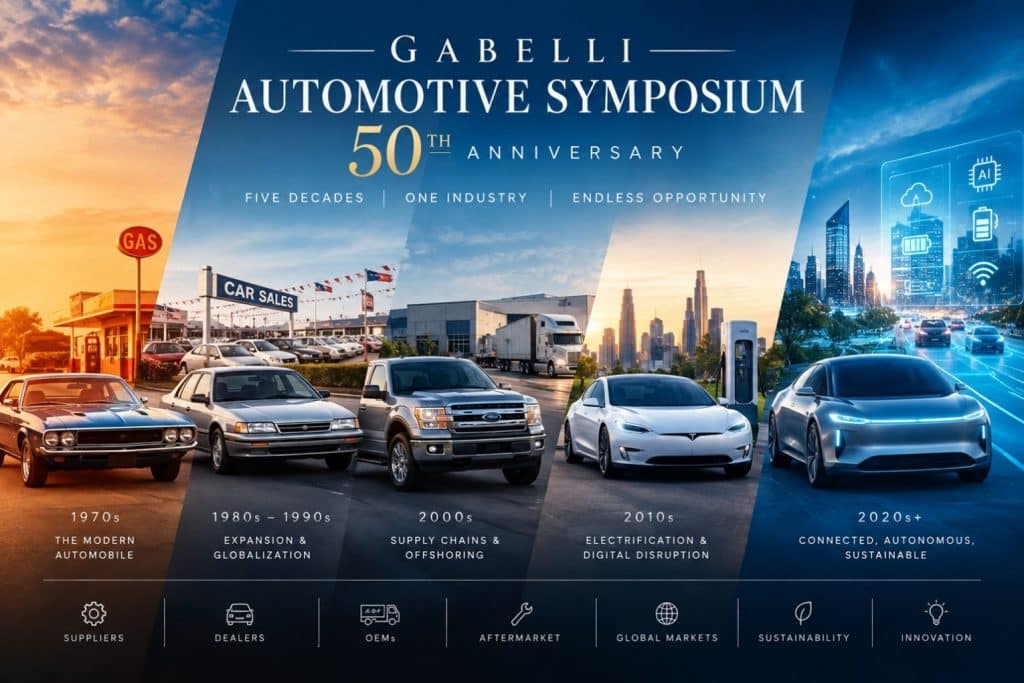
Las Vegas Auto Symposium 2026
50 Years In Las Vegas
The Gabelli Automotive Symposium celebrates its 50th year in Las Vegas at Encore at Wynn November 2 and 3, 2026. Held contemporaneously with the Automotive Aftermarket Products Expo (AAPEX) and the Specialty Equipment Market Association (SEMA) conventions, we know of no other investor conference that has stood the test of time for this long, and plan to celebrate our fifty years in a way only Las Vegas can.
For five decades, the event has provided investors with a unique opportunity to engage with company executives and industry operators in a highly condensed period of time. Our 20+ conference participants span the entire automotive ecosystem, offering investors exposure to a diverse range of growth opportunities across the global automotive industry. Originally established as an automotive aftermarket symposium, the conference has evolved to include leading auto dealers, truck manufacturers, and automotive and commercial truck original equipment suppliers, creating a well-balanced forum for understanding the interconnected drivers shaping the industry.
In what is the first of what is likely to be a series of notes ahead of the conference, we thought it appropriate to provide an appetizer of sorts, highlighting year by year the biggest events that helped shape the industry. This trip down memory lane provides not only a nostalgic history lesson but also illustrates some of the major financial engineering opportunities provided by Symposium corporate attendees over five decades.
The 1970s
1977
- Clean Air Act Amendments of 1977 tighten tailpipe emissions and set the stage for expanded catalytic-converter mandates: a defining regulatory driver for the parts business for decades to come.
- GM begins its major “downsizing” of full-size cars for better fuel economy, reshaping OEM product strategy after the first oil shock.
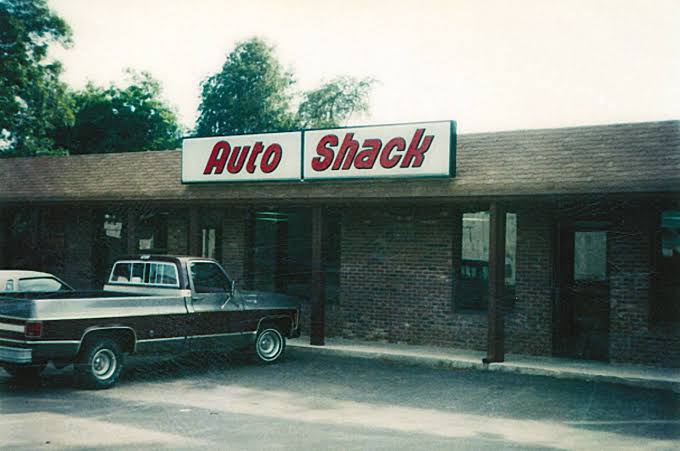
- Genuine Parts Company (NAPA), already decades into its public-company life, continues building out its wholesale distribution network – one of the aftermarket’s earliest national footprints.
Source: Reddit
1978
- Chrysler posts mounting losses, setting up the crisis that culminates in the 1979–80 federal bailout.
- Ford faces intense scrutiny and litigation over the Pinto fuel-tank design, an early landmark in automotive product-liability law.
- Rising import competition (VW, Toyota, Datsun) accelerates share gains for smaller, more fuel-efficient vehicles.
1979
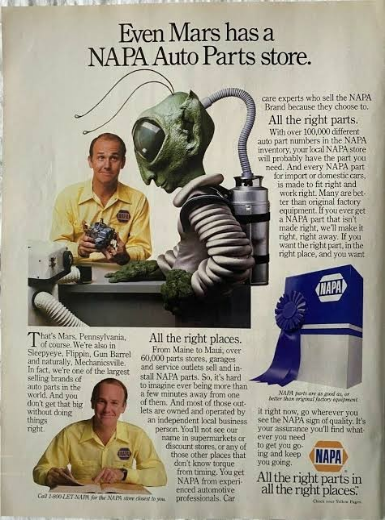
- Auto Shack (later AutoZone) opens its first store in Forrest City, Arkansas, founded by J.R. “Pitt” Hyde III – the seed of what becomes the largest U.S. auto parts retailer.
- The Iranian Revolution triggers the second oil shock, again driving consumers toward smaller cars and toward keeping/maintaining existing vehicles longer, creating a multidecade, durable tailwind for the aftermarket.
- Chrysler, near collapse, seeks federal loan guarantees; Congress passes the Chrysler Loan Guarantee Act in early January 1980.
The 1980s
1980
- The Chrysler Loan Guarantee Act is signed, providing $1.5 billion in federally guaranteed loans – one of the first major U.S. government auto-industry bailouts. Lee Iacocca’s turnaround begins.
- Deep auto-sector recession (record interest rates) drives layoffs across OEMs and suppliers.
Source: ebay
1981
- The U.S. and Japan agree to a Voluntary Export Restraint, capping Japanese vehicle imports and reshaping competitive dynamics for the next decade.
- Continued industry recession pressures both OEMs and independent parts/service networks.
1982
- Honda opens the first Japanese “transplant” assembly plant on U.S. soil (Marysville, Ohio), the start of major Japanese manufacturing investment in America.
- GM and Toyota begin negotiating what becomes the NUMMI joint venture (formalized 1983–84).
1983
- Chrysler repays its government-guaranteed loans seven years ahead of schedule, a symbolic turning point for the industry.
- GM–Toyota formalize the NUMMI joint venture in Fremont, California (production begins 1984).
- Chrysler launches the minivan (Dodge Caravan/Plymouth Voyager), creating a segment that reshapes family-vehicle demand.
1984
- NUMMI begins production – the first major U.S.–Japan manufacturing joint venture, a template for later transplant strategy.
- Chrysler’s minivan success helps fund the company’s recovery and diversification.
1985
- GM creates the Saturn Corporation as a standalone subsidiary, an ambitious (and costly) experiment in a new manufacturing/labor/retail model.
- Ford deepens its equity relationship with Mazda.
- NAPA/Genuine Parts and independent warehouse distributors continue consolidating the fragmented jobber network.
1986
- Auto Shack is spun out of Malone & Hyde in a leveraged transaction backed by Kohlberg Kravis Roberts (KKR). The deal that eventually becomes AutoZone’s ownership structure heading into its 1991 IPO.
1987
- Chrysler acquires American Motors Corporation (AMC) from Renault for roughly $1.5 billion, gaining the Jeep brand, in what will become one of the most consequential M&A deals in U.S. auto history.
- Auto Shack renames itself AutoZone.
1988
- AutoZone launches Duralast, its private-label parts brand, in an early example of aftermarket retailers building proprietary brand margin.
- Ford acquires Aston Martin, part of a wave of prestige-brand acquisitions by U.S. OEMs.
1989
- AutoZone’s sales top $500 million and it becomes the third-largest U.S. auto parts retailer, opening its 500th store.
- Ford acquires Jaguar for about $2.5 billion, capping the decade’s luxury-brand buying spree.
The 1990s
1990
- The Clean Air Act Amendments of 1990 impose sharply tighter emissions standards, another multi-decade driver of parts/technology demand.
- GM launches the Saturn brand’s first production cars.
- A new recession begins to squeeze Big Three margins heading into the early ’90s.
1991
- AutoZone completes its IPO on the NYSE (April 1991), with KKR retaining a majority (68%) stake – the first of the major aftermarket-retail IPOs that define the sector’s public-market era.
- GM reports a record annual loss (~$4.5 billion for fiscal 1991), triggering a board-driven management shake-up.
1992
- GM’s board ousts CEO Robert Stempel amid the company’s financial crisis – a landmark corporate-governance event.
- CAFE and environmental policy debates intensify under the incoming Clinton administration’s agenda.
1993
- O’Reilly Automotive completes its IPO on NASDAQ (April 23, 1993) at $17.50/share.
- CarMax opens its first used-car superstore in Richmond, Virginia, as a subsidiary of Circuit City, launching the “used-car superstore” retail model.
- Chrysler’s new “cab-forward” LH sedans (Intrepid, Concorde, Vision) mark a major design/engineering turnaround.
1994
- NAFTA takes effect (January 1, 1994), fundamentally reshaping OEM and supplier manufacturing footprints across the U.S., Mexico, and Canada for the next three decades.
- Chrysler posts record profits, completing its recovery from the late-’80s slump.
- American Axle & Manufacturing formed via LBO of GM’s driveline operations by Richard Dauch.
1995
- CarMax continues expanding its superstore concept under Circuit City.
- Big Three profitability peaks amid strong truck/SUV demand.
1996
- H. Wayne Huizenga’s Republic Industries begins an aggressive roll-up of new- and used-car dealerships, the start of what becomes AutoNation – the first large-scale consolidation of auto retail.
- CarMax begins its Professional/delivery-style commercial expansion groundwork.
1997
- Circuit City issues a CarMax tracking stock (February 1997), an early step toward CarMax’s eventual full spin-off.
- Republic Industries becomes the largest auto retailer in the U.S. through rapid dealership acquisitions.
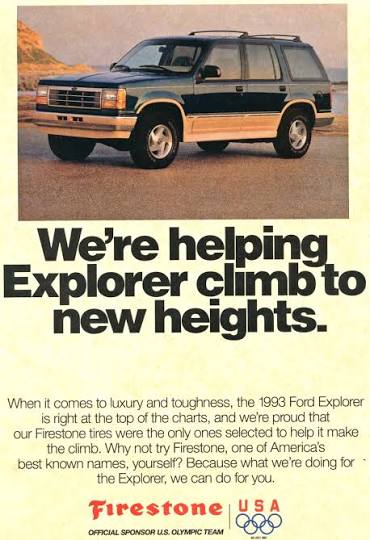
- Firestone tire issues on Ford Explorers begin quietly surfacing (years before the 2000 recall).
1998
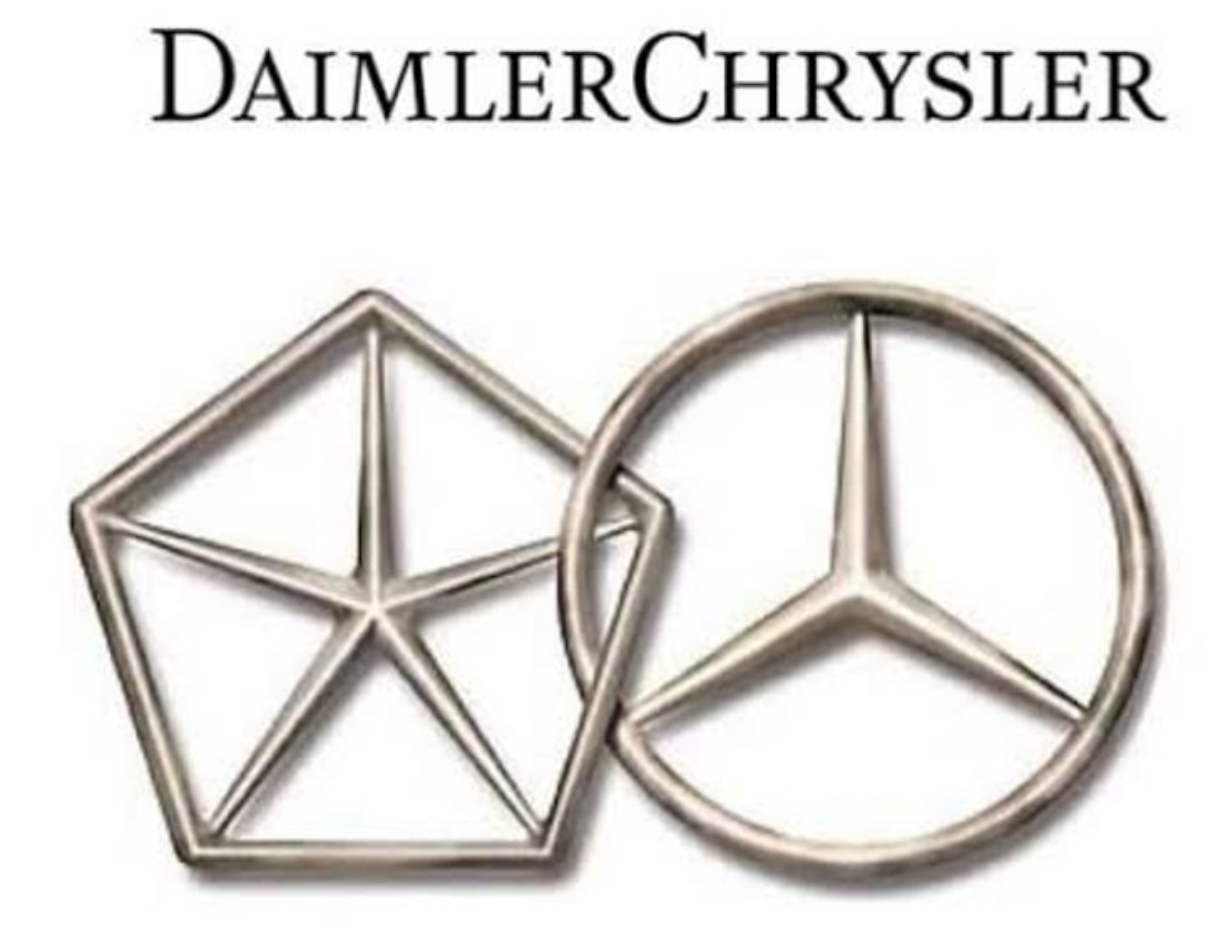
- Daimler-Benz merges with Chrysler in a roughly $36 billion “merger of equals,” creating DaimlerChrysler, one of the largest cross-border industrial mergers in history.
- LKQ Corporation is founded by Donald Flynn to consolidate the fragmented recycled/salvage auto parts industry, the start of what becomes the largest alternative-parts supplier in North America.
- Republic Industries rebrands as AutoNation.
1999
- Ford acquires Volvo Cars for about $6.45 billion, continuing its Premier Automotive Group luxury strategy.
- Renault takes a 36.8% stake in Nissan for roughly $5.4 billion, forming the Renault-Nissan Alliance.
- Firestone tire failures linked to Ford Explorer rollovers begin drawing regulatory attention.
Source: MBA Knowledge Base
The 2000s
2000
Source: Facebook
- The Ford–Firestone tire recall (6.5 million tires) becomes a defining product-liability and brand crisis, ending the companies’ century-long supply relationship and prompting the federal TREAD Act.
- GM discontinues the Oldsmobile brand (wind-down through 2004), an early sign of Big Three brand-portfolio rationalization.
- Visteon spun off from Ford as an independent public parts supplier.
- Arvin Industries merges with Meritor Automotive, forming ArvinMeritor.
2001
- Advance Auto Parts is incorporated and goes public in connection with its acquisition of Discount Auto Parts, listing on the NYSE.
- September 11 disrupts just-in-time supply chains industry-wide, exposing single-source supplier risk.
- Ford CEO Jacques Nasser is ousted amid the lingering Firestone fallout.
- Federal-Mogul files Chapter 11 (asbestos liabilities): major supplier bankruptcy.
2002
- CarMax is fully spun off from Circuit City (October 1, 2002), becoming an independent NYSE-listed company (KMX).
- GM begins the multi-year wind-down of Oldsmobile.
2003
- LKQ Corporation completes its IPO on NASDAQ, giving the recycled/alternative-parts consolidator public-market currency for further acquisitions.
- Advance Auto Parts continues acquisitive growth, closing in on AutoZone’s store count.
2004
- Rising “legacy cost” pressure (pensions, retiree healthcare) becomes the dominant narrative for GM and Ford.
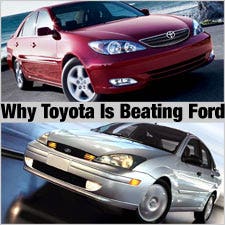
- Toyota overtakes Ford in U.S. sales volume for parts of the year – an early signal of the coming shift in market share.
- Dana Corp. sells its automotive aftermarket business to The Cypress Group for ~$1B, forming Affinia Group.
- Cooper-Standard Automotive sold/spun by Cooper Tire & Rubber to The Cypress Group for ~$1.15B
Source: Forbes
2005
- Delphi Corporation (GM’s former parts division, spun off in 1999) files Chapter 11 – at the time the largest auto-supplier bankruptcy in U.S. history, and a warning sign for the whole supply base.
- GM’s debt is downgraded to junk status by major rating agencies.
2006
- Cerberus Capital Management leads a consortium that acquires 51% of GMAC (GM’s finance arm) for about $14 billion – a landmark private-equity transaction that foreshadows Cerberus’ next move.
- Ford launches its “Way Forward” restructuring plan and borrows $23.6 billion against nearly all its assets to fund the turnaround.
- Sumitomo Corp. of America acquires TBC Corporation for ~$1.1B.
- Dana Corp. itself files Chapter 11 (emerges 2008).
2007
- Cerberus Capital acquires an 80.1% stake in Chrysler from DaimlerChrysler for about $7.4 billion, effectively ending the “merger of equals” and returning Chrysler to independent (PE-owned) status.
- LKQ acquires Keystone Automotive Industries (collision replacement parts) for roughly $687 million, a major aftermarket consolidation deal.
- Federal-Mogul emerges from its long Chapter 11 reorganization (filed 2001).
2008
- The global financial crisis collapses new-vehicle sales. GM and Chrysler receive roughly $17.4 billion in emergency federal TARP loans in December.
- O’Reilly Automotive acquires CSK Auto for $528 million, at the time the largest deal in its history, adding over 1,200 stores.
2009
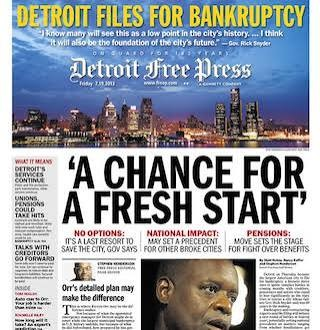
- GM and Chrysler both file Chapter 11 bankruptcy (June 2009) in a U.S. government-orchestrated restructuring; Fiat takes an initial 20% stake in a reorganized Chrysler.
- The “Cash for Clunkers” program stimulates a short-term sales rebound.
- LKQ acquires GreenLeaf Auto Recyclers, its largest salvage-industry competitor at the time.
- Visteon files Chapter 11 (emerges 2010); Cooper-Standard also files Chapter 11 in 2009
Source: Detroit Free Press
The 2010s
2010
- General Motors’ IPO (November 2010) – the U.S. Treasury sells down its stake, raising about $20 billion in what was then one of the largest IPOs in U.S. history.
- Ford returns to sustained profitability without having taken a federal bailout, a key brand differentiator.
2011
- LKQ acquires Euro Car Parts in the UK, beginning its international (European) expansion.
- Japan’s earthquake/tsunami severely disrupts global parts supply chains, exposing continued OEM/supplier fragility.
- Toyota’s unintended-acceleration recall fallout continues through settlements and litigation.
2012
- Fiat increases its ownership stake in Chrysler moving toward majority control.
- Tesla’s Model S launch accelerates the long-run narrative around EV disruption of both OEMs and the aftermarket.
- TBC Corporation (Sumitomo) acquires Midas Inc. for ~$310M.
2013
- Fiat moves to acquire the remaining VEBA (UAW retiree trust) stake in Chrysler, completing full ownership (finalized January 2014) and forming Fiat Chrysler Automobiles (FCA).
- The U.S. Treasury sells its final GM shares, formally ending the government’s ownership stake from the 2009 bailout.
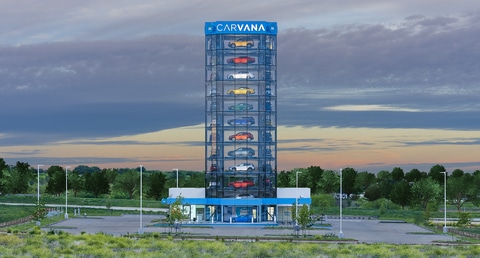
- Carvana is founded as a used-vehicle e-commerce company (spun out of DriveTime).
- Apollo Tyres’ attempted $2.5B acquisition of Cooper Tire collapses (failed deal).
- Affinia sells its Brake Parts unit (Raybestos) as it narrows focus. It also sells its Chassis business to Federal-Mogul in 2014.
2014
- GM’s ignition-switch recall crisis (2.6 million vehicles, tied to well over 100 deaths) becomes one of the largest product-safety and financial-liability events in industry history.
- Advance Auto Parts acquires General Parts International (Carquest/Worldpac) for about $2.05 billion, making Advance the largest aftermarket parts retailer by store count.
- Takata airbag-inflator recalls begin escalating toward what becomes the largest auto recall in history (~67 million inflators).
2015
- Volkswagen’s “Dieselgate” emissions-cheating scandal erupts (September 2015), ultimately costing VW tens of billions of dollars in fines, buybacks, and settlements.
- FCA’s Sergio Marchionne publicly pursues (and is rebuffed on) a merger with GM.
- Aging-fleet dynamics continue to support strong same-store growth across AutoZone, O’Reilly, and Genuine Parts.
- ZF Friedrichshafen acquires TRW Automotive for ~$13.5B, forming ZF TRW.
- Icahn Enterprises acquires Auto Plus (aftermarket distributor).
2016
- Ford commits roughly $4.5 billion to electrification plans; GM acquires self-driving startup Cruise Automation for about $1 billion.
Source: Zillionize
- The average age of U.S. vehicles on the road hits a then-record (roughly 11.6 years, per IHS Markit/S&P Global Mobility), a core structural tailwind for the aftermarket.
- 2015 (announced) / 2016 (closed) – Icahn Enterprises acquires Pep Boys for ~$1.03B
- Federal-Mogul fully absorbed into Icahn Enterprises via squeeze-out merger.
2017
- Carvana completes its IPO on the NYSE (April 2017), raising $225 million and becoming the highest-profile pure-play used-car e-commerce stock.
- Takata files for bankruptcy under the weight of the record airbag recall.
- GM invests in ride-share company Lyft as mobility bets accelerate across OEMs.
- Genuine Parts Company acquires Alliance Automotive Group (Europe) for ~$2B.
- Delphi Automotive splits itself: renames as Aptiv, spins off powertrain unit as Delphi Technologies.
2018
- Tesla’s Model 3 ramps through “production hell” into real volume, marking the start of mainstream EV scale production.
- Section 232/301 tariff threats on autos, steel, and aluminum begin reshaping supplier sourcing decisions.
- GM announces major North American plant “unallocation”/restructuring.
- Tenneco acquires Federal-Mogul from Icahn Enterprises for $5.4B.
- 2018 (announced) / 2020 (completed via alternate sale) – Genuine Parts Company divests S.P. Richards office-products unit (RMT deal with Essendant fell through 2019; sold to a H.I.G. Capital–backed investor group in 2020).
2019
- The UAW’s 40-day national strike against GM – the longest in decades – costs GM an estimated $3.6 billion.
- Fiat Chrysler and PSA Group (Peugeot) agree to merge (announced December 2019), in a deal that becomes Stellantis.
- Genuine Parts Company continues its multi-decade run of annual dividend increases (a “Dividend King”).
- Tenneco completes DRiV spin-off (aftermarket/ride performance business separated from powertrain-focused Tenneco).
- KAR Auction Services spins off Insurance Auto Auctions (IAA) as an independent public company Source: Tyre Press
Source: Tyre Press
The 2020s
2020
- COVID-19 shuts down plants and dealerships in spring 2020; new-vehicle sales collapse, then the global semiconductor chip shortage begins emerging late in the year, setting up years of production disruption.
- Used-vehicle and DIY/aftermarket parts demand surges as consumers avoid public transit and delay new-vehicle purchases.
- Carvana and CarMax benefit sharply from the shift to online/contactless used-car buying.
- BorgWarner acquires Delphi Technologies for ~$3.3B (stock deal).
2021
- The chip shortage cripples new-vehicle production industry-wide, pushing new- and used-vehicle prices to record highs.
- Driven Brands (Take 5 Oil Change, Meineke, Maaco, CARSTAR) completes its IPO on NASDAQ (January 2021), backed by Roark Capital, raising roughly $725 million.
- Stellantis is formally created (January 2021) from the completed FCA-PSA merger.
- Record aftermarket demand as the chip shortage and an aging fleet keep older vehicles on the road longer.
2022
- The Inflation Reduction Act reshapes EV tax credits around domestic-content and assembly requirements, forcing a rework of OEM/supplier sourcing strategy.
- Carvana’s stock collapses more than 98% from its 2021 peak amid a used-car market downturn and mounting debt concerns.
- Right-to-repair fights intensify, including litigation over Massachusetts’ telematics-data access law – a key aftermarket policy battleground.
- Average U.S. vehicle age hits a new record (about 12.2 years, S&P Global Mobility).
- Carvana acquires ADESA’s U.S. physical auction business from KAR Global for $2.2B.
- Tenneco taken private by Apollo Global Management for ~$7.1B enterprise value (closed Nov. 2022).
2023
- The UAW’s historic “Stand Up Strike” hits GM, Ford, and Stellantis simultaneously for the first time (Sept–Oct 2023), winning record contract gains.
- Carvana restructures its debt, narrowly avoiding bankruptcy, and its stock stages a dramatic rebound.
- EV demand growth slows relative to earlier forecasts (the “EV winter”), pressuring automaker profitability.
- Average vehicle age climbs to about 12.5 years, reinforcing the aftermarket’s core “aging fleet” investment thesis.
- LKQ Corporation acquires Uni-Select Inc. for ~C$2.8B (~US$2.1B).
Source: Carvana
2024
- Average U.S. vehicle age reaches a new record (~12.6 years, S&P Global Mobility): the single most-cited data point supporting aftermarket demand.
- EV price competition (led by Tesla) and slower-than-expected adoption prompt Ford and GM to delay EV plant investments and lean back into hybrids.
- Continued private-equity-backed consolidation among collision/repair multi-shop operators (MSOs) and parts distributors.
- Goodyear acquires Cooper Tire & Rubber for ~$2.5B.
2025
- New U.S. tariffs on imported vehicles and auto parts take effect, forcing another round of supplier sourcing and cost realignment across the industry.
- Further changes/rollback to EV tax-credit policy add uncertainty to OEM electrification roadmaps.
- Continued roll-up activity in aftermarket distribution and service (parts distributors, collision MSOs, quick-lube and tire chains).
- TBC Corporation (Sumitomo/Michelin) divests its Midas franchise portfolio to Mavis Tire
2026 (Year to Date)
- Section 232 tariffs weigh heavily on Detroit’s Big Three – GM guides to as much as $4 billion in 2026 tariff costs while pursuing plans to overtake Ford in U.S. production; Stellantis absorbs a $1.7 billion tariff hit, with all three diverging on how much cost to pass to consumers.
- Genuine Parts Company announces plan to split into two public companies (Feb. 17) – separating Global Automotive (NAPA) from Global Industrial (Motion), targeting a Q1 2027 close; O’Reilly Automotive reportedly countered in July with a $10B+ cash bid for the automotive unit instead.
- UAW strikes GM axle supplier American Axle & Manufacturing (June 1–12) – a 10-day strike that threatens GM truck production before a tentative contract is ratified.
- First Brands Group’s bankruptcy escalates from Chapter 11 to Chapter 7 liquidation (Aug. 24) – after its Raybestos and Centric Parts/StopTech brake brands are sold off separately in June to Friction One and Motorcar Parts of America; Mavis Tire also closes its $700 million purchase of Pep Boys from Icahn Enterprises (Aug. 20).
- Detroit automakers cut more than 20,000 U.S. salaried jobs (through May) at GM, Ford, and Stellantis, with executives citing AI-driven efficiency alongside softening EV demand following the September 2025 expiration of the $7,500 federal EV tax credit.
- Vehicle recalls hit a five-year high, topping 12 million vehicles in Q1 alone, with Ford leading the industry at roughly 11.2 million vehicles across 19 separate recalls.
- Waymo’s robotaxi expansion accelerates sharply, opening driverless service in Houston, Dallas, San Antonio, Orlando, San Diego, Las Vegas, Tampa, and Denver, with coverage area up more than 20% during the year.
Source: Aftermarket News
Brian Sponheimer Eddie Nakamura
(914) 921-8336 (914) 921-7784
©Gabelli Funds 2026
249 ROYAL PALM WAY, PALM BEACH, FL 33480 Gabelli Funds TEL (561) 671–2100
This whitepaper was prepared by Brian Sponheimer and Eddie Nakamura. The examples cited herein are based on public information and we make no representations regarding their accuracy or usefulness as precedent. The Portfolio Manager’s views are subject to change at any time based on market and other conditions. The information in this report represent the opinions of the individual Portfolio Manager as of the date hereof and is not intended to be a forecast of future events, a guarantee of future results, or investments advice. The views expressed may differ from other portfolio managers or of the Firm as a whole.
As of June 30, 2026, affiliates of GAMCO Investors, Inc. beneficially owned 1.68% of AutoNation and less than 1% of all other companies mentioned.
These portfolio managers may know the substance of the report prior to its distribution.
This whitepaper is not an offer to sell any security nor is it a solicitation of an offer to buy any security.
Investors should consider the investment objectives, risks, sales charges and expense of the fund carefully before investing.
For more information, visit our website at: www.gabelli.com or call: 800-GABELLI
800-422-3554 • 914-921-5000 • Fax 914-921-5098 • info@gabelli.com