
The Underlying Strength of the Aerospace & Defense Industry
Near-Term Pullback Amid Record Backlogs, Demand, Secular, and Structural Drivers
The aerospace and defense sector’s pullback in the third quarter has been driven largely by near-term political and sentiment factors. Specifically, uncertainty around the upcoming midterm elections and growing “peak defense” concerns that higher spending could face congressional gridlock, delayed appropriations, or reduced momentum if control of Congress shifts. These worries have prompted pullback across the group even as operational backlogs remain at or near record levels.
Near-Term Sentiment Drivers
Investors caution has centered on two interrelated themes:
- Midterm election uncertainty and the potential shifts in congressional control that could complicate the appropriations process.
- “Peak defense” narrative that multi-year growth in outlays may slow or face greater scrutiny, leading to delayed funding or reduced program momentum.
These factors have weighed on valuations across the sector despite continued strength in order books, production ramps, and multi-year visibility on key platforms.
Operational Reality: Backlogs and Stockpile Replenishment
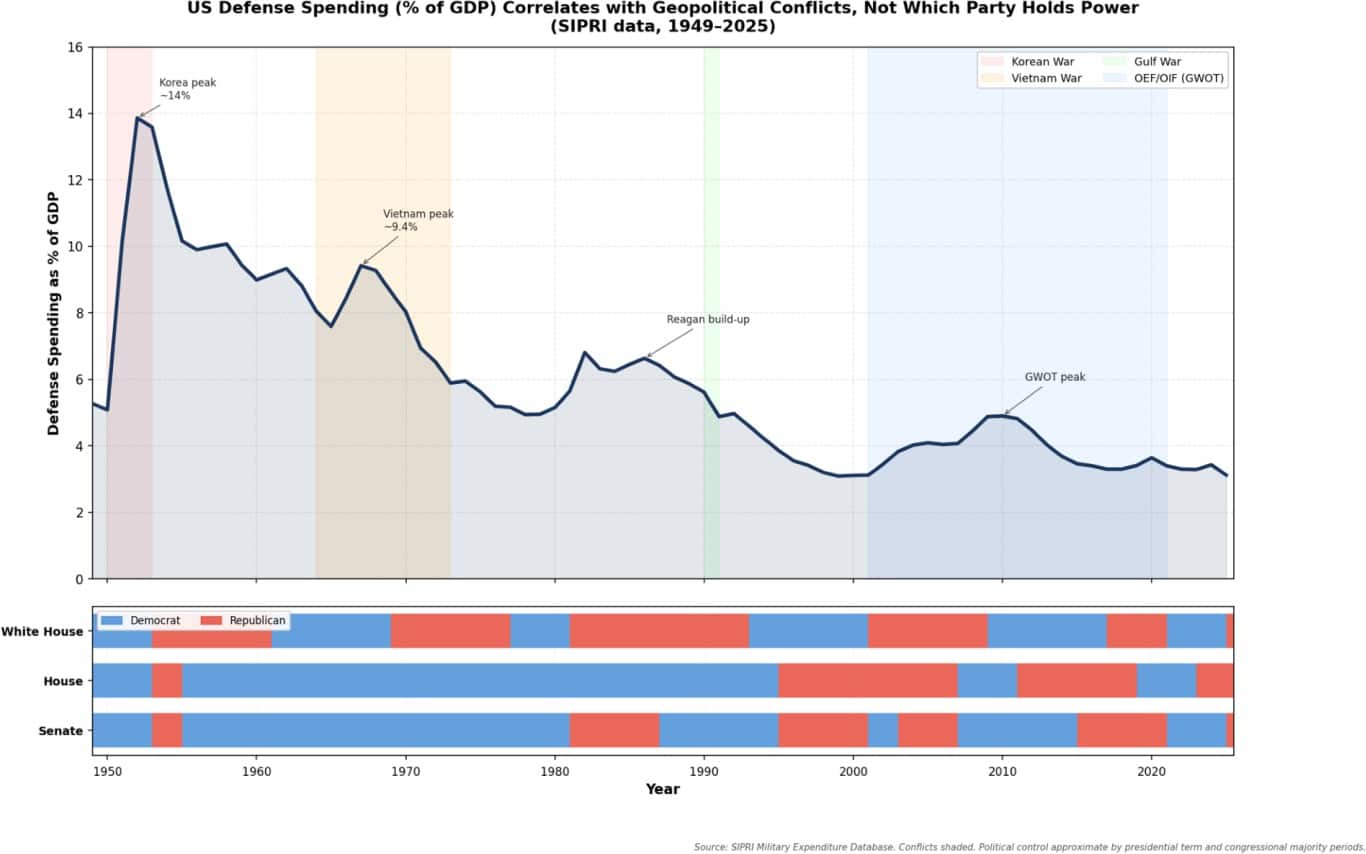
In reality, U.S. defense spending is fundamentally driven by geopolitical volatility and the need to replenish depleted munition stockpiles and modernize forces against peer and near-peer threats. Operational backlogs across major primes and suppliers remain at or near historic highs, providing multi-year revenue visibility independent of near-term appropriation timing.
Exhibit 1
Source: SIPRI Military Expenditure Database
Recent operations have underscored the urgency of inventory rebuilding. During Operation Epic Fury (February – April 2026), U.S. inventories of precision munitions and interceptors were consumed well in excess of replacement rates. Key systems experienced significant drawdowns:
Table 1
| Munition | Pre-War Inventory | Depletion | % of Inventory | Depleted Value |
| Tomahawk | 3,100 | 1,000 | 32.3% | $2.60B |
| SM-3 | 410 | 130 | 31.7 | 3.73 |
| SM-6 | 1,160 | 190 | 16.4 | 1.01 |
| THAAD | 360 | ~202 | 56.1 | ~3.13 |
| Patriot (PAC-3) | 2,330 | ~1,430 | 61.4 | ~5.58 |
| Total | 7,360 | ~2,952 | 40.1% | $16.05B |
Source: CSIS April 2026 Estimates, Gabelli Estimates
The Army Requirements Oversight Council had already raised the PAC-3 MSE acquisition objective substantially prior to the conflict. FY27 requested deliveries represent multiples of current production rates for Patriot, THAAD, Tomahawk, SM-6, and SM-3 systems, with replenishment timelines extending three-to-five years. Capacity constraints at primes and across the supply chain mean that requested volumes will take years to fully materialize, supporting sustained production growth.
Historical Spending Context
Current U.S. defense outlays represent roughly 3% of GDP, well below the long-term post-World War II average (which has historically run closer to 6%) and a smaller share of the overall federal budget than was typical for much of the Cold War and post-9/11 eras. This provides both fiscal room and strategic rationale for elevated investment to address peer competition, munitions shortfalls, and force modernization.
Allied demand remains robust as European and Indo-Pacific partners increase spending in response to the same threat environment. Combined with domestic requirements, this supports a multi-year demand backdrop that is not solely dependent on any single annual appropriation cycle.
Aftermarket Overreaction
Since July 1, 2026, aerospace aftermarket stocks have fallen ~26%, well behind the rest of the aerospace and defense sector. The selloff has been driven largely by rising fuel prices. We believe that view is misplaced and that these companies remain well positioned for growth.
Fuel costs hit airlines directly, but aftermarket companies depend on different drivers. Boeing and Airbus are still working to raise production, and until that ramp is sustainable, airlines must keep their existing fleets flying longer. Older aircraft need more maintenance, repair and overhaul (MRO), which drives demand for aftermarket parts and services.
Demand for flying remains intact. Excluding Middle East carriers, IATA reported that global RPKs rose 0.6% year-over-year in August, with international traffic up 1.3%. Continued traffic growth on an aging fleet means more maintenance per flight hour and sustained demand for the aftermarket. As high-margin businesses in a supply-constrained market, aftermarket companies are better positioned than their recent share prices suggest.
Structural Drivers Remain Intact
With multi-year program backlogs at historic highs, ongoing requirements to rebuild inventories, and sustained demand from both the U.S. and allies, the structural drivers of defense investment remain intact irrespective of short-term election-related dynamics. Key considerations include:
- Geopolitical volatility continues to drive requirements for air and missile defense, precision strike, and space-based capabilities.
- Munitions inventories, particularly interceptors and long-range strike systems, remain well below desired levels following recent high-intensity use.
- Production capacity expansion across solid rocket motors, seekers, and airframes is underway but will take years to fully scale, locking in elevated activity.
- International orders and FMS pipelines provide additional diversification and visibility beyond U.S. domestic budgets.
Investment Implications
The recent pullback has created a disconnect between near-term sentiment and the multi-year operational outlook. Companies with exposure to missile solutions, air and missile defense, and related supply chains are positioned to benefit from sustained production ramps as inventories are rebuilt and force structures are modernized. The aftermarket companies have seen an overreaction to the rise in oil prices for how they will be impacted. While election-related noise may continue to influence near-term price action, the underlying demand drivers; geopolitical threat environment, depleted stockpiles, and historic backlogs are independent of short-term political cycles.
We continue to view the aerospace and defense sector as fundamentally supported by structural requirements that are unlikely to be reversed by midterm election outcomes or temporary appropriation delays.
249 ROYAL PALM WAY, PALM BEACH, FL 33480 Gabelli Funds TEL (561) 671-2100
This whitepaper was prepared by Tony Bancroft, Daniel Gliem, CFA and Michael Neviera. The examples cited herein are based on public information and we make no representations regarding their accuracy or usefulness as precedent. The Research Analyst’s views are subject to change at any time based on market and other conditions. The information in this report represent the opinions of the individual Research Analyst’s as of the date hereof and is not intended to be a forecast of future events, a guarantee of future results, or investments advice. The views expressed may differ from other Research Analyst or of the Firm as a whole.
As of June 30, 2026, affiliates of GAMCO Investors owned less than 1% of all other companies mentioned. This whitepaper is not an offer to sell any security nor is it a solicitation of an offer to buy any security.
Investors should consider the investment objectives, risks, sales charges and expense of the fund carefully before investing.
For more information, visit our website at: www.gabelli.com or call: 800-GABELLI 800-422-3554 • 914-921-5000 • Fax 914-921-5098 • info@gabelli.com