ETF Liquidity: Why Trading Volume Doesn’t Tell the Whole Story
Liquidity is one of the most important yet frequently misunderstood aspects of exchange-traded funds (ETFs). Unlike individual stocks and closed-end funds, ETFs operate within a unique market structure that provides multiple layers of liquidity beyond what daily trading volume may suggest.
The Mechanics Behind ETF Liquidity
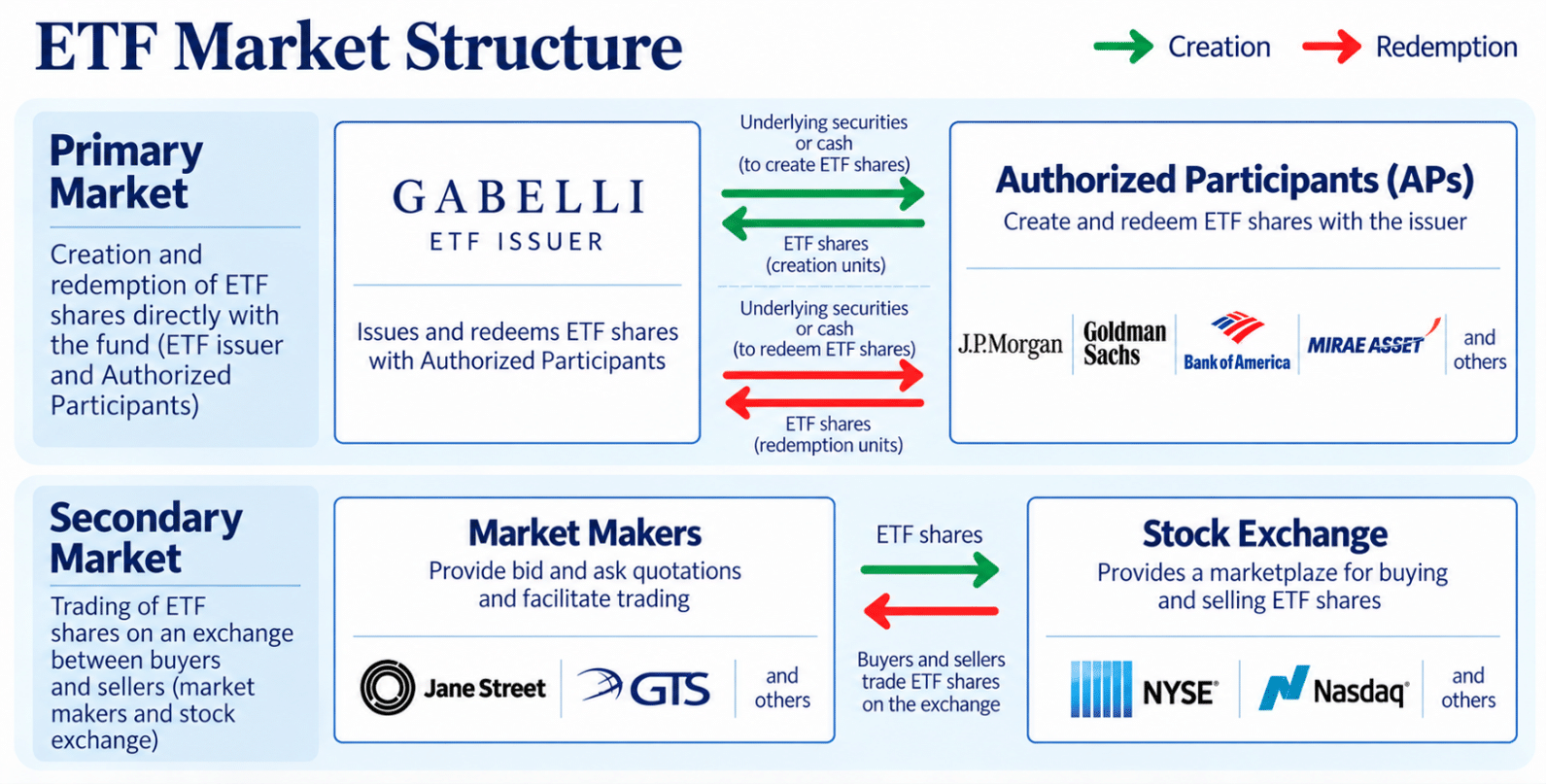
Liquidity refers to how easily an investment can be bought or sold without significantly affecting its price. Unlike individual stocks and closed-end funds, ETF liquidity is not determined solely by trading volume or assets under management. Instead, ETFs benefit from two interconnected sources of liquidity: the secondary market, where shares trade on an exchange, and the primary market, where shares can be created or redeemed based on investor demand.
This unique structure is supported by market makers and authorized participants (APs). Market makers provide bids and offers throughout the trading day, while APs can create or redeem ETF shares directly with the fund in exchange for underlying securities or cash. This mechanism supports arbitrage activity that helps keep ETF market prices closely aligned with the value of their underlying holdings, as reflected in net asset value (NAV).
As a result, an ETF with relatively low daily trading volume may still be able to accommodate larger trades, depending on the liquidity of its underlying holdings and prevailing market conditions.
Investors should also consider an ETF’s bid-ask spread, the difference between its purchase and sale prices. Tighter spreads generally indicate lower transaction costs, while wider spreads may signal higher trading costs. Evaluating bid-ask spreads alongside trading volume and underlying holdings provides a more complete picture of an ETF’s liquidity.
ETF Liquidity in Practice: A $100,000 Trade
Consider an ETF trading at $25 per share with an average daily trading volume of just 800 shares ($20,000). An investor looking to invest $100,000 would need to purchase 4,000 shares, or 5x the ETF’s typical daily volume. Despite the low trading volume, the transaction may still be executed efficiently:
- Market Maker Inventory: Market makers can sell shares from existing inventory or obtain additional shares through the ETF creation process with an authorized participant
- Price Impact: Unlike an illiquid individual stock, where a large purchase may significantly drive up the share price, an ETF’s creation and redemption mechanism helps keep its market price aligned with the value of its underlying holdings (NAV)
- Underlying Liquidity: If the ETF holds liquid securities, market makers may be willing to facilitate the entire $100,000 trade
The above hypothetical example is for illustrative purposes only. It does not represent any specific Gabelli ETF or actual transaction, and is not a guarantee of execution price, cost, or market impact. Actual results will vary.
- Low trading volume does not necessarily mean an ETF is illiquid or that larger trades will significantly impact its price
- Trading costs depend largely on the liquidity of the underlying holdings and market condition
IMPORTANT DISCLOSURES
- Shares of this ETF are bought and sold at market price (not NAV) and are not individually redeemed from the fund.
- Buying or selling ETF shares may require additional fees such as brokerage commissions, which will reduce returns.
- These additional risks may be even greater in bad or uncertain market conditions.
You should consider the ETF’s investment objectives, risks, charges and expenses carefully before you invest. The ETF’s Prospectus and Summary Prospectus contain this and other information about the ETF and should be read carefully before investing. To obtain a Prospectus or Summary Prospectus, please call 800-GABELLI or visit https://www.gabelli.com/funds/etfs/documents
This material is provided for educational purposes only and does not constitute investment advice or a recommendation to buy or sell any security. Investors should consult their financial professional before making investment decisions.
ETFs can trade at a premium or discount to NAV.
Investing involves risks, including the possible loss of principal.
Gabelli ETFs are distributed by G.distributors, LLC, a registered broker-dealer and member of FINRA.