Power, Public, Politics, P/E’s
EPS CAGR’s RISE
US Utilities-The Tale of Two Grids-Strong First Half 2026
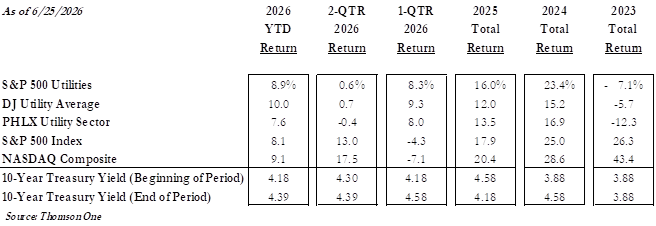
During the first half of 2026 (through 6/25/2026), the S&P 500 Utilities Index gained 8.9%, compared with 8.1% for the S&P 500 and 9.1% for the NASDAQ. After rallying 12% to a record high in late February, utilities gave back nearly 10% as the Iran conflict drove oil prices higher, fueled inflation concerns, and lifted Treasury yields. The sector later recovered as tensions eased and interest rates stabilized. The period was marked by sharp swings in investor sentiment, with capital rotating between defensive utilities and higher-growth technology stocks as geopolitical headlines repeatedly shifted market expectations.
Table 1 First Half 2026 Performance
Despite recent volatility, the fundamental outlook for utilities remains strong. Many companies are now targeting annual EPS growth of 6-8% or better, well above historical levels, as power demand from data centers, manufacturing, and electrification drives one of the largest infrastructure investment cycles in decades. Utilities are expected to invest a record $240 billion in 2026, supporting rapid rate base expansion and providing a runway for above-average growth through at least 2032.
At the same time, data center development is facing growing public and political resistance due to concerns about rising electric bills, water consumption, land use, and grid reliability. Several communities have imposed moratoriums, leading to project delays and cancellations. With 36 states holding gubernatorial elections in November 2026, utility affordability has become a more prominent political issue, particularly in higher-cost states within the PJM Interconnect (PJM) where capacity prices have risen sharply and power supply growth has lagged demand. As a result, some states could face more challenging regulatory environments and lower utility returns. Elsewhere, data center development continues to accelerate and is fundamentally reshaping load forecasts and utility growth expectations. Incremental demand can benefit customers by spreading fixed costs across a larger sales base, while large-load tariffs and long-term contracts are increasingly requiring data centers to fund the infrastructure needed to serve their electricity demand.
These dynamics are creating a widening gap between utility growth leaders and laggards. Those operating in supportive jurisdictions with available power, streamlined permitting, and constructive regulatory frameworks are likely to capture a disproportionate share of future investment. States such as Texas, Louisiana, Ohio, Missouri, Wisconsin, Wyoming, and portions of the Midwest and Southeast appear particularly well positioned, while some PJM and Northeastern markets continue to face greater regulatory and political headwinds.
In addition, utilities with greater scale, financial resources, and speed to market capabilities are targeting high-single-digit EPS growth and commanding premium valuations, while more traditional utilities are expected to grow at mid-single-digit rates. The proposed NextEra Energy–Dominion Energy merger, the largest utility merger ever announced, reflects the growing importance of scale in meeting rapidly rising power demand, while recent investments by BlackRock and Blackstone underscore the increasing value of energy and power infrastructure assets.
We continue to see attractive long-term opportunities across electric and gas utilities, as well as select midstream companies, with total return potential of 8-11%, supported by a 3.3% dividend yield and 5-8% annual EPS growth. At approximately 18x 2027 EPS, valuations remain reasonable, as the improved earnings outlook is partially offset by higher interest rates.
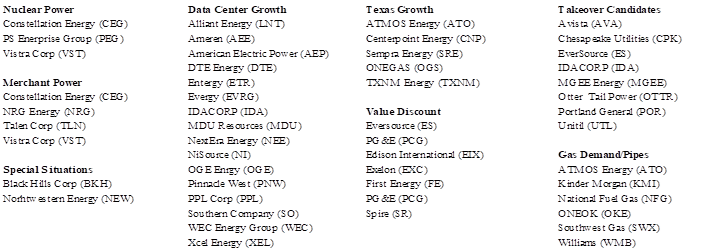
Exhibit 1 Stocks to Capitalize on By Theme
Macro Outlook: More Hawkish Fed; Focus on Price Stability
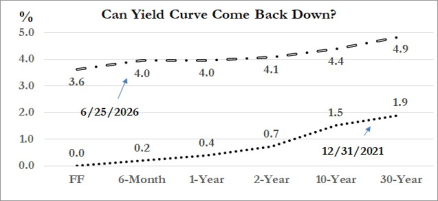
On June 17, 2026, the Fed unanimously kept its benchmark interest rate unchanged at 3.5% to 3.75%, but its outlook became more hawkish. The shift reflects stronger economic growth, a resilient labor market, and renewed inflation pressures stemming from higher energy prices related to the Iran conflict and increased investment tied to AI and data center development. The Fed began cutting rates in September 2024 and lowered rates six times before pausing in late 2025. However, supply chain disruptions, tariffs, geopolitical conflicts, and strong demand have reduced confidence that inflation will return to the Fed’s 2% target. As a result, the 10-year Treasury yield had risen to over 4.5% (currently 4.40%) in 2026, creating a headwind for interest-rate-sensitive sectors such as utilities. If a negotiated end to the Iran conflict holds, lower energy prices could ease inflation concerns and put downward pressure on Treasury yields, providing a supportive backdrop for utility stocks.
Exhibit 2 Ten Year Treasury Yield at 4.40% (was 4.18% at 12/31/2025)
The S&P Utility Sector – Middle of the Pack First Half 2026 Performance
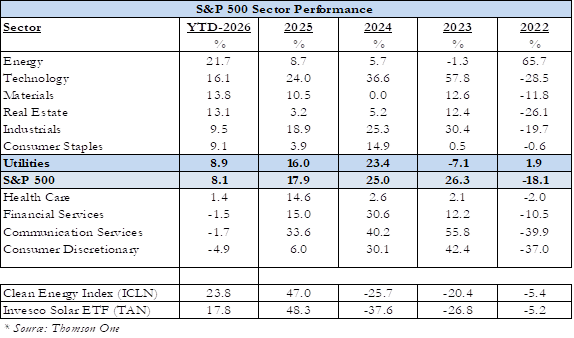
Table 2 highlights the utility sector’s stable and solid multi-year performance relative to the S&P 500 eleven sectors. Year-to-date 2026, the utility sector was the seventh (of 11 sectors) best and the fifth weakest as growth and cyclical sectors (Energy, Tech, Industrials) led more defensive sectors. The utility sector delivered double-digit returns in each 2024 and 2025, reflecting solid EPS growth but lagged faster-growing tech and cyclical sectors. Despite rising inflation and interest rates from 2022–2024, utility stocks continued to grow EPS and dividends at an accelerating pace. In 2025-26, clean-energy stocks outperformed strongly after several years of under-performance which we attribute to a better than anticipated outcome from the OBBB (tax credits through 2030) and recognition that renewables and battery storage will be a key part of meeting rising electric demand.
Table 2 Utilities Were Seventh Best (Fifth Worst) Sector in the First Half of 2026
Best Performing Utility Stocks Year-to-Date
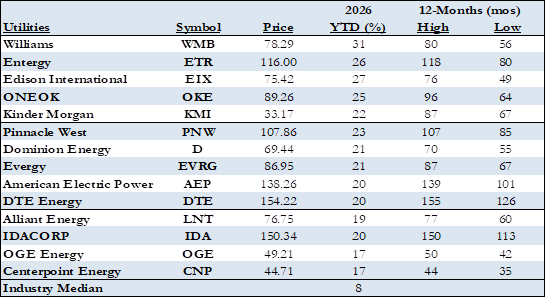
While most regulated utilities posted positive returns in the first half of 2026, natural gas pipeline companies and utilities with significant data center exposure were the best performers. In addition, Edison International (EIX) gained 23% as its shares recovered from the sharp decline following the January 2025 wildfires. ONEOK (OKE), Kinder Morgan (KMI), Williams and (WMB) benefited from renewed investor interest in natural gas, growing behind-the-meter data center opportunities, and an improving outlook for natural gas pipeline infrastructure development. Over the past two years, several electric utilities have raised their long-term EPS growth targets to reflect accelerating demand from large customers, including Entergy (ETR), NextEra Energy (NEE), American Electric Power (AEP), Evergy (EVRG), and CenterPoint Energy (CNP), while Pinnacle West (PNW) has highlighted the potential for faster growth. Dominion Energy also outperformed after agreeing to be acquired by NEE at a premium valuation. We believe higher EPS growth expectations will remain the primary driver of utility stock performance over the next several years and discuss this theme in more detail on page 5
Table 3 Best Performing Utility Stocks in First Half 2026
Worst Performing Utility Stocks Year-to-Date
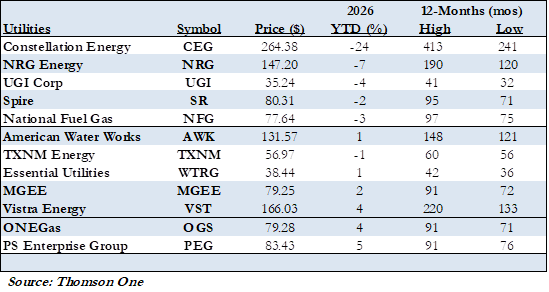
Some of the weaker performers were the non-utility independent power producers (see Table 4), including Constellation Energy (CEG), NRG Energy (NRG), and Vistra (VST), after leading the sector in 2024 and 2025. Investors have become more cautious as potential government intervention, new supply additions, and alternative power solutions for data centers could limit the duration of unusually high profit margins. The large swings between 12-month highs and lows also underscore the group’s elevated volatility. Utilities involved in mergers and acquisitions, such as Spire (SR), National Fuel Gas (NFG), and TXNM Energy (TXNM), also lagged, as did gas, water, and electric utilities with limited exposure to data center growth.
Table 4 Non-Regulated Merchant Power Companies Pull Back in First Half 2026
FIRST HALF DEVELOPMENTS AND SECOND HALF WATCH ISSUES
During the first half of 2026, several developments reinforced our constructive, though increasingly nuanced, utility investment thesis. Industry consolidation continued as Constellation completed its acquisition of Calpine, NextEra Energy agreed to acquire Dominion Energy in what would be the largest utility merger in history, and BlackRock Global Infrastructure Partners announced an agreement to acquire AES Corp. At the same time, we continue to closely monitor the evolving political and regulatory landscape as rising utility bills and the rapid growth in electricity demand from data centers prompt policymakers and regulators to reassess how future infrastructure investments and costs should be allocated among customers.
SIZE MATTERS: NEED TO BUY D (LARGEST EVER)
On May 18, 2026, NextEra Energy (NEE-88.27) announced an agreement to buy Dominion Energy (D-67.73) in an all-stock deal for ~$76 per D share (0.8138 NEE shares per 1 D share). Based in Richmond, VA, D is one of the nation’s larger regulated electric utilities serving 4.1 million customers in VA (2.8 million), South Carolina (1.3 million) and North Carolina. The company owns 30 GW regulated generation (3.5 GWs of regulated nuclear), the 2 GW non-regulated Millstone nuclear plant and 10,800 miles of transmission. NEE’s rationale for the acquisition is to further increase scale ($420 billion combined enterprise value), improve its regulated business mix (80%, from 70%) and improve power supply opportunities (adds D’s 51 GW data center pipeline to total 131 GW) to meet growing electric demand. The companies expect the approval process (VA, NC, SC, FERC and the NRC) to take 12-18 months.
The combination is expected to be immediately accretive and increase NEE’s long-term EPS growth to 9%+, supported by a more favorable regulated mix and meaningful multiple expansion from combining higher-growth NextEra (22x) with Dominion (16x). Dominion’s footprint in Northern VA—where data centers already represent 28% of electricity sales—provides direct exposure to one of the fastest-growing load centers in the U.S, including its 51 GW pipeline. The combined platform creates unprecedented size and scale as well as strengthens participation in PJM, where demand is expected to grow more than 5% annually.
On March 2, 2026, AES Corporation agreed to be acquired for $15 per share in an all-cash deal led by Global Infrastructure Partners and EQT Infrastructure, alongside CalPERS and Qatar Investment Authority. AES Corporation is a large global power company operating utilities and power plants in 14 countries, serving customers across the Americas, with about 32 gigawatts of generation capacity and a strong focus on expanding renewable energy, battery storage and long-term data center partnerships. The offer represents a ~13% discount to the prior trading close but a ~40% premium to the unaffected July 2025 share price, when takeover discussions first emerged. The transaction implies an enterprise value of $33.4 billion and a valuation of roughly 12.0x EV/EBITDA based on forward estimates. The transaction highlights increasing interest from large infrastructure investors in power and utility infrastructure and platforms.
On January 7, 2026, Constellation Energy (CEG) closed on the acquisition of Calpine (27 GW gas-fired capacity) for $29.1 billion ($4.5 billion cash, $16.4 billion stock, $12.7 billion assumed debt). Adjusted multiple: 7.9x 2026 EV/EBITDA. Calpine was previously taken private in 2017 by Energy Capital Partners for $17 billlion (9.1x EV/2017 EBITDA). The implication is that other smaller companies will consider opportunities to be part of a larger utility, including IDA, POR, OGE, AVA, MDU, OTTR, AQN, UTL, PNW, MGEE, and SWX.
HYPERSCALERS (MSFT, META, GOOG, AMZN) BUILDING MORE AND MAORE DATA CENTERS
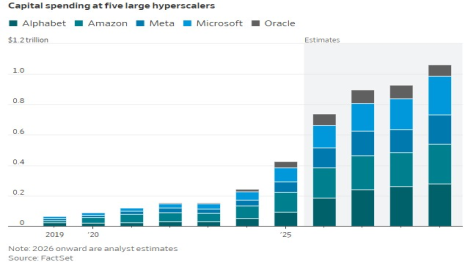
According to a June 2026 Wall Street Journal report, Microsoft, Alphabet, Meta Platforms, Amazon and Oracle collectively spent about $420 billion on capex in 2025 and are expected to increase 75% to $741 billion in 2026 primarily related to AI data center construction, GPU clusters, and compute expansion. On June 2, 2026, Alphabet raised its 2026 capital expenditure guidance to $180–$190 billion, more than doubling prior spending levels, and signaled that 2027 capex could increase further. The company also announced an $80 billion equity offering and a $10 billion private placement with Berkshire Hathaway to help fund its expansion. In February 2026, AMZN outlined plans for $200 billion in 2026. See Exhibit 3
Exhibit 3 Significant and Growing Hyperscaler Investment
DATA CENTERS GETTING BIGGER AND BIGGER (ETR-META Hyperion – 5 GWs)
On March 27, 2026, Entergy (ETR) announced a major expansion of Meta’s Hyperion data center development in Richland Parish, LA. The project totals $27 billion and could ultimately scale to 5 GW of data center load. Meta will fund a significant portion of the supporting infrastructure, including seven new gas-fired plants (5.2 GW), 240 miles of transmission, battery storage, nuclear uprates, and up to 2.5 GW of renewable energy. The agreement is expected to be materially accretive to ETR’s already strong “greater than 8%” EPS growth target and generate $2.65 billion of long-term customer savings.
ETR’s Meta agreement is one of several emerging 5+ GW AI infrastructure projects across the U.S., including OpenAI’s 10-GW Stargate initiative and Oracle’s Project Jupiter, signaling a fundamental shift from traditional hyperscale data centers to multi-gigawatt AI campuses that will reshape utility growth opportunities over the next decade. Not all data centers are being served by utilities because speed to market is important and regulatory delays (interconnection) force developers to find alternatives like the behind the meter power. On June 24, 2026, MSFT announced a 2.7 GW behind-the-meter (BTM) data center agreement in West Texas (Project Kilby). MSFT entered into a 20-yr PPA with Chevron. CHV will deploy 7 combined cycle natural gas plants, via the company’s partnership with GEV, and fueled by Permian Basin gas.
AFFORDABIITY AND POLITICAL INTERVENTION A CONCERN
Rising electricity costs have pushed affordability to the forefront of political and regulatory discussions, particularly in PJM, where sharp increases in capacity auction prices contributed to meaningful customer bill increases in 2024 and 2025. According to government data, electricity prices rose 6.7% from December 2024 to December 2025, compared with a 2.7% increase in the overall Consumer Price Index (CPI).
Higher bills reflect several factors, including inflation, rising infrastructure investment, supply constraints, and growing electricity demand—not simply data center development. In PJM, an undersupplied power market, slower-than-expected generation additions, and challenges connecting new resources to the grid have put upward pressure on wholesale power prices. The issue has prompted increased political and regulatory scrutiny in several states, including Pennsylvania, New Jersey, Maryland, California, and Indiana.
PENNSYLVANIA: On April 29, 2026, Governor Josh Shapiro sent letters to the CEOs of 24 Pennsylvania utilities outlining new expectations for future rate cases, including lower financing costs, greater transparency around infrastructure investments, and an end to “black box” settlements.. Over the past 18 months, Shapiro has expanded his involvement in energy policy, shifting from criticizing PJM and rising power costs to increasing oversight of regulated utilities, while simultaneously promoting AI, data centers, and advanced manufacturing projects that will require significant investment in power infrastructure. On June 23, 2026, the PA House unanimously passed a bill capping ROEs at the 10-year US Treasury yield plus 2%. At today’s UST 10Y yield, it would result in ROEs of about 6.65%. Most do not expect the bill to pass the Senate, but the proposal is concerning.
Historically, the PA PUC has been a constructive regulator and governors have played a limited role in utility oversight. However, Shapiro has argued that the state’s energy framework is “broken,” opposed large rate increases, proposed changes to ratemaking and allowed ROEs, publicly challenged PECO’s rate case, and intervened in UGI’s pending proceeding. While the PUC remains independent, the increasing scrutiny of utility capital spending, rate cases, and allowed returns, highlighting the tension between promoting economic growth and funding the infrastructure needed to support it. PA has become a more uncertain regulatory environment.
Table 5 PA Regulated Distribution Utilities
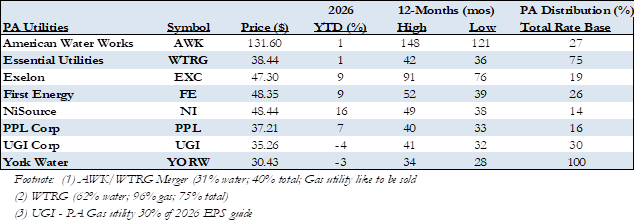
On June 18, 2026, the PaPUC voted 3-2, along party lines, to hold the benchmark ROEs for electric, gas and water at 10.05%, 10.25% and 9.75%, respectively. The benchmark ROEs are used for the quarterly distribution system improvement charge (DSIC) purposes.
On June 4, 2026, the PA PUC approved (5-0) PPL’s rate settlement authorizing a $275 million annual revenue increase (3.2% bill increase for residential customers) to be effective July 1, 2026. PPL agreed to a two-year stay-out but can adjust rates quarterly for investment under the DSIC at a 10.05% allowed ROE (upon reaching 5.0% revenue increase a new rate case must be filed). In addition, the settlement established a new large-load customer rate class (data centers) designed to protect existing customers (10-year minimum with binging commitments), including $11 million annually to subsidize low-income customers through a non-by-passable charge.
Given heightened public focus on affordability and Governor Shapiro’s recent pressure on utility rate requests, we consider the approval to be a welcome relief as it removes an overhang (although there is a 5-day period waiting period) and supports PPL’s growth outlook. However, we remain concerned about pending AWK, WTRG, and UGI rate cases.
The Ratepayer Protection Pledge:
On March 4, 2026, Amazon, Google, Meta, Microsoft, Oracle, OpenAI, and xAI signed a “ratepayer protection pledge” committing to ensure that data center growth does not increase electricity bills for households and small businesses. The agreement emphasizes that hyperscalers will pay their full share by funding new generation, covering grid infrastructure upgrades, and securing dedicated rate structures, aligning new demand with new supply. The ETR-Meta agreement (above) and NI-AMZN (discussed later) illustrate the customer-friendly utility-data center model in which hyperscalers fund much of the required infrastructure investment. The model is a win-win and benefits utilities through higher rate base and EPS growth while helping protect customer affordability by spreading fixed costs over a larger sales base.
Politicians Support New PJM Generation:
In January 2026, the White House, along with several Democratic governors, proposed a potential emergency intervention in the PJM capacity market to address rapidly rising electricity demand from AI data centers and electrification. The concept centers on a “Reliability Backstop Auction” designed to accelerate new generation and improve resource adequacy in PJM. Under the emerging framework, large-load customers such as hyperscalers would be required to directly contract for or fund incremental capacity through long-term agreements tied to new generation builds. Discussions through mid-2026 also include separate pricing and queue prioritization for large-load interconnections to ensure new demand is matched with dedicated supply. While not yet finalized, the policy direction reflects a shift away from broadly socialized capacity costs toward a more explicit “load-funded” expansion model.
US/Japan Announce $66B for ~19 GW of New Gas Generation: On March 19, 2026, the White House announced a $33 billion tranche of its $550 billion Japan–U.S. initiative. The second tranche would add ~9.5 GW of new power generation, including two gas plants—a $16 billion (~5.2 GW) plant in East TX and a $17 billion (~4.3 GW) plant in southwestern PA (linked to Marcellus/Utica supply and the PJM Interconnection grid). The plants would be built and operated by NextEra Energy and jointly owned by the US/Japan. This follows a separate $33 billion plan for a 9.2 GW gas plant in Portsmouth, OH led by SB Energy to support a 10 GW data center. Combined, the 13.5 GW in PA/OH represents ~7–8% of PJM capacity, while the Texas project is ~3% of ERCOT. The initiative also includes $40 billion for SMRs in TN and AL by GE Vernova and Hitachi (BWRX-300).
Year-end EPS Reports Higher and Guidance Tailwinds Indicate Higher for Longer
Over the past 12–18 months, nearly every earnings season has brought higher utility EPS growth targets, larger capital investment plans, and faster rate base growth as utilities secure new data center and other large-load customers. Most utilities have increased capital programs, with leading companies outlining double digit EPS growth.
- At its June 2026 Analyst Day, Entergy (ETR) formally extended its “greater-than-8%” EPS CAGR through 2035 but outlined 2025-2030 EPS numbers that result in a remarkable 13% EPS CAGR.
- American Electric Power (AEP)’s official long-term EPS target is 7-9% annually but expects to deliver greater than 9% through 2030.
- On May 19, 2026, Next Era Energy (NEE) announced its agreement to buy Dominion Energy (D-67.73-HOLD) and raised its EPS growth CAGR to 9%-plus (from 8%-plus) through 2035.
- NiSource (NI) targets 9-10% annual EPS CAGR over 2026-2033 (6-8% annual EPS CAGR over 2026-2030) as Amazon ramps from on Jan. 1, 2027, with load ramping to nearly 3 GW by the end of 2032.
- PG&E (PCG) affirmed its 9%+ EPS growth target for 2027–2030.
In Table 6, we show each utility’s formal management EPS CAGR targets and consensus EPS CAGR’s.
Table 6 Utility EPS Growth Rates At Historical Highs
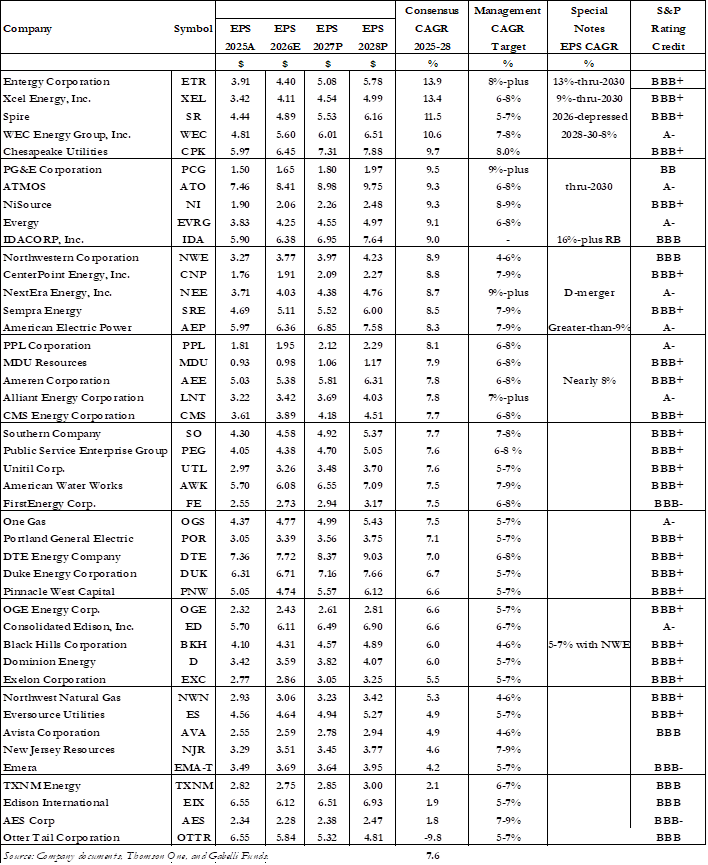
Many utilities are contracting substantial large-load pipelines to electric service agreements (ESA), positioning them for additional growth. Rate base growth now averages roughly 10% annually, ranging from about 7% to 16%. In 2025, electric and gas utilities delivered strong results, with median EPS increasing over 7% versus 2024 while many raised or reaffirmed long-term targets. Overall, the sector is undergoing a sustained step-up in growth, with consensus EPS CAGR expectations exceeding 7% through at least 2028 and visibility extending into 2030–2032, although execution and regulatory risks remain.
LIKE IT OR NOT: DATA CENTERS ARE COMING! MORE AND MORE!
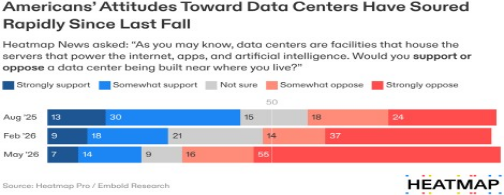
Long-term AI-driven electricity demand remains exceptionally strong, but data center development is facing growing opposition from local communities concerned about land use, water consumption, electricity costs, and grid reliability. In response, governments and regulators are implementing moratoriums, tightening permitting requirements, reducing tax incentives, and requiring developers to fund a larger share of transmission, generation, and water infrastructure costs.
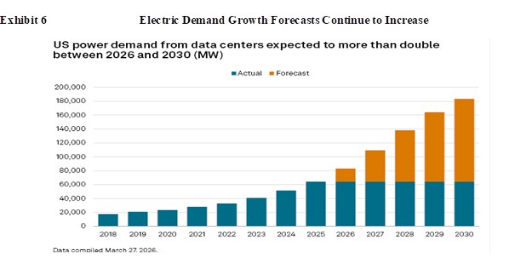
According to Heatmap Pro, over 20 data center projects representing $41 billion of investment and 3.5 GW of capacity were canceled during the first quarter of 2026 following significant public opposition. As a result, developers are becoming more selective about where they build, prioritizing access to reliable power, available land, streamlined permitting, and supportive regulatory environments over traditional advantages such as tax incentives, geography, or proximity to population centers.
This shift is creating a growing divide between data center “winner” and “non-winner” utilities. A utility’s ability to capture AI-driven growth is becoming increasingly dependent on its operating environment, including regulatory support, permitting efficiency, infrastructure readiness, and community acceptance. Utilities located in states that can quickly deliver power and approve projects are likely to capture a disproportionate share of future investment, while those facing lengthy approval processes, transmission constraints, and rising local opposition risk falling behind.
Exhibit 7 Data Center Backlash
Large Load Tariffs Designed to Protect Customers
To address concerns, state regulators and utilities are implementing “large load tariffs.” which are designed to protect customers and force the “large-load customers” to pay for system upgrades. Large-load tariffs (Premium rates for data centers) and long-term contracts are becoming increasingly important as utilities and regulators seek to protect residential customers from cost shifting by requiring data centers to pay for the infrastructure needed to serve their growing demand. Definitions of “large load” have increased, from around 5–25 MW a few years ago to 50 MW or more today, reflecting the much larger scale of modern data centers. These tariffs have a few key characteristics:
- Higher upfront costs: Large users pay for the grid upgrades (new transmission or substations) needed to serve them.
- Long-term commitments: Contract lengths and guarantees that the customer will pay for the power even if not used.
- Risk protection: If the project is delayed, scaled back, or canceled, the customer may owe fees or penalties.
- Operational requirements: Some include ramp-up schedules or incentives to reduce usage during peak times.
According to Smart Electric Power Alliance (SEPA), 77 large-load tariffs are now proposed or in place across 36 states. The database added 12 new tariff entries and expanded into three additional states since late 2025, highlighting the rapid nationwide adoption of policies designed to allocate data center infrastructure costs to large-load customers rather than residential customers. These tariffs are required to assure the public and the utility that rapid data center growth will not cause overall system rates to rise and ensure new large loads pay their fair share of grid costs.
Developers are seeking new locations that can energize projects quickly, while established markets continue to retain value because of fiber networks, connectivity, and proximity to large customer bases as well as to expand existing capacity. This shift is creating a growing separation between states positioned to attract AI infrastructure investment and those that could fall behind. Texas appears particularly well positioned given its pro-business environment, abundant land, and independent grid. Other attractive markets include Wisconsin, Iowa, Georgia, Louisiana, Missouri, Indiana, Arkansas, Mississippi, Wyoming, North Dakota, South Dakota, Ohio, and portions of the Carolinas. In contrast, some Northeastern states and parts of PJM are facing greater regulatory scrutiny, transmission constraints, and local opposition that could slow development.
Utilities operating in states with abundant generation, available transmission capacity, supportive regulators, and efficient permitting processes are likely to capture a disproportionate share of future growth, while utilities in jurisdictions with lengthy approval processes, uncertain regulations, and growing opposition risk becoming relative losers in the AI buildout.
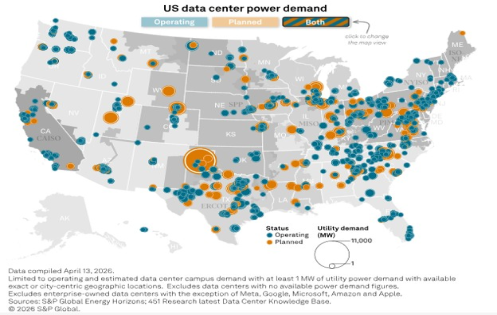
Exhibit 8 Huge Data Centers Scheduled for 2026-2027
BOTTOMS UP-UPDATE: DATA CENTER/LOAD GROWTH UTILTIES
From a bottoms-up perspective, we highlight several of the faster-growing utilities, bigger data center announcements and more significant backlogs, including AEP and PPL’s 56 GWs and 29 GWs. Given the affordability narrative, utilities more clearly stated hyperscalers are funding growth and some like NI, ETR, and SO note direct customer benefits. Many utilities extended strong EPS growth visibility though 2030 as large loads ramp capacity higher.
ENTERGY (ETR)- Outlines “13% EPS Growth” (2025-30)-Mega-Data Centers (META, GOOG, AMZN)
At its 6/9/2026 Investor Day, ETR extended its “greater-than-8%” EPS CAGR through 2035 (was 8%-plus from 2025- 2029). And outlined 2026-30 EPS guidance: 2026E: $4.25-4.46; 2027E: $4.90-5.20; 2028E: $5.55-5.85; 2029E: $6.25-6.55; 2030 EPS: $7.05-7.35 ($7.20 mid-point). The numbers imply 2025-2030 EPS CAGRETR’s 2025 rate base CAGR rose to ~16% and grows from $46 billion (2025) to $97 billion by 2030. ETR’s service area of LA, AR, MS, and TX benefits from favorable fossil fuel policies, gas infrastructure, gulf ports, available land and constructive politics. ETR’s 5-year retail sales growth is 9% CAGR (16% industrial CAGR; 50% industrial increase in 5 years).
On March 27, 2026, ETR announced of a major expansion of its Meta (META) Hyperion data center development, which now totals $27 billion and could sale up-to-5GW in Richland Parish, LA. Meta is funding the full infrastructure buildout, including ~5.2GW of new gas generation, 240 miles of transmission, storage, nuclear upgrades, and up to 2.5GW of renewables. ETR is arguably the sector’s biggest data center beneficiary and secured massive deals with Meta, Google, and Amazon. Amazon plans a $10 billion MS facility, and Google plans at least a $4 billion campus in Arkansas.
AMERICAN ELECTRIC POWER (AEP) – Greater Than 9%- EPS CAGR Through 2030; More on 3Q Call?
AEP’s official long-term EPS target is 7-9% annually but expects to deliver greater than 9% through 2030 driven by a $78 billion capital program (potentially $10 billion more), which results in 11% rate base CAGR. AEP’s pipeline of large load opportunities totals an enormous ~190 GWs (current peak demand is 37 GWs) with ~63 GWs of contracted load in its plan by 2030. AEP’s core growth states are TX, IN, OH, and OK where it expects growth to ramp higher beginning in 2028. Contracted customers include GOOG (IN, WV), Amazon (LA, OH), MSFT (IN), META (OK), Stargate (TX), SB Energy (OH), Cheniere (TX) and NUCOR (WV). AEP is the nation’s largest transmission owner (44,000miles) with significant 765kV buildout and has secured over 10 GWs of gas fired turbine capacity from major manufacturers. AEP more focused on transmission interconnections forecasts $16 billion in cost offsets for existing customers over the life of its contracted large load contracts.
NEXTERA ENERGY (NEE) – Mega-Merger Leads to 9%-Plus EPS CAGR;
NEE expects its pending acquisition of Dominion Energy (D-67.73-HOLD) to be immediately accretive and increase its EPS growth CAGR to more than 9% (from more than 8%) through 2035. At announcement, NEE traded at $93.36 (21.7X 2027 EPS of $4.30) versus D at $61.73 (16.2X 2027 EPS of $3.80), allowing the favorable valuation gap (22X versus 16X) to drive pro forma accretion. NEE also expects to improve D’s 5-7% EPS growth through operational efficiencies and expanded power supply opportunities. NEE is widely regarded as one of the industry’s strongest operators, with expertise in renewables, gas, nuclear generation, battery storage, and could accelerate Virginia data center development while helping meet the state’s requirement for 4 GW of battery storage by 2030. The acquisition also provides access to the PJM market, where peak summer demand could grow more than 5% annually over the next decade, driven largely by hyperscale data centers. NEE has relationships with major data center customers, including Google and Meta, targets 15 GW of data center hubs by 2035 with upside to 30 GW, and has identified 30 potential hubs totaling about 60 GW. In 2025, NEE signed a 25-year power purchase agreement with Google tied to restarting the Duane Arnold Energy Center nuclear plant, expected to return to service in 2029, while also evaluating small modular reactors at existing nuclear sites. D is a top-five nuclear operator, and the combination strengthens the potential for a disciplined nuclear growth strategy.
NEE plans to develop 77-108 GW through 2032, including 40-56 GW of renewables, 32-43 GW of storage, 4-8 GW of gas, and 600 MW of nuclear generation, while benefiting from renewable tax credits through 2030. Planned additions include 20-27 GW of renewables and storage during 2026-2027, 25-35 GW during 2028-2029, and 32-46 GW during 2030-2032, including 4-8 GW of gas. We believe part of this pipeline could be directed to Northern Virginia and PJM opportunities. On March 19, 2026, the White House selected NEE to build and operate about 9.5 GW of new generation, including a $16 billion, 5.2 GW gas plant in East Texas and a $17 billion, 4.3 GW gas plant in southwestern Pennsylvania connected to Marcellus and Utica gas supplies and the PJM grid. The projects would be jointly owned by the United States and Japan.
DOMINION ENERGY (D) D targets 5-7% EPS CAGR from 2025-2030 (with a bias to upper half 2028-30) and is currently the largest data center provider in the US (with ~7 GW in service). Data centers represented 28% of D’s Virginia electric sales in 2025, and its pipeline totals 51 GW, including 10.4 GW under electric service agreements, 11.1 GW under signed construction agreements, and 29.5 GW in substation engineering studies. It emphasized that data center-driven load growth in Northern Virginia shows no signs of slowing with over 11-GW’s contracted and 51 GW’s in queue. Dominion 5-year capital plan to $64.7 billion.
AMEREN (AEE) Third Quarter Guide Up Coming? (Amazon & Google = $25 billion)
On its upcoming October 2026 third quarter call, we expect AEE to raises/extend its EPS outlook. Recent electric service agreements (ESA’s) represent tailwinds to AEE’s to nearly 8% EPS CAGR. AEE’s 2026 EPS guidance is $5.25-5.45 and long-term growth is driven by the $60 billion (5-year) capital program and 10.6% rate base CAGR. AEE has added to its potential rate base growth further supporting long-term EPS growth at the upper end of its 6-8% CAGR target. In 2026, AEE has executed 2.8 GWs (600-MWs since February) of large load electric service agreements (ESAs) in MO, signed an additional 2.2 GW of large-load customers and secured $700 million of new MISO transmission projects.
On June 15, 2026, Amazon announced plans to develop a $10 billion data center campus in Montgomery County, MO Amazon and will pay for 100% of the costs to provide electric service, including all costs with connecting to the energy grid. On May 20, 2026, the MO Governor’s office announced that Google plans to build a $15 billion data center campus in Montgomery County, MO under an ESA with AEE. Under Missouri SB 4, Google will fund 100% of power and incremental infrastructure costs tied to its operations. Google has contracted for over 1 GW of new generation in MO, while AEE is developing an additional 500 MW. AEE’s guidance assumes 1.2 GW of new MO demand by 2030 and annual MO sales growth CAGR of 6.2%. The 2.8 GWs of executed ESAs represents upside to current sales and earnings forecasts. Beyond signed ESAs, the company maintains a strong pipeline of large-load opportunities. AEE-MO has 3.4 GW of construction agreements (including ESAs), while Ameren Illinois has 850 MW.
WEC ENERGY GROUP (WEC)-Third Quarter Guide Up Coming-
WEC targets an above-average long-term EPS CAGR of 7-8% (upper half 2028-2030) with 2028-2030 annual electric demand growth forecast to 6.0-8.0%, from 0.7% in 2025. Over 2026-2030, WEC expects to add 3.9 GW (45% of current peak load) of electric demand resulting in 2028-30 sales growth of 6-8% per annum (retail electric sales grew 1.1% in 2025. The April PSCW approval of large-load tariffs allows WEC to earn a 10.48-10.98% ROE (57% equity) on data center infrastructure investment. WEC plans to serve the $20 billion MSFT data center (2.6 GW) on 2.5 acres in Mt Pleasant, WI (Phase one $3.3 billion-early 2026/Phase 2-$4 billion scheduled for 2027) and the $8 billion Vantage Data Centers (1.3 GW) data center (Oracle) on 1,900 acres in Port Washington, WI. The Port Washington data center could reach full capacity of 3.5 GW, but 1.3 GW is planned for 2029 with the first phase 1 on-line in 2027. By 2030, 15% of asset base will be to serve large-load customers. On its upcoming third quarter 2026 call, WEC expects more announcements and noted that the existing “data-center-approved” acreage could be expanded by another 4-5 GW (1 GW is $2.0-2.5 billion).
PINNACLE WEST (PNW) – More than Data Centers in the “Silicon Desert”; TMSC $165 billion Fab Facilities
PNW targets 5-7% annual EPS CAGR driven by 1.5-2.5% customer growth, and 5-7% long-term sales growth (4-6% is C&I customers). The Phoenix AZ metropolitan area continues to attract semiconductor manufacturing, data centers, and other advanced industries. The AZ utility plans to add 4.5 GW of large-load capacity by 2030, with an additional 20 GW of projects in the interconnection queue. Taiwan Semiconductor Manufacturing Company (TSMC) is investing $165 billion across six fabrication plants, two packaging facilities, and an R&D center, supporting an estimated 70,000 jobs. The region—often referred to as the “Silicon Desert”—is also emerging as a major data center hub, with projects including Meta’s Mesa campus, Google’s new Mesa facility, 5C Data Centers’ 140,000-square-foot Phoenix site (2025), a $20 billion campus in Buckeye, and Vermaland’s planned $33 billion data center park along the Phoenix–Tucson corridor.
By 2028, APS plans to add nearly 7.3 GW of new resources to support rapid demand growth. This includes development of the 2 GW Desert Sun gas generation plant in Gila Bend, AZ, with Phase 1 targeted for late 2030. Energy Transfer’s Transwestern Desert Southwest gas pipeline expansion is expected to enter service in 2029, with Desert Sun serving as an anchor shipper.
CENTERPOINT ENERGY (CNP) – Texas Continues to Grow Gangbusters
CNP targets 7-9% EPS CAGR through 2035 (high-end over 2026-28) driven primarily by Houston load growth and higher capital investment (11% rate base CAGR). Houston Electric has secured 12.2 GW of committed industrial load and expects 8 GW of data center demand (including 3.5 GW under construction) to be energized by 2029. Peak load in the Houston service territory is projected to increase 50% to ~31 GW by 2029 and reach 42 GW by 2035. Growth is driven by diversified demand across residential (~2% annual growth), data centers, advanced manufacturing, life sciences, logistics, energy exports, and electrification of the Port of Houston (more than a dozen customers and nearly 20 projects). The company estimates $4 billion of customer savings over the next decade from scale benefits associated with load growth. Additional investment opportunities, including downtown Houston redevelopment, are not yet included in the current capital plan. In Indiana, CNP expects a single large-load project in its Southern Indiana service territory that would represent the largest customer in that region and could generate incremental growth while providing approximately $250 million in customer savings.
SOUTHERN COMPANY (SO) Georgia On My Mind; 10% Sales CAGR; 75-GW Large-Load Pipeline;
SO targets long-term EPS growth of 7-8% (8-9% EPS growth through 2028). Strong growth is driven by 9% rate base growth from its $81 billion 5-yearcapital plan and strong load growth. Over 11 GW of contracted large load customers and is finalizing another 6 GW of additional agreements (and another 6 GW in late stages) in near term across eight projects in Alabama and Georgia. Over 75 GW of prospective large load pipeline provides robust opportunity for continued progress. The utility forecasts 10% sales growth in 2026-30 and 13% in GA over same period. In addition, SO expects to add at least 10 GW of new generation. SO has rate freezes (AL 2026-27) and GA (2026-28).
NISOURCE (NI) 9-10% annual EPS CAGR over 2026-2033; AMZN Provides Big Cost Savings
NI targets 9-10% annual EPS CAGR over 2026-2033 (6-8% annual EPS CAGR over 2026-2030) based on 9-11% annual rate base CAGR over 2026-2033 (8-10% annual rate base CAGR over 2026-2030). NI ‘s 2026-2030 capital plan totals $28.6 billion capital, including $7.6 billion at the non-regulated Genco (generation company). NI formed a non-regulated GENCO designed to serve mega-load customers, including a mega Amazon data center. NiSource begins serving Amazon on Jan. 1, 2027, with load ramping to nearly 3 GW by the end of 2032. GenCo will build two 1,300-MW, combined-cycle gas plants and 400 MW of battery storage.
In addition, AMZN will pay a system charge under the special contract which will return $1.4 billion (raised from $1.25 billion/$124 per annum) to existing customers. NIPSCO residential customers are expected to receive a monthly bill credit beginning in 2027, reaching $7-9 per month in 2033. On the first quarter call, NI added a 300-MW GOOG contract (commences will in the summer of 2026 and ramps to full demand by 2030). NI (via GENCO) has signed ~4 GW of large load capacity, actively negotiating another 3 GW and is in discussion with 2 GW of opportunities in its pipeline by 2035.
XCEL Energy (XEL) – Winning in the Midwest; More to Come
XEL remains confident in its ability to deliver 6% to 8-plus percent long-term EPS growth and expects to deliver 9% EPS growth on average through 2030. XEL raised its target to “6-8%-Plus” EPS, from “6-8%” to reflect 11% rate base growth driven by a $60 billion 2026-30 capital plan (with $10 billion upside) to support 20 GWs of data center pipeline, including 2 GW under construction and 6 expected by 2027. XEL highlights that 1 GW datacenter is equal to 1 million customers, ~ 3 GWs of renewable and firm dispatchable energy, $6-8 billion of investment requirement, $0.9-1.0 billion of incremental revenues and 10% customer savings.
IDACORP (IDA) – Boom Town Boise
IDA does not provide EPS growth targets but expects an industry-leading 16.7% rate base CAGR 2026-30. The most recent integrated resource plan (IRP) affirmed a 5-year retail sales CAGR of +8.3% (annual peak +5.1%), but growth will likely be higher. IDA management explained that the pipeline of prospective customers (incremental to the IRP) exceeds IDA’s record peak load of 3,800 MW’s. Micron is undergoing a major expansion of its Boise HQ’s and new $15 billion microchip fab facility and has plans for a second fab facility of equal size. Other new customers include a Meta data center, $415 million Lamb Weston potato processing facility, Chobani expansion and $225 million Tractor Supply facility.
First quarter 2026 industrial sales rose 5.7%, driven by capacity ramps at Micron and Meta. Management also noted that its ability/capacity to serve is maxed out and customer requests exceed the current 3,800 MW system peak. The 2026-30 capital budget totals $7.1 billion (2025-29 was $5.8 billion), exclusive of resources to be procured through upcoming 2028–2029 request-for-proposals process. The company’s regulated rate base is projected to more than double from $5.3 billion in 2025 to $11.3 billion by 2030, supported by annual capital outlays of roughly $1.4 billion. The current plan excludes 2032 RFP wins and some later-stage pipeline projects.
PPL CORP (PPL) – PA Distribution Utility With 10-GW ESA’s; More to Come?
PPL targets 6–8% annual EPS growth through at least 2029, with performance expected near the upper end of the range from 2027–2029 driven by rate base growth from rising PA and KY data center demand, along with a new JV with Blackstone to develop long-term contracted, non-regulated gas power plants in PA. In PA, PPL operates in a favorable energy environment, sits on the Marcellus/Utica shale, and benefits from rising demand in the PJM market. PPL-PA has a 28.3 GW advanced-stage data center pipeline, including 10 GW energy service agreements (ESAs) and 5 GW under construction, along with a $3.5 billion manufacturing investment from Eli Lilly in Allentown. In Kentucky, PPL has a 12.9 GW development queue (2026–2032), including 11.9 GW of data center requests and manufacturing projects (Toyota, Foxconn, GE, and Anthro Energy). PPL-KY’s updated forecasts call for ~3.5 GW of new load by 2032, requiring new generation capacity. PPL’s 2026–2029 capital plan totals $23 billion (vs. $20 billion previously), including $4.3 billion in 2025, and supports 10.3% rate base growth through 2029.
EVERGY (EVRG) – Kansas City’s Chief Customers Include GOOG, META & Panasonic
EVRG’s long-term EPS growth target is 6%-8%+ from the 2026 midpoint of $4.24 and expects EPS growth to exceed 8% during 2028-2030. EVRG signed 5 large-load ESAs to five agreements totaling 2.5 GW under Large Load Power Service (LLPS) rates including Google, Meta, Beale Infrastructure, and Panasonic. The incremental pipeline totals 11.5-13 GW, including 1.5-3.0 GW with secured land rights and initial agreements under review. Two existing customers also have expansion opportunities of 1.0-1.5 GW. Management expects at least one additional large-load ESA by year-end. EVRG electric load growth forecast is now 8%-9% over 2026-2030. EVRG expects large-load demand additions of 350-400 MW in 2026, 700-800 MW in 2027, 1,250-1,350 MW in 2028, 1,750-1,850 MW in 2029, and 2,050-2,250 MW in 2030. Peak large-load demand is expected to reach approximately 3 GW. To support this growth, the company is expanding transmission and generation resources.
At year-end, EVRG increased its 2026-2030 capital plan to $21.6 billion and raised expected rate base CAGR to 11.5%. Management indicated additional increases (12% rate base with EPS CAGR 250-basis points lower) are likely on the year-end 2026 call. Rate base is expected to grow from $20.7 billion in 2025 to approximately $36 billion by 2030. EVRG is developing three gas plants totaling 1,860 MW scheduled for 2029-2031 and three solar projects totaling 325 MW planned for 2027-2028. The company is also evaluating an additional 2,100 MW of generation for 2029 and beyond. Its 2025-2035 integrated resource plan (IRP) includes 6,600 MW of future generation additions, including additional gas capacity in the early 2030s. Management expects to update the IRP during the second quarter to reflect higher projected load growth.
ALLIANT ENRGY (LNT) ) Iowa is proving to be data center hub
LNT affirmed its ‘5-7%-plus’ long-term EPS CAGR as well as its expectation to earn 7%-plus EPS growth 2027-2029. LNT continues to advance 3 GW (4 projects) of contracted data center load, which represents over a 50% increase from 2025 peak load (5.5 GW) through 2031 and ~11% electric sales 2025-31 CAGR. Construction on the first three large data centers is underway and demand ramps between 2027-2030. The Big Cedar Industrial Center Mega-site in Cedar Rapids, Iowa will house the two mega-data centers for QTS and Google while the Meta (260-370-MW) complex is on 500 acres in Beaver Dam, WI. Further, LNT remains in active negotiation for an additional 2-4 GWs and has various development-ready sites throughout Iowa. The 2026-2029 capital expenditures to $13.4 billion, including $4.1 billion for gas generation (1.6 GW new gas and 400 MW increased capacity), $5.0 billion for renewables (1.3 GW’s of wind/solar and1.0 GW of batteries) and $4.3 billion for electric and gas distribution. LNT expects 12%-plus rate base CAGR ($16.9 billion rate base in 2025 to $26.5 billion in 2029).
DTE ENERGY (DTE)
DTE expects the top-end of the 6-8% EPS growth target through 2030 and rate base growth of ~8%+, Anchor data center customers include ORCL (1.4 GWs) and GOOGL (1.0 GWs)
BLACK HILL CORP (BKH) Wyoming is also a data center region
The pending NWE merger is progressing toward the second half of 2026 close. Managements expect the combination to be EPS accretive in the first year following the close and support an increased long-term EPS target growth rate to 5-7% (NWE targets 4-6% EPS CAGR). Black Hills views Wyoming, particularly Cheyenne, as an emerging AI data center hub. Management continues to advance a 1.8 GW hyperscale project expected to enter service in early 2028, has secured more than $200 million of customer-funded equipment deposits, and is pursuing advancing plans to serve its 3 GW data center pipeline, including 600 MW by 2030 driven by MSFT’s ongoing expansion and Meta’s new AI data center to be served with minimal capital investment through its Large Power Contract Service tariff in Cheyenne, WY. BKH expects the data center EPS contribution to represent greater than 10% of consolidated EPS in 2028. We are paying attention to the Crusoe-Tallgrass 2 GW (could scale to 10 GW) data center development in eastern WY, which could be a material driver for BKH future growth as well as make them a takeover candidate.
RECORD INVESTMENT (RATE BASE GROWTH) LEADS TO EPS GROWTH UPDATED
Over 2026–2030 period, electric and gas utility capital expenditures will likely continue to rise at near double-digit rates driven by a significant build-out of new generation and transmission capacity to meet continuing data center growth as well as grid reliability and resiliency and the need to connect to new resources. For the 2026–2030 period, aggregate energy utility spending for 46 companies tracked by Regulatory Research Associates (RRA) is forecast at a record $1.295 trillion, versus $1.169 trillion in its December 2025 forecast.
Exhibit 9 Record Capital Investment
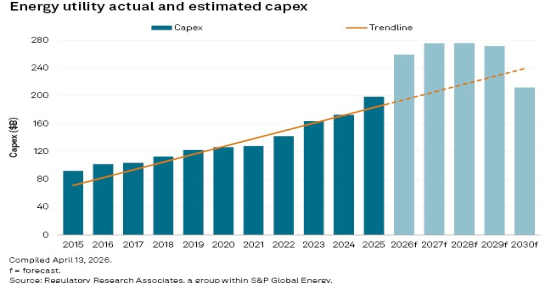
In 2026 and 2027, S&P Global Market Intelligence projects utility capital expenditures will rise 30% to $259.1 billion ($227.8 billion) and another 6% to $275.6 billion ($233 billion), respectively, with continued growth over the next decade driven by rising demand and the need for new baseload generation. Capital spending for this peer group of 44 North American electric utilities increased 15% nominally in 2025 compared with the same period in 2024.
Full-year 2025 capex is projected to rise 19% year over year (16% real) to $215 billion, up from $173 billion in 2024, $164 billion in 2023, and $146 billion in 2022, implying a 10.5% three-year CAGR. This represents a sharp acceleration from the 7% nominal (4% real) CAGR of the prior decade, which was driven by climate policy, net-zero targets, fossil-fuel retirements, renewable development, infrastructure replacement, disaster recovery, and grid hardening. More recently, utilities have pushed capital budgets and rate base growth to historic highs to meet surging demand, including long-term power contracts with mega-cap technology companies for AI data centers that can consume energy at the scale of small cities. The larger utility capital plans are listed below:
Nearly 70% of North America’s grid infrastructure is more than 25 years old (DOE), driving investment in system replacement, renewable mandates, modernization, and weather resilience. Investment spans all major areas of the system, including distribution (33%), generation (24%), transmission (20%), gas-related infrastructure (14%), and other (8%).
AND MORE EQUITY ISSUANCES
Regulated utility rate base growth occurs when infrastructure investment outpaces depreciation, requiring ongoing external financing. Credit rating agencies account for utilities’ monopoly service territories, regulatory protections, and their public-good role. The industry’s average parent-level credit rating has remained at BBB+ since rising from BBB in 2014, reflecting strong access to capital. Utilities typically fund capital programs through a mix of operating cash flow, debt, and equity—often including forward and convertible equity issuance. These issuances are accretive when executed above book value and when regulators permit returns on the invested capital.
MORE RATE CASES TO SUPPORT HIGHER CAPEX-MEDIAN ROE 9.7%
With record investment, a utility’s ability to grow earnings increasingly depends on how its state’s Public Utility Commission (PUC) regulates rates—and whether the utility is given a fair opportunity to earn its authorized return on equity (ROE). With mid-term elections coming later this year, 36 states and the District of Columbia will be conducting gubernatorial elections in 2026, while legislative elections will be held in 46 states and Washington, DC. Because PUCs are political bodies, rate decisions are shaped not only by financial metrics but also by public pressure to keep customer bills affordable. To help evaluate this dynamic, we provide a Regulatory Research Associates (RRA’s) ranking of electric and gas rates across utilities (Appendix and Exhibit 17), along with an assessment of how constructive each state’s regulatory environment is—specifically, how effectively it supports utilities in earning their allowed ROE.
Exhibit 10 State PUC Rankings – AL, FL, GA, PA Constructive; CT, MD Not So Much
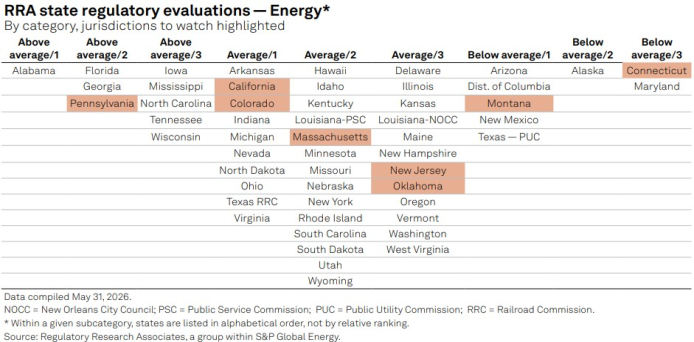
In 2026, RRA raised the ranking of California regulation to Average/1 from Average/2 (improving treatment of incremental wildfire liabilities) and raised Arizona’s to Below Average/1 from Below Average/2, reflecting constructive recent rate case decisions and implementation of previously approved generic rules for alternative ratemaking plans. RRA lowered the ranking of Montana regulation to Below Average/1 from Average/3 and Alaska regulation to Below Average/2 from Below Average/1 due to the absence of innovative or proactive developments.
We are concerned about PA, which has historically been a very constructive state, as well as NJ, CT, MD, and IN. In PA, NJ, and MD, recent PJM power capacity auction have resulted in affordability issues. Other items to watch include CA wildfire legislation, Hawaii regulatory reform, and New Jersey (Governor Sherrill campaigned on lower utility bills and named new NJ BPU President).
Exhibit 11 State PUC’s With Potential To Change
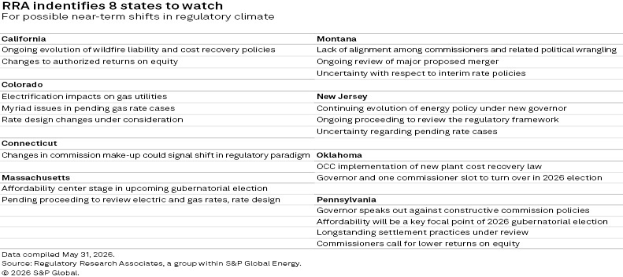
NEW JERSEY: Utility affordability became a major political issue under Governor Mikie Sherrill, who took office in January 2026. Her administration has focused on lowering electricity costs by expanding in-state power generation, accelerating energy infrastructure projects, and modernizing energy policies. She has emphasized that New Jersey cannot reduce costs without adding more generation, including solar, battery storage, and nuclear power, while also promoting AI and data center development. At the same time, the New Jersey Board of Public Utilities (NJBPU) has begun reviewing utility regulation, including performance-based ratemaking, multi-year rate plans, and allowed ROEs, which could lead to greater scrutiny of utility returns and cost recovery mechanisms. Sherrill has also stated that large-load customers should bear more of the infrastructure costs needed to serve them to help protect residential customers.
CONNECTICUT: Connecticut’s regulatory environment has become somewhat more constructive following the departure of former PURA Chair Marissa Gillett, but Governor Lamont’s increased focus on utility affordability continues to create uncertainty. High electricity prices have intensified scrutiny of utilities, including Eversource and United Illuminating, and the state has challenged certain utility returns, including a FERC transmission incentive. Eversource’s pending electric distribution rate case will be an important test of the new PURA leadership. While the regulatory environment may be less adversarial than in recent years, affordability has become a major political issue, increasing scrutiny of capital spending, storm cost recovery, and future earnings growth opportunities.
CALIFORNIA: Following the 2025 Los Angeles wildfires, CA policymakers are debating how to strengthen and expand the state’s wildfire liability framework and whether the existing Wildfire Fund has sufficient resources to absorb future losses. State leaders have discussed increasing the fund by roughly $18 billion, with costs shared between utilities and customers, while also expanding financing tools for wildfire mitigation and grid investments. At the same time, utilities continue to invest billions of dollars annually to harden the grid, underground power lines, and reduce wildfire risks. CA has some of the highest electricity prices in the country, driven by wildfire mitigation spending, grid investments, clean energy mandates, and programs that shift costs onto utility bills. In February 2026, Governor Newsome appointed new leadership at the California Public Utilities Commission (CPUC) with an explicit mandate to focus on affordability and consumer protection. Utility returns and the cost of capital are also under pressure. In December 2025, the CPUC approved lower authorized returns on equity (ROEs) for 2026-2028 for the state’s largest utilities. Authorized ROEs were set at 9.98% for PG&E, 10.03% for Southern California Edison, 9.93% for San Diego Gas & Electric, and 9.78% for Southern California Gas, all below prior levels and consistent with national trends. Regulators have emphasized balancing investor needs with customer affordability and maintaining access to capital needed to fund grid modernization and wildfire mitigation investments.
First Quarter 2026 ROE Decisions Trend Down
In recent years, rate case activity for investor-owned electric and gas utilities in the US has been elevated. RRA anticipates this surge in rate case activity will continue, as elevated interest and inflation rates and the need for significant capital expenditures show no signs of abating. Moreover, additional expansion is expected to come from rising data center demand. Together, these factors will likely heighten pressure around growing affordability concerns.
Exhibit 12 In 2026, Allowed ROE’s Averaged 9.71% Compared to 9.84% in 2025
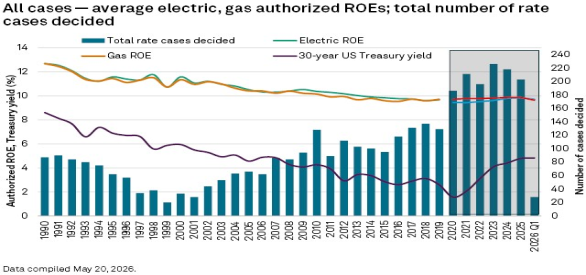
According to calculations by RRA, the overall average authorized return on equity (ROE) for electric utilities was 9.71% (11 decisions) in rate cases decided in the first quarter of 2026, below the 9.84% (86 decisions) average for full year 2025. There were 11 electric ROE authorizations in the first quarter of 2026 versus 86 in full year 2025. Gas utilities was 9.63% in rate cases decided in the first quarter of 2026, below the 9.87% in rate cases decided in full year 2025. There were seven gas ROE authorizations in the first quarter of 2026 versus 68 in full year 2025.
Exhibit 13 PUC’s Reluctant to Raise Profits Despite Higher Treasury Yields
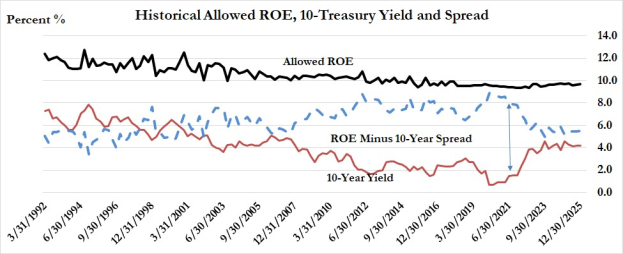
Source: S&P Global; RRA; US Treasury
Authorized returns have generally followed the overall direction of interest rates, with a lag. However, the magnitude of the year-over-year change in authorized ROEs is generally much smaller than interest rate changes. Between 1990 and 2020, interest rates declined faster than authorized ROEs leading to a widening spread between authorized ROEs and the average yield on 30- year US Treasurys. This spread increased from just over 400 basis points in 1990 to nearly 800 basis points in 2020 when rates were near 1.0%. Since 2020, allowed ROE’s have ticked up modestly, but regulators are more reluctant to raise profit levels given affordability issues. The current spread is 540 basis points (9.7% vs 4.3%).
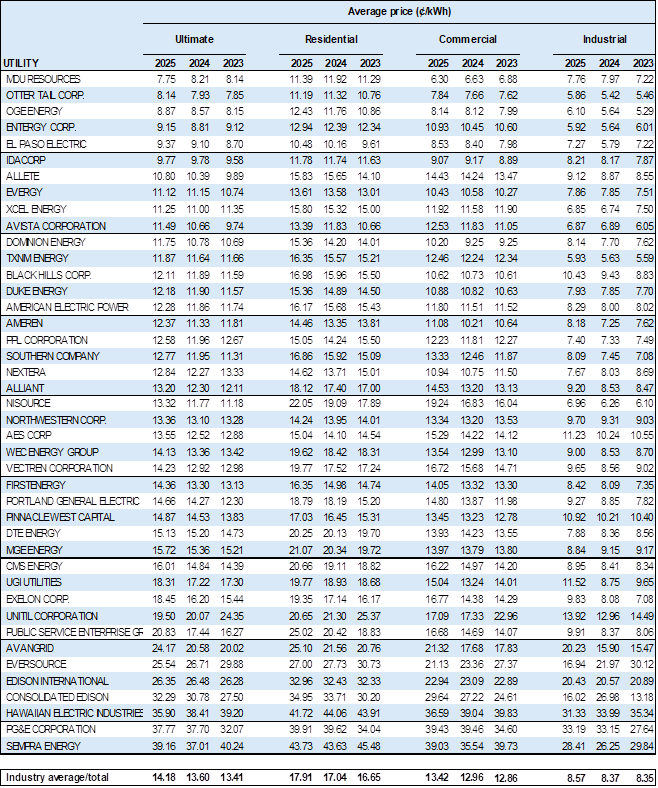
Affordability Becomes a Political Issue But More So in Some States Than Others
In Table 8, RRA ranks the publicly-traded electric utilities from lowest ultimate (or average retail) rate per kWh. MDU Resources is the lowest cost retail provider and Otter Tail is the lowest-cost residential provider followed by OGE, ETR, AVA, IDA, and EVRG. All tend to serve rural population centers and benefit from low-cost hydro or gas generation
Table 8 Ranking Electric Utilities by Affordability
Utility and Energy Infrastructure Becoming More Valuable!
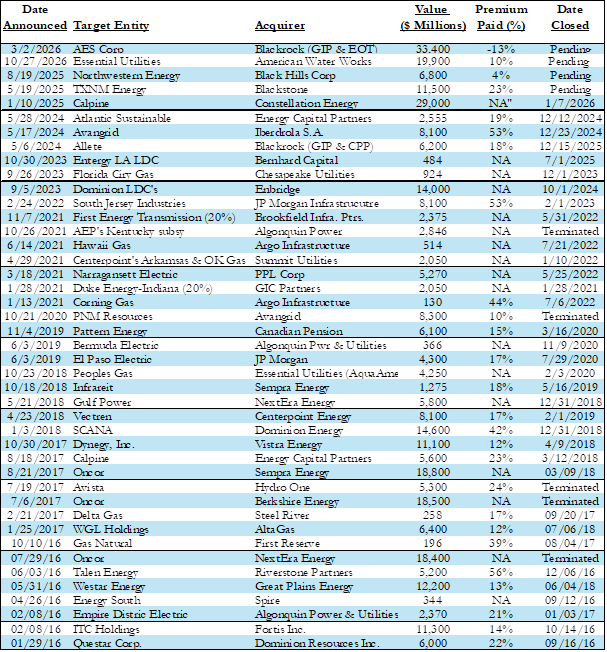
Consolidation is driven by higher capital investment budgets and economies of scale, as accelerated energy demand and decarbonization create double-digit rate base growth and require significant debt and equity issuance. Smaller utilities with limited balance sheets need partners to finance larger projects. Large global infrastructure players see acquisitions as a way to access valuable existing assets and participate in growth.
Many large private equity funds, including Blackrock (owns Global Infrastructure Partners) highlight infrastructure as one of the most exciting investment opportunities owing to structural shifts, including de-carbonization, energy independence, domestic industrial capacity and on-shoring. Given accelerated power demand, energy infrastructure, (power generation, renewables, transmission, gas pipelines) has become increasingly valuable and development opportunities abound. Some recent announcements:
Table 9 Utility Consolidation Over the Past 10-Years
Source: Company reports, Gabelli Funds
Recent Announcements:
- DOMINION ENERGY: On May 18, 2026, NextEra Energy (NEE-88.27-HOLD) announced an agreement to buy Dominion Energy (D-67.73-HOLD) in an all-stock deal for ~$76 per D share (0.8138 NEE shares per 1 D share). Based in Richmond, VA, D is one of the nation’s larger regulated electric utilities serving 4.1 million customers in VA (2.8 million), South Carolina (1.3 million) and North Carolina. The company owns 30 GW regulated generation (3.5 GWs of regulated nuclear), the 2 GW non-regulated Millstone nuclear plant and 10,800 miles of transmission. NEE’s rationale for the acquisition is to further increase scale ($420 billion combined enterprise value), improve its regulated business mix (80%, from 70%) and improve power supply opportunities (adds D’s 51 GW data center pipeline to total 131 GW) to meet growing electric demand. The companies expect the approval process (VA, NC, SC, FERC and the NRC) to take 12-18 months.
- AES CORP: On March 2, 2026, AES Corporation agreed to be acquired for $15 per share in an all-cash deal led by Global Infrastructure Partners and EQT Infrastructure, alongside CalPERS and Qatar Investment Authority. The offer represents a ~13% discount to the prior trading close but a ~40% premium to the unaffected July 2025 share price, when takeover discussions first emerged. The transaction implies an enterprise value of $33.4 billion and a valuation of roughly 12.0x EV/EBITDA based on forward estimates. The transaction highlights increasing interest from large infrastructure investors in power and utility infrastructure and platforms.
- ALLETE (ALE): On December 15, 2025, GIP and Canada Pension Plan Investment Board acquired ALE for $67/share (18% premium to May 5, 2024 closing price), or $6.2B including debt. ALE owns and develops renewables and transmission assets
- BLACK HILLS CORP/NORTHWESTERN ENERGY: On August 19, 2025, Black Hills Corp. (BKH) and NorthWestern Energy (NWE) announced an all-stock merger of equals (0.98x exchange, 4% premium). The combined utility will serve 2.1M customers across eight contiguous states, double rate base to $11.4B ($7.0B electric, $4.4B gas), and target 5–7% long-term EPS growth. The deal, expected to close in 12–15 months pending shareholder and regulatory approvals, highlights renewed sector consolidation after slowing during COVID and rising interest rates. Both stocks traded at discounted multiples due to wildfire risk and limited data center exposure, but scale and synergies are increasingly critical.
- TXNM ENERGY: On May 19, 2025, TXNM Energy agreed to be acquired by Blackstone Infrastructure for $11.5B ($61.25/share, 23% premium), at 11.8x EV/EBITDA, 20.4x 2026 EPS, and 1.8x rate base.
- CALPINE: On January 7, 2026, Constellation Energy (CEG) closed on the acquisition of Calpine (27 GW gas-fired capacity) for $29.1B ($4.5B cash, $16.4B stock, $12.7B assumed debt). Adjusted multiple: 7.9x 2026 EV/EBITDA. Calpine was previously taken private in 2017 by Energy Capital Partners for $17B (9.1x EV/2017 EBITDA).
The implication is that other smaller companies will consider opportunities to be part of a larger utility, including IDA, POR, OGE, AVA, MDU, OTTR, AQN, UTL, PNW, MGEE, and SWX.
Utility Stocks Trade at Reasonable Valuations
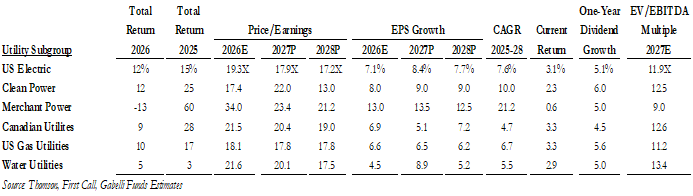
We believe the utility EPS growth supported by capital investment in utility infrastructure (rate base) thesis has considerable runway given electric demand growth through at least 2030 and the challenges bringing new supply on-line. We also believe many electric and gas utility stocks will benefit from the infrastructure build out with above historical average EPS and dividend growth. In addition, their defensive characteristics could appeal in the event of an economic slow-down. Please see Table 12 for Utility Subgroup Metrics and appendix for more utility stock financials.
- Electric utility valuation multiples have declined from 23x forward earnings in early 2020 and trade at 17.9X 2027 earnings estimates. Over the past twenty-five years, utility forward multiples have ranged between 10x and 23x earnings with a median of 16.8x.
- Independent Power Producers (IPPs), or merchant power companies, are highly leveraged to potential supply shortages. IPPs/merchants own power plants in non-regulated power markets, including PJM (Northeast/MidAtlantic), ERCOT (Electric Reliability Council of Texas), and CA, and provide marketing/power management services to customers. In 2023-25, the share prices of CEG, NRG, VST and TLN rose dramatically and driven by electric power demand and power shortages. After roughly 30% pull-backs from extraordinary stock price and EBITDA/EPS growth in 2024-2025, the sector trades at ore reasonable EV/EBITDA multiples of ~8.0X.
- Gas utility performance reflects improved investor sentiment and ongoing consolidation but likely does not reflect potential increased gas demand. Gas utilities currently trade at 17.8x 2027 earnings estimates.
- Water utility two-year under-performance reflects the impact of higher interest rates on higher multiple stocks. Water utilities trade no longer trade at the highest multiples and are more attractively valued than they have been in recent years. They are unique investments due to their scarcity, small size, takeover premium, ESG value, and long-term growth potential through consolidation and
- Canadian electric and gas utilities have lower growth rates and higher current returns, but Fortis, Emera and Algonquin have more assets and earnings power in the US than Canada. Canadian provincial regulatory environments are more challenging (lower allowed ROEs and equity ratios) than many US utility jurisdictions.
Table 10 Utility Subgroup Statistics
Valuation
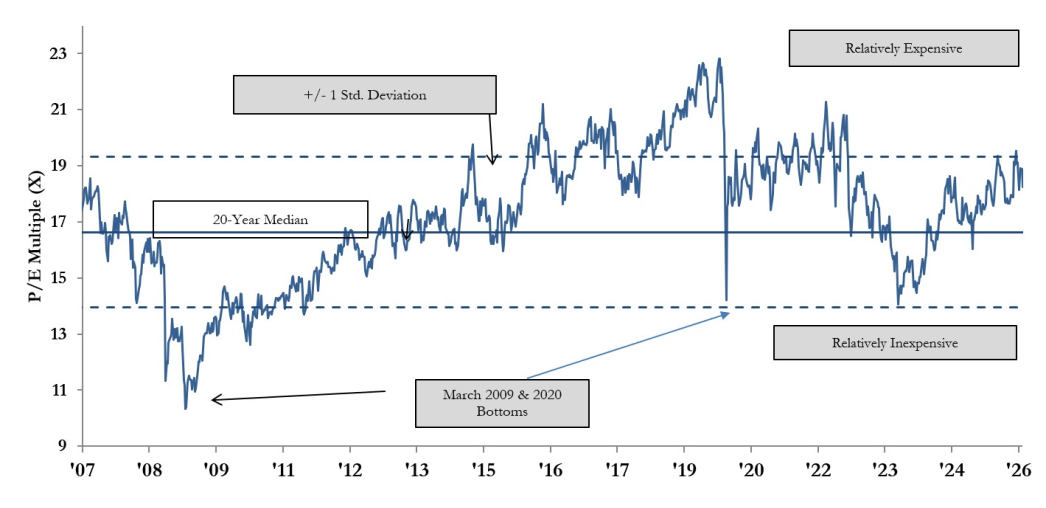
Over the past twenty years, electric utility multiples climbed from roughly 10x forward earnings to over 23x, driven by improving fundamentals, higher growth rates and lower interest rates from 2000-2022 (Exhibit 20). Electric utilities trade at ~18.0x consensus forward earnings estimates which is above (but near) the historical median (16.8x).
Exhibit 14 Absolute P/E Multiple Range Near Historical Median Despite Stronger EPS CAGR
Source: Thomson One, Company documents
Interest Rates and the Fed
Utility stocks are not bond proxies, and share prices are a function of earnings and dividend growth rates, but higher (lower) rates negatively (positively) impact stocks, given that future cash flows are impacted by the discount rate. In addition, current utility dividend returns become less compelling when returns on other investments increase, including Treasury yields. Short-term Treasuries yield 3.5-3.75% and US Treasuries hold even greater defensive appeal than utilities. The factors below mitigate the negative impact of higher rates.
- Annual dividend hikes: Utilities target annual dividend increases, which serve to mitigate the negative impact of higher rates. In 2025, electric utilities increased the annual dividend by a median of 5.4%.
- ROE is set based on interest rates: A utility’s cost-of-capital, including equity returns (ROEs), is set by state PUCs and increases (decreases) as interest rates rise (fall).
- Annual riders minimize inflation risk: State PUCs and FERC regulatory principles have improved to include more frequent rate adjustments, which mitigate inflation risk.
- Utility stocks pay higher dividends than other sectors: The present value of a higher near-term dividend stream is less impacted by changes in interest rates than a lower near-term dividend stream.
While utility dividend yields and 10-year U.S. Treasury yields are highly correlated and will likely remain so in the future, utility dividends have risen over time (most on annual basis) while the Treasury yield remains fixed. Utility stock prices, unlike Treasury bond prices, are likely to rise should earnings and dividends grow over time.
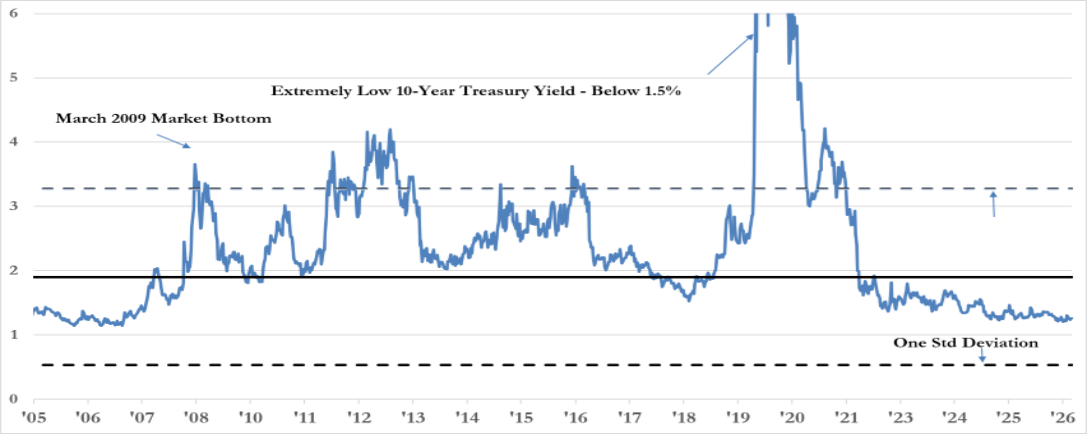
We consider the multiple attractive given higher utility earning growth rates and strong fundamentals. Given that long-term interest rates (specifically the 10-year Treasury yields) have risen to 4.40% following a long-term secular decline since the late 1980’s, we measure the earnings yield (1/P/E) as a percentage of the 10-Year T- Bond Yield to gauge interest rate adjusted valuations. As can be seen in Exhibit 21 the current ratio of 129% indicates the sector P/E is modestly higher than its historical median relationship (190%) with the 10-Year T-Bond Yield
Exhibit 15 Utility Earnings Yield as a Percent of 10-Year T-Bond Yield (near Historical Median)
Source: Thomson One, Company documents
Conclusion
Over the next five years, the electric demand visibility is strong as large-scale data centers continue to ramp through phased buildouts, supporting sustained load growth and increased utility capital investment. This is driving higher earnings power across the sector, with limited perceived counterparty risk given the financial strength of hyperscalers such as Microsoft, Meta, Amazon, and Google, as well as chip manufacturers. Utilities have effectively secured high-quality customers and are now entering an execution phase, with the current build cycle expected to run through 2026–2029 before transitioning to the next wave of investment. Many utilities are positioned to sustain strong EPS growth. Affordability challenges are more acute in deregulated regions exposed to wholesale price volatility, whereas traditional regulated utilities continue to benefit from data center-driven demand growth and maintain their role as defensive investments. The utility sector offers a 3.3% current return and many utilities managements target 6-8% annual earnings and dividend growth. The utility business model represents a safer haven in the face of an economic slowdown, geopolitical issues, tariffs and/or inflation fears. We believe that the combination of strong utility fundamentals, and the potential for accelerated electric demand bode well for the relative performance of utilities.
Appendix 1 Electric Utilities Selected Statistics
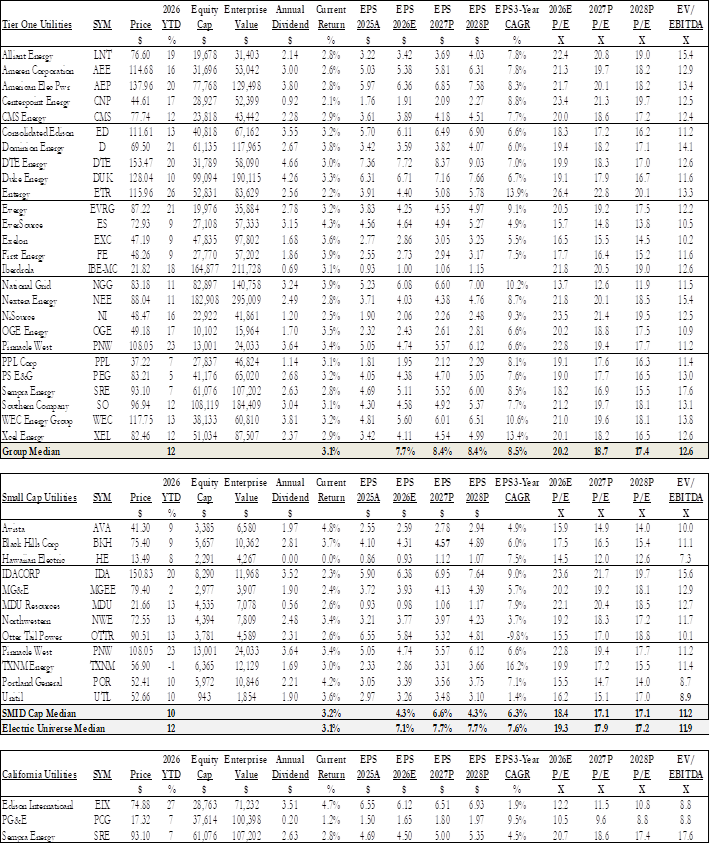
Source: Public data, Gabelli Funds estimates
Appendix 2 Canadian, Gas & Water Utilities Selected Statistics
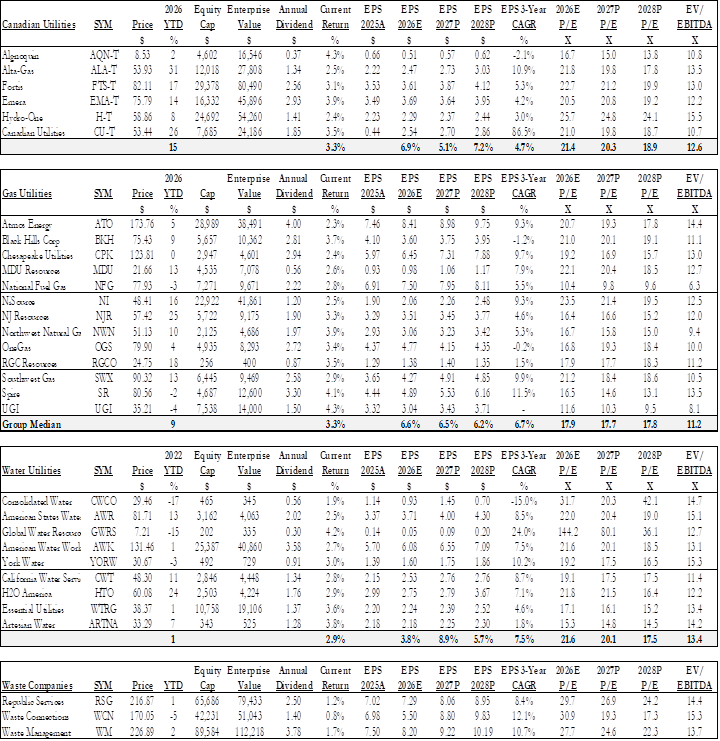
Source: Public data, Gabelli Funds estimates
Appendix 3 Merchant Power, Clean IPP, Midstream and Utility Construction Selected Statistics
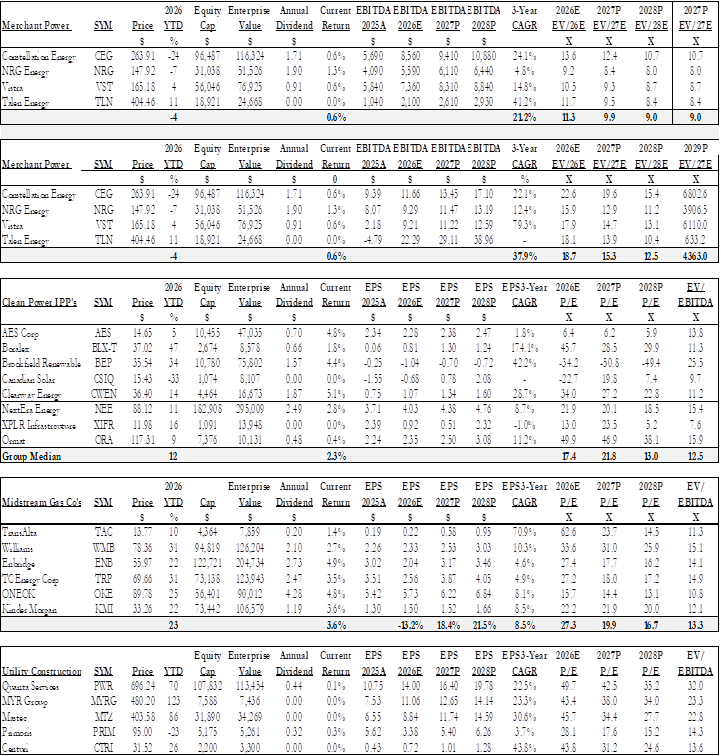
Source: Thomson One
249 ROYAL PALM WAY, PALM BEACH, FL 33480 Gabelli Funds L (561) 671-2100
This whitepaper was prepared by Timothy M. Winter, CFA. The examples cited herein are based on public information and we make no representations regarding their accuracy or usefulness as precedent. The Research Analysts’ views are subject to change at any time based on market and other conditions. The information in this report represent the opinions of the individual Research Analysts’ as of the date hereof and is not intended to be a forecast of future events, a guarantee of future results, or investments advice. The views expressed may differ from other Research Analyst or of the Firm as a whole.
As of March 31, 2026, affiliates of GAMCO Investors, Inc. beneficially owned 7.13% of RGC Resources, 3.98% of National Fuel Gas, 2.44% of Southwest Gas, 2.10% of Northwest Natural, 1.80% of TXNM Energy, 1.29% of York Water, and less than 1% of all other companies mentioned.
Funds investing in a single sector, such as utilities, may be subject to more volatility than funds that invest more broadly. The utilities industry can be significantly affected by government regulation, financing difficulties, supply or demand of services or fuel and natural resources conservation. The value of utility stocks changes as long-term interest rates change
Investors should carefully consider the investment objectives, risks, charges and expenses of the Fund before investing. The prospectus, which contains more complete information about this and other matters, should be read carefully before investing. To obtain a prospectus, please call 800 GABELLI or visit www.gabelli.com
Returns reprsent past performance and do not guarantee future results. Current performance may be lower or higher than the performance data quoted. Investment return and principal value will fluctuate so, upon redemption, shares may be worth more or less than their original cost. To obtain the most recent month end performance information and a prospectus, please call 800-GABELLI or visit www.gabelli.com
Distributed by G.distributors, LLC., a registered broker dealer and member of FINRA.
This whitepaper is not an offer to sell any security nor is it a solicitation of an offer to buy any security.
For more information, visit our website at: www.gabelli.com or call: 800-GABELLI
914-921-5000 • Fax 914-921-5098 • info@gabelli.com
Gabelli Funds, LLC is a registered investment adviser with the Securities and Exchange Commission and is a wholly owned subsidiary of GAMCO Investors, Inc. (OTCQX: GAMI).