State of Power Demand: Full Steam Ahead
Capital Investment Super-Cycle
EPS (And Dividends) GROWTH
US Utilities – State of Power Demand: Full Steam Ahead
In 2025, the S&P 500 Utilities Index returned 16.0%, modestly trailing the S&P 500’s 17.9% gain and the NASDAQ’s 20.4% return. Most companies in the regulated utility universe generated positive total returns, with a median return of 15%.
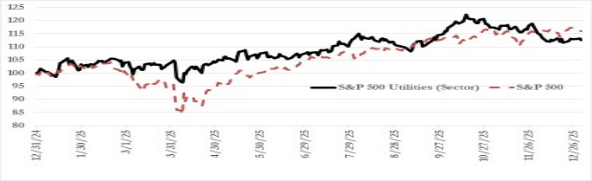
Utilities outperformed early in the year, as their defensive characteristics provided protection amid tariff uncertainty and recession concerns. As trade tensions eased and economic data strengthened in the second and third quarters, the sector shifted from defense to offense, supported by accelerating AI-driven power demand. By October 15, 2025, utilities had delivered nearly 25% year-to-date returns, outperforming both the broader market and the NASDAQ. Independent power producers led the sector but exhibited rising volatility, reflecting uncertainty over whether tight supply and elevated power prices can persist should AI demand moderate or government intervention increase. From October 15 through year-end, the sector pulled back roughly 7% as investors reassessed the risk of an AI-driven bubble, affordability pressures, and interest-rate uncertainty. We view these concerns as sentiment-driven overhangs rather than fundamental threats. The scale and durability of load growth are underpinned by well-capitalized hyperscalers and long-term structural trends.
Table 1 Utility Indices Vs. S&P 500 and NASDAQ: Playing Offense and Defense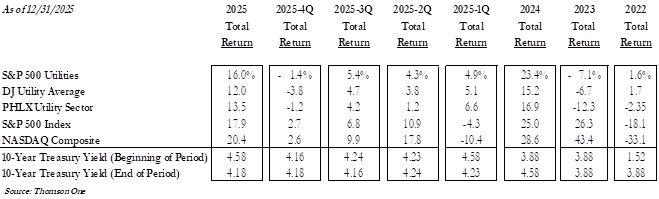
Looking ahead, we see electric and gas utilities positioned to deliver EPS growth above historical averages, driven by rising power consumption, accelerating rate base growth, and constructive policy. U.S. electricity demand appears increasingly likely to inflect higher from 2026–2032, led by AI-intensive data centers and supported by diversified end-market demand. Utilities are responding with record capital investment, often partnering with hyperscalers such as Amazon, Microsoft, Meta, and Alphabet to secure long-duration power supply. Many utilities are now selecting from waiting lists of large customers seeking to locate within their service territories, underscoring the depth and durability of demand. Higher consumption also allows fixed infrastructure costs to be spread across a broader base, helping mitigate affordability concerns. As a result, the utility investment thesis remains compelling.
Performance Driven By Fundamentals (And Some New Investors)
Exhibit 1 illustrates the defensive performance of utility stocks during the “Liberation Day” market decline, as well as their strong performance through October 15, 2025. We attribute a portion of both the strong gains and the late-year pullback to the AI-driven investment theme, which broadened investor interest but also drew momentum- and growth-oriented traders into a sector traditionally dominated by conservative income and retail investors. In our view, the resulting increase in volatility and the fourth-quarter correction reflect shifting sentiment among these more short-term investors rather than any deterioration in underlying utility fundamentals.
Exhibit 1 2025 S&P Utility Stock Performance Versus S&P 500
Source: Public data
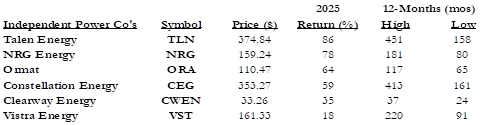
While most regulated utilities generated a positive total return (15% median), the non-utility independent power producers (see table 2) led the broader sector (second year in a row) owing to positive exposure to power supply-demand imbalances and non-regulated power prices. In 2025, Talen Energy (TLN-358.5), NRG Energy (NRG) and Constellation Energy (CEG) delivered outsized gains. The wide range in 12-month highs and lows exemplifies the volatility of these non-utility power producers.
Table 2 Independent Power Producers Strongest Performers
Source: Public data
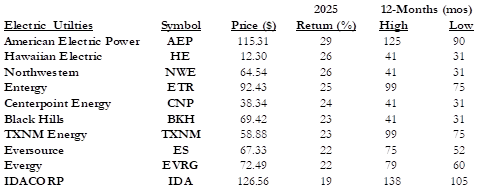
In 2025, the best performing traditional electric utilities were those that raised EPS growth rates, including AEP, ETR, and CNP or highlighted the prospect of higher EPS growth (EVRG and IDA). TXNM, BKH, NWE outperformed due to positive reactions to merger activity, Finally, recovering previous period underperformers, HE and ES, provided strong returns. We believe higher EPS growth profiles will continue to drive the sector over the next several years and discuss this on page 5.
Table 3 Traditional Utilities That Raised EPS CAGR’s or Merged Also Strong
Source: Public data
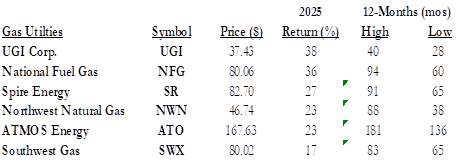
Gas utilities outperformed the regulated electric utility group led by UGI Corp (UGI), which completed a strategic review, and National Fuel Gas (NFG), which benefits from higher natural gas prices. The rising importance and support for natural gas helped boost the performance of the gas utilities.
Table 4 Gas Utilities Benefit From Policy Support and Sentiment Improvement
Source: Public data
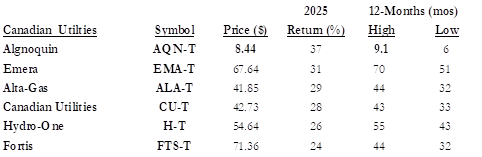
In addition, Canadian utilities outperformed the US regulated electric utility group led by turnaround story, Algonquin (AQN).
Table 5 Canadian Utilities Outperform US Utilities
Source: Public data
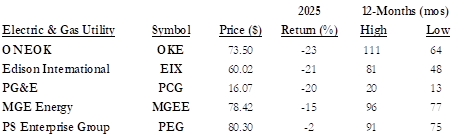
The California electric utilities, specifically PCG and EIX, under-performed as investor confidence in the state’s wildfire liability fund weakened following the destructive January 2025 wildfires. Although lawmakers enacted near-term measures and committed to pursuing a more permanent solution in 2026, concerns over future catastrophic wildfire risk continue to weigh on sentiment. Affordability concerns also impacted utility stock performance, including PEG, as utility bills became a focal point in the November 2025 gubernatorial campaigns in New Jersey and Virginia, where winning candidates highlighted rising electricity costs as a key issue.
Table 6 California Utilities Underperform
Source: Public data
The S&P Utility Sector Performance
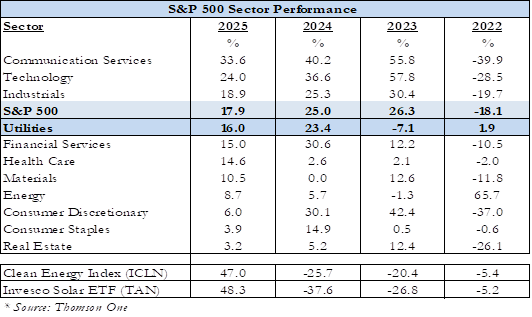
Table 7 highlights the utility sector’s stable and solid multi-year performance relative to the S&P 500 eleven sectors. Utilities delivered double-digit returns in each 2024 and 2025, reflecting solid EPS growth but lagged faster-growing tech and cyclical sectors. In 2024, the S&P Utility Index returned 23.4% and was influenced by outsized gains from non-regulated IPP’s CEG, VST and NRG. In 2022, the utility sector was one of two sectors to generate a positive return (S&P 500 down -18%). The sector was the worst performer in 2023 (-7.1%) as the interest rate/inflation outlook remained elevated, recession fears faded, and growth sectors rebounded. Despite rising inflation and interest rates from 2022–2024, utility stocks continued to grow EPS and dividends at an accelerating pace. In 2025, clean-energy stocks outperformed strongly after several years of under-performance which we attribute to a better than anticipated outcome from the OBBB (tax credits through 2030) and recognition that renewables and battery storage will be a key part of meeting rising electric demand.
Table 7 S&P 500 Sector Performance Compared to Utilities and Clean Energy
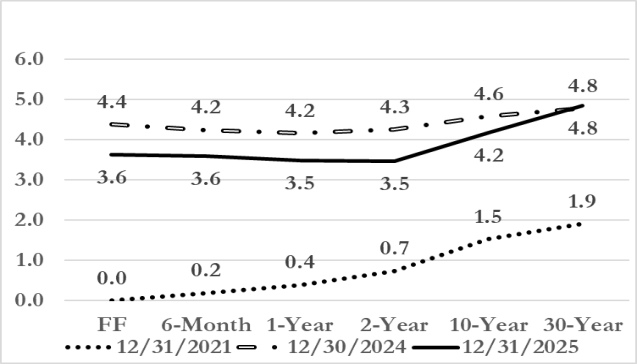
On December 9, 2025, the Federal Reserve lowered its overnight rate 25-basis points for the third time in 2025 (September, October and December) and finished the year at 3.50-3.75% (from 4.25-4.5%). The 10-year U.S. Treasury yield declined from 4.58% at the end of 2024 to 4.18% on September 30, 2025. A lower yield curve supports utility valuations, lowers financing costs, and provides rate relief to customers.
Exhibit 2 US Treasury Yield Curve Falls Modestly: Much Higher Than 2021
Appraisal
Our favorable utility stock outlook anticipates the sector’s ability to deliver historically strong EPS growth, with recent stock price volatility driven by sentiment rather than fundamentals. U.S. power demand growth is increasingly evident as utilities sign large-load customers, secure approval for higher capital plans, expand rate bases, and raise long-term EPS targets. Supportive federal and state policy and ongoing consolidation reinforce durable earnings growth and the scarcity value of regulated utilities. While concerns around affordability, AI overbuild, and counterparty risk are valid, demand already exceeds utilities’ capacity to serve it, leaving ample room for above-historical growth even with some moderation. As projects move from announcement to construction, utilities are mitigating risk through specialized tariffs and long-term contracts, while higher consumption spreads fixed costs across a broader base. The dynamics support long-term annual total return potential of 8-11% or higher (3.3% dividend current return plus 5-8% EPS growth).
TAILWINDS OF HIGHER SALES, CAP_EX, RATE BASE CAGR’S = HIGHER EPS GROWTH
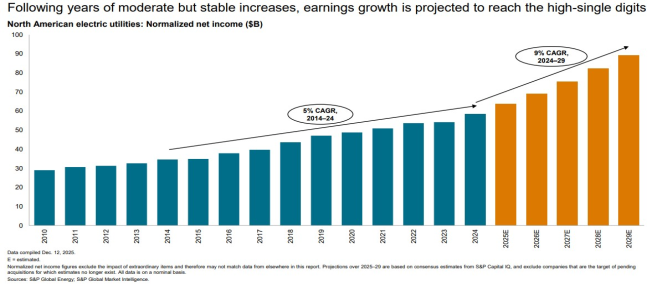
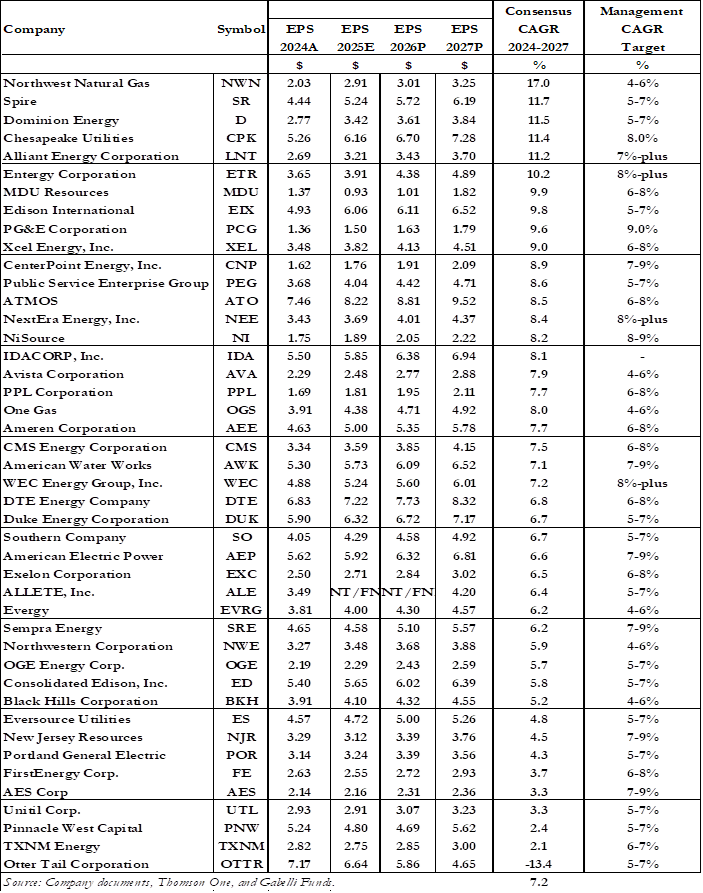
As of December 31, 2025, most utilities guided to annual EPS growth of 5–7% or 6–8%, 7–9% and a few more conservative at 4–6%. These growth rates far exceed historical utility norms (1990–2020) and reflect a decade-long acceleration in capital investment and rate base expansion. In 2025 and during the third-quarter earnings season (late October/early November), several utilities raised long-term EPS growth targets, while others highlighted the potential for stronger growth pending finalization of large-load contracts.
Exhibit 3
Current EPS CAGR targets are distributed as follows:
- 4–6%: 5 utilities (including BKH and NWE; merger target of 5–7%)
- 5–7%: 14 utilities
- 6–8%: 9 utilities
- 7–9%: 10 utilities (including CPK at 8%, ETR at “8%+,” and PCG at “at least 9%”)
Utility management teams typically provide conservative EPS guidance given regulatory and political sensitivity to customer affordability. The principal risk to accelerated rate base and EPS growth is execution, including planning, financing and building as well as continued regulatory support for timely cost recovery amid affordability concerns. That risk is increasingly mitigated by rising electricity demand. Consensus estimates (Thomson One) project a median sector EPS CAGR above 7% from 2024–2027, reflecting continued rate base expansion and strengthening demand fundamentals.
Table 8 Historically High EPS CAGRs; Who Could Go Higher?
RECORD INVESTMENT (RATE BASE GROWTH) LEADS TO EPS GROWTH UPDATED
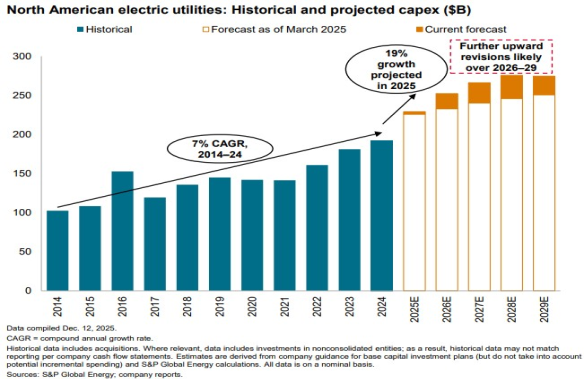
In 2026 and 2027, S&P Global Market Intelligence projects utility capital expenditures will rise to $227.8 billion and $233 billion, respectively, with continued growth over the next decade driven by rising demand and the need for new baseload generation. Capital spending for a peer group of 44 North American electric utilities increased 15% nominally in the first three quarters of 2025 compared with the same period in 2024.
Full-year 2025 capex is projected to rise 19% year over year (16% real) to $215 billion, up from $173 billion in 2024, $164 billion in 2023, and $146 billion in 2022, implying a 10.5% three-year CAGR. This represents a sharp acceleration from the 7% nominal (4% real) CAGR of the prior decade, which was driven by climate policy, net-zero targets, fossil-fuel retirements, renewable development, infrastructure replacement, disaster recovery, and grid hardening. More recently, utilities have pushed capital budgets and rate base growth to historic highs to meet surging demand, including long-term power contracts with mega-cap technology companies for AI data centers that can consume energy at the scale of small cities.
Beyond 2025, company guidance implies a 7% nominal (5% real) capex CAGR through 2029, though these estimates will likely rise as investment plans are finalized and regulatory approvals obtained. Nearly 70% of North America’s grid infrastructure is more than 25 years old (DOE), driving investment in system replacement, renewable mandates, modernization, and weather resilience. Transmission rate base for 79 U.S. electric utilities rose 7.6% to $185.14 billion in 2024 up from $172.02 billion in 2023, rebounding after two years of slower growth. Investment spans all major areas of the system, including distribution (33%), generation (24%), transmission (20%), gas-related infrastructure (14%), and other categories (8%).
Exhibit 4 Record Capital Investment
AND MORE EQUITY ISSUANCES
Regulated utility rate base growth occurs when infrastructure investment outpaces depreciation, requiring ongoing external financing. Credit rating agencies account for utilities’ monopoly service territories, regulatory protections, and their public-good role. The industry’s average parent-level credit rating has remained at BBB+ since rising from BBB in 2014, reflecting strong access to capital. Utilities typically fund capital programs through a mix of operating cash flow, debt, and equity—often including forward and convertible equity issuance. These issuances can be accretive when executed above book value and when regulators permit returns on the invested capital.
FULL STEAM AHEAD: ELECTRIC DEMAND GROWTH FASTER THAN INFRASTRUCTURE BUILD
The electric demand growth thesis appears to be playing out and electric forecasts are being revised upward as actual data center and industrial project announcements exceed expectations. While precise national demand levels remain are difficult to quantify because of regional differences, project overlap, efficiency gains, and economic conditions, the trajectory is clear: electricity demand is rising faster than infrastructure can be expanded.
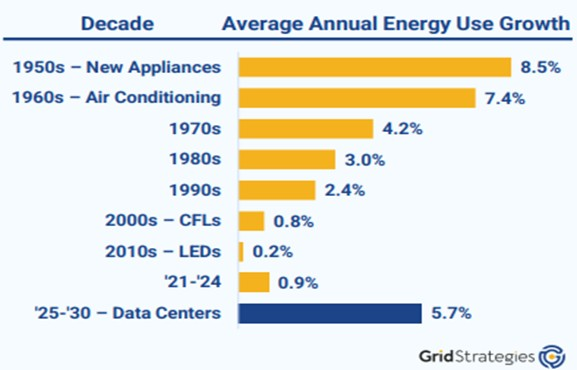
Table 9 Electric Demand Growth Strongest Since Central Air Conditioning Era
The EIA’s December 2025 Short-Term Energy Outlook indicates that U.S. electricity demand will continue to rise to record levels in 2025 and 2026, driven by data centers, electrification trends, and commercial and industrial growth. EIA’s forecast is 2.4% growth in 2025 and 1.7% in 2026. We expect the demand major growth to begin in 2026 and 2027 when large-load customer facilities begin operating and ramping to capacity. Regionally, the EIA projects PJM demand growth of about 3.3% in both 2025 and 2026, while ERCOT (Texas) demand grows more rapidly (about 5.0% in 2025 and 9.6% in 2026). Other strong growing regions include Midcontinent Independent System Operator (MISO) and Southwest Power Pool (SPP). We highlight notable activity in PA, the Southeast, AZ, ID, and the Midwest. Constraints such as grid capacity, permitting, and costs will limit expansion in New England, Alaska, and Hawaii.
According to the GridStategies (leading power reliability consulting firm) November 2025 report, power demand forecasts were revised upward for the third consecutive year. US electricity usage is forecast to grow by an average of 5.7% per year over the next five years, with peak demand growth forecast at 166 GW, a 3.7% annual rate. Over the past three years, the 5-year forecast of utility peak load growth has increased by from 24 GW to 166 GW. (see exhibit 5)
Exhibit 5 Electric Demand Growth Forecasts Continue to Increase
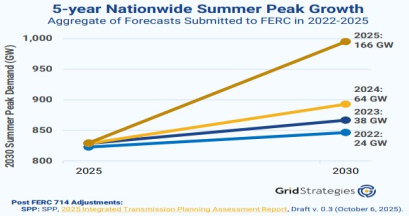
Grid Strategies emphasize that overall electricity use is forecast to grow even stronger than peak power demand due to the high load factors of data centers. Data centers are the largest driver of demand and energy growth and require much larger load factor (meaning the demand is constant not just peaking). New load for industrial/manufacturing, oil & gas/mining, and other load types is also increasing compared to recent decades.
In December 2025, S&P Global (S&P GMI) forecast US data center demand would represent roughly 9-14% of total demand by decade-end. US data center load is expected to grow 12-20% per year between now and 2030. (see exhibit 6).
Exhibit 6 Electric Demand Growth Forecasts Continue to Increase
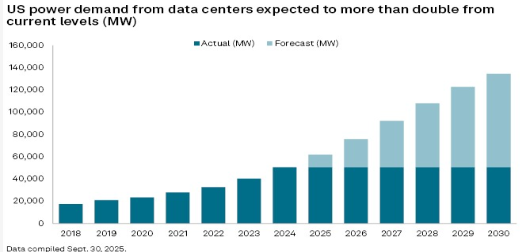
U.S. data center consumption reached 47 GW in Q4 2024, up 9 GW from the previous year and expected to grow to ~140 GWs by 2030. Major technology companies (Amazon, Microsoft, Meta, and Alphabet, Oracle) continue to commit substantial capital to AI and data center expansion. (exhibit 7)
Exhibit 7 Electric Demand Growth Forecasts Continue to Increase
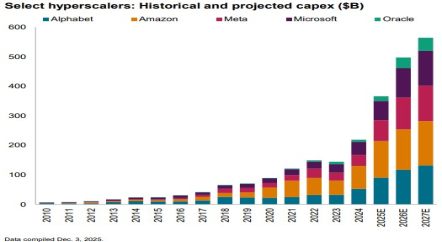
Source: S&P Global
What is the State of US Electric Demand Growth and AI Data Centers?
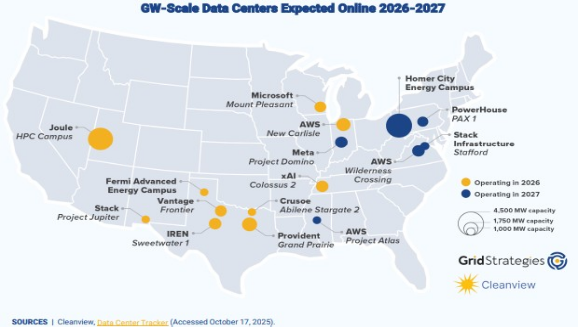
According to GridStrategies, 16 giga-scale data center projects representing ~30 GW of incremental load are scheduled to come online in 2026–2027 (see Exhibit 8). Facility size continues to expand meaningfully, with typical projects growing from roughly 40 MW to ~100 MW, and an increasing share of campuses exceeding 200 MW. OpenAI, Oracle, and SoftBank’s Stargate initiative outlines plans for up to 10 GW of AI computing capacity across multiple U.S. sites over time, representing hundreds of billions of dollars in potential investment, with several GW’s targeted later this decade. Separately, Google plans to invest approximately $75 billion in AI and cloud infrastructure, including significant spending in Pennsylvania, while Microsoft has outlined a $100 billion AI supercomputing and data center initiative expected to ramp by 2028. Several large developments are pursuing on-site or co-located generation solutions, including the Homer City redevelopment in Pennsylvania, Joule projects in Utah, Crusoe’s Stargate facilities in Texas, and xAI’s Colossus project in Tennessee. These high-profile projects illustrate both the scale of capital investment and the unprecedented power requirements associated with AI infrastructure. Collectively, these commitments reinforce the depth, durability, and long-term nature of electricity demand growth tied to AI.
Exhibit 8 Huge Data Centers Scheduled for 2026-2027
Data Center Backlash But They Are Coming
Data centers are emerging as a major driver of U.S. electricity demand, but their rapid growth is increasingly constrained by local opposition tied to affordability, land use, and infrastructure scale. While federal regulators are exploring ways to accelerate grid connections for large loads, states, utilities, and communities are pushing back over cost impacts and jurisdictional authority, prompting tools such as specialized large-load tariffs. Zoning resistance—particularly around converting agricultural land—is also intensifying, complicating siting near population centers. As a result, future data center growth is likely to favor regions with excess grid capacity or co-location at existing power plants, which may ease community concerns but could moderate the pace of development.
BOTTOMS UP: DATA CENTER/LOAD GROWTH UTILTIES
From a bottoms-up perspective, and to emphasize utility stocks positioned to benefit from significant growth tailwinds, we highlight several of the fastest-growing utilities experiencing strong load growth across the nation.
NEXTERA ENERGY (NEE) At its December 8, 2025, Analyst Day update, NEE raised its 2025-2026 EPS ranges to $3.63-3.70 (from $3.45-3.70) and $3.92 (from $3.65-4.00), respectively, and outlined its expectation to grow EPS at an 8%-plus CAGR from 2025-2032 (and target another 8%-plus 2032-35). The 8%-plus compares to previous guidance of high-end of 6-8% through 2027. NEE outlined its leading position to capitalize on the secular change in electric demand with its “12-ways to grow”, including regulated and contracted non-regulated investments.
ENTERGY (ETR) targets “greater than 8% EPS CAGR” and 7% retail sales growth 2024-2029, including 13-14% industrial growth, supported by agreements with at least three hyperscale data centers. Meta is investing $10 billion in a Northeast LA complex, Amazon plans a $10 billion MS facility, and Google plans $4 billion in Arkansas. ETR forecasts 50 GW of large-load growth ~20 GW from data centers and 15 GW from other industrials—and plans 18 GW of new generation by 2034. In August 2025, the LPSC approved 2,265 MW of combined-cycle gas (2028-29) designed for future carbon capture and 1,500 MW of renewables to serve 2-GW at Meta (but can be expanded to 5-GW). The $41 billion 2026-2029 capital plan drives a 14% annual rate base CAGR. Meta and Google plan to fund new generation, transmission upgrades, and the ongoing share of Entergy’s costs.
DOMINION ENERGY (D) D targets 5-7% EPS CAGR from 2025 EPS and is currently the largest data center provider in the US. Dominion added 7 GWs of new data centers since year-end 2024. It emphasized that data center-driven load growth in Northern Virginia shows no signs of slowing with over 10-GW’s contracted and 47 GW’s in queue. Dominion expects to update its 5-year $50.1 billion capital plan on the year-end call. Its pending $10.9 billion (75% complete) Coastal Virginia Offshore Wind projects dominates investor concerns.
WEC ENERGY GROUP (WEC). WEC targets an above-average long-term EPS CAGR of 7-8% (raised from 6.5-7.0% on third quarter call) with 2028-2030 annual electric demand growth forecast to 6.0-7.0%, from 0.7% in 2025. WEC forecasts two data centers totaling 3.4GWs of demand (40% increase from current peak demand) over 2026-2030. The $7.3 billion MSFT data center in Mt Pleasant, WI (Phase one is estimated at $3.3 billion and scheduled to open in early 2026/Phase 2 scheduled for 2027) and the $8 billion Vantage Data Centers (1.3 GW) data center (Oracle) in Port Washington, WI. WEC expects a decision regarding the Very Large Customer Tariff (VLC) which dedicates new power sources (excluding rate cases) based on a 10.48-10.98% ROE with early termination fees. WEC’s 2026-2030 capital plan totals $36.5 billion and results in 11% rate base CAGR.
PINNACLE WEST (PNW) PNW targets 5-7% annual EPS CAGR, expects 1.5-2.5% customer growth, 4-6% sales growth over 2024-2027 and PNW has committed to adding 4,500 MW’s of large load by 2030 with an additional 20 GW’s in queue (recently freed up by Transwestern gas contract). In March of 2025, Taiwan Semi-Conductor raised its expected investment in the Phoenix area to $165 billion, including 6 fabrication plants, 2 packaging facilities and a research and development facility. The investment is expected to add 70,000 jobs Fab 1 started in 2024; Fab 2 – the box is built and will full ramp in 2027-28; All 6 fabs is part of 4,500 MW’s by 2030.
CENTERPOINT ENERGY (CNP) On September 29, 2025, CNP raised its 2025-2030 EPS CAGR to 7-9%, from 6-8%, to reflect Houston load growth and higher capital investment (11% rate base CAGR). Strong EPS growth is driven by Houston electric load growth from 21 GW’s in 2024 to 31 GWs by 2021 and 42 GW’s by 2035. Load growth is underpinned by 2% annual residential customer growth plus Port of Houston electrification, data centers, medical center expansion, the energy sectors. The company announced a new higher and revised 5- and 10-year capital plan of $33 billion and $65 billion.
SOUTHERN COMPANY (SO) SO targets EPS growth of 5-7% supported by projected state-regulated electric and gas utility rate base growth of over 8%. SO forecasts 8% sales growth through 2029 driven in part by 10-GWs large load pipeline. The three-state utility (GA, AL, MS) 50-GW large load queue continues to grow. On December 19, 2025, GPSC approved 9.9 GW of new resources includes more than 3.6 GW of new combined-cycle generation, over 3.0 GW of storage, 350 MW of solar/storage, and 2.8+ GW of PPAs. Georgia Power’s company-owned projects represent ~$16.3 billion of capex (excluding AFUDC), with about $14 billion expected between 2026 and 2029. Georgia Power agreed that incremental revenues from large-load customers in its next base rate case will place at least $556 million per year of downward pressure on residential bills during 2029–2031, equivalent to about $8.50 per month for a typical customer. The incremental $4 billion of upside capex into Southern’s 2025–2029 plan, brings total planned investment to ~$80 billion through 2029.
AMERICAN ELECTRIC POWER (AEP) On its third quarter earnings call, AEP raised its EPS growth target to 7-9% (from 6-8%) based on its 2026-2030 capital program ($72 billion). AEP expects a 9% EPS CAGR through 2030: but in the lower half of the 7-9% range for 2026 and 2027 and at or above the high end of the range in 2028, 2029 and 2030. The higher budget is to meet ~28-GW’s of a peak demand growth (22-GW’s of data centers; 6 GW’s of industrial) to 65 GW’s (from 37-GW’s in 2024). The utility has 190-GW’s of interconnect requests in various stages of development across it 11-state footprint. AEP forecasts 2025-27 retail sales growth of 5.7%, 8.4%, and 8.9%, including 8.5%, 12.2%, and 12.3% commercial and industrial sales. AEP expects 2025-2034 resources needs of 28 GWs (6.4 GWs of solar, 5.1 GWs of wind, 0.5 GWs of storage, and 15.3 GWs of gas). AEP is focused on affordability by limiting residential rate increases to 3.5% annually across the system, below the 5-year historical average inflation rate of over 4%
NISOURCE (NI) NI targets 8-9% annual EPS CAGR over 2026-2033 (6-8% annual EPS CAGR over 2026-2030) based on 9-11% annual rate base CAGR over 2026-2033 (8-10% annual rate case CAGR over 2026-2030). NI has agreed to a partnership with Amazon for 3 GW of power capacity (plans to add 2.6 GW of combined cycle gas and 400 MWs of batteries for $6-7.0 billion) ramping from 2027-2032 under a special electric service agreement. On September 24, 2025, NI received Indiana regulatory approval to form a non-regulated GENCO designed to serve mega-load customers, including Amazon. In addition, AMZN will pay a system charge under the special contract which will return $1 billion dollars to existing customers. NIPSCO residential customers are expected to receive a monthly bill credit beginning in 2027, reaching $7-9 per month in 2033.
XCEL Energy (XEL) On it third quarter call, XEL raised its EPS targets to “6-8%-Plus”, from “6-8%” to reflect strong 5% sales growth (8% in TX) and 20 GWs of data center pipeline. XEL highlights that 1 GW datacenter is equal to 1 million customers, ~ 3 GWs of renewable and firm dispatchable energy, $6-8 billion of investment requirement, $0.9-1.0 billion of incremental revenues and 10% customer savings. XEL’s raised its base capital plan to $60 billion, reflecting 11% rate base growth.
IDACORP (IDA) IDA does not provide EPS growth targets but expects an industry-leading 16.1% rate base CAGR. The 2025 integrated resource plan (IRP) filed in June, reaffirmed a 5-year retail sales CAGR of +8.3% (annual peak +5.1%), but growth will likely be higher. IDA management explained that the pipeline of prospective customers (incremental to the IRP) exceeds IDA’s record peak load of 3,800 MW’s. Notable growth activity includes Micron’s expansion of its Boise HQ’s and new $15 billion microchip fab facility, a Meta data center, and $415 million Lamb Weston potato processing facility, Chobani expansion and $225 million Tractor Supply facility. In June 2025, Micron announced a second large fab facility equal to the size of the first. On December 30, 2025, the ID PUC approved a constructive rate plan based on a 9.6% allowed ROE.
PPL CORP (PPL) PPL expects to earn the top-end of its 6-8% annual EPS CAGR through 2028 driven by rate base growth from rising PA and KY data center demand, along with a new JV with Blackstone to develop long-term contracted, non-regulated gas power plants in PA. At the PA Energy Summit, PPL highlighted the state’s pro-business environment, shale resources, and need for $17–19B of new generation as demand surges and IPPs face little incentive to build. PPL is advocating for regulated utility-owned generation while also pursuing non-regulated projects with Blackstone. PPL notes that 1 GW connected reduces transmission costs on the retail customer bill by about 10% (~2% of total bill or $3 per month). Its PA data center pipeline totals 20.5 GW (11.3 GW announced and 5 GWs under construction), requiring $1 billion in transmission (vs. $400M currently planned). Additional active requests exceed 50 GW through 2034. In KY, load growth projections include 9.7 GW of new demand (8.7 GW data centers, 3 GW manufacturing) from 2026–2032, with ~2.8 GW expected by 2032. To meet demand, PPL is building the 600-MW Mill Creek Unit 5 CCGT (2027) and two 645-MW CCGTs in 2030-31, plus extending coal operations. PPL’s 2025-28 capital plan totals $20B ($4.3B in 2025), supporting 9.8% base growth over 2024-2028.
EVERGY (EVRG) On its third quarter call, EVRG updated its 15 GW growth pipeline to include 4-6 GW in active discussion, including 1.2 GWs under active construction (Meta opened $1 billion/1.4 million square feet data center in August 2025), 1.5-2.0 GW in finalizing agreements, 2-3 GWs in advanced discussions and 10 GW in the queue. The utility is finalizing agreements for 4-6 GW’s from data center projects (KS and MO expansion). Larger customers include ~$1 billion Meta and GOOG data centers, $4 billion Panasonic EV battery plant (expected COD 2026/4,000 new jobs) and a $100 billion hyperscale data center campus (6-data centers) near the KCI airport. EVRG’s current (but stale) 2-3% load growth CAGR through 2029 is based on 500-MW’s of new load, but an additional 1.0-1.5 GW’s (actively building or finalizing agreements) would bring the sales forecast to 4-5% CAGR beginning as early as 2027. EVRG currently targets 4-6%, Given growing demand and a forecast 8.5% rate base growth rate, we expect the 4-6% EPS growth rate to increase to at least 5-7%.
ALLIANT ENRGY (LNT) On its third quarter call, LNT raised its 5-7% EPS target to “5-7% plus” with a 2027-29 CAGR of 7% plus. LNT’s 2025 and 2026 EPS mid-points of $3.20 and $3.41, respectively, result in 6.6% annual growth, while the 2027-2029 CAGR is “7%+-plus”. Higher growth reflects an increase in its contracted data center load to 3 GW, representing a 50% increase from the company’s 6 GW (2024) peak load demand by 2030 and ~12% electric sales 2025-30 CAGR. LNT expects the energy resources to serve this expected load results in a $1.9 billion, or 17%, increase in forecasted 2026-2029 capital expenditures to $13.4 billion. The investment results in 12%-plus rate base CAGR ($16.9 billion rate base in 2025 to $26.5 billion in 2029). In Q3 2025, Wisconsin Power and Light (WPL) executed a 900-MW electric service agreement for the $10 billion QTS Madison site, part of four major data-center agreements including QTS and Google at the Big Cedar Industrial Center in Cedar Rapids, Iowa, and Meta (260–370 MW) on 500 acres in Beaver Dam, WI. Construction is underway on the first three projects, with demand ramping from 2027–2030 and expected to drive 12% electric sales growth over 2025–2030. LNT is actively negotiating an additional 2–4 GW of potential load and has multiple development-ready sites in Iowa, including Big Cedar and Prairie View Industrial Center in Ames, highlighting available transmission capacity and interconnection positions. The utility noted it would reassess its long-term annual EPS growth target if it signs these additional large loads, which could require significant capital investment.
AMEREN (AEE) affirmed its 6-8% EPS CAGR and laid out plans to update the financial plan in February 2026. The midpoints of 2025 and 2026 EPS guidance represent over 8% growth over the previous year. AEE has executed electric service agreements (ESAs) totaling 3 GW (was 2.3 GW) with large load customers and has room for more with numerous sites with access to transmission, fiber, labor and water. Over 2025-2029, AEE expects load growth to accelerate to 5.5% (from < 1.0%) driven by data centers and manufacturing. AEE expects the electric demand to begin ramping-up in late 2026, with expected 1 GW of load growth by end of 2029 and 1.5 GW’s by end of 2032. The agreements are conditioned upon MPSC approval of a modified tariffs for large load customers (over 75 MW) by February 2026. The ESA requires a base rate of $0.06/kWH, a 12-year service term, minimum demand charge of 80%, and exit terms/fees.
US POWER EQUATION – ALL OF THE ABOVE POWER
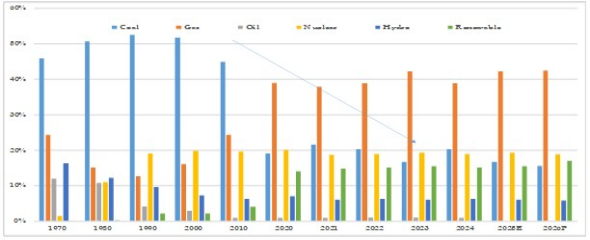
As of August 2025, U.S. power capacity totaled ~1,344 GW: 568 GW gas, 159 GW wind, 156 GWs of solar, 18.5 GW of geothermal/biomass, 198 GW coal, 102 GW hydro, 104 GW nuclear and 40 GW’s of other. (See Table 10) In 2024, natural gas represented 42% of output, nuclear 19%, coal 16%, wind 11%, hydro 6% and solar 7%. In 1985, coal accounted for over 50% of U.S. electricity generation. Since 2010, the U.S. has retired approximately 100 GW of coal-fired power generation capacity with another 80 GW more to retire by 2030 (~10 GW being converted to natural gas). Over the past few years, new capacity additions have been dominated by renewables.
Exhibit 9 US Power Generation Fuel Mix-Coal Declines
Source: Gabelli Funds; FERC; EIA
Capacity additions continue to be dominated by renewables (See Table 10) According to FERC Energy Infrastructure Update August 2025, the U.S. added 26 GW of new capacity, primarily solar (19 GW), followed by wind (3.8 GW) and gas (3.1 GW) January-August 2025. Looking forward, FERC identifies 136.5 GW of high-probability capacity additions through August 2028, led by solar (90 GW), wind (23 GW), and gas (22 GW), against 39 GW of retirements. These figures exclude battery storage, which is expected to add roughly 125 GW by 2035 and is increasingly paired with solar.
Table 10 US Plans to Add 137 GW’s of Primarily Solar to Existing 1,300 GWs (Installed)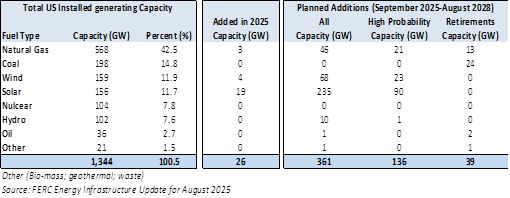
New Renewables; Navigating a Changing Environment
The near-term power development pipeline reflects net-zero carbon policies, state and corporate mandates as well as tax incentive urgency. As of September 18, 2025, S&P Global market Intelligence (SPGMI) data identifies roughly 350-GW’s of renewable (wind and solar) power planned through 2030, including:
- Utility-scale solar of 269 GW (40.3 GW under construction and 8-GW in advanced development)
- Wind of 79.2 GW (21.5 under construction and 9.6 GW in advanced development)
Much of this capacity is being accelerated to qualify for OBBB/IRA tax credits, with solar and storage favored due to faster development timelines and cost competitiveness. Wind development is more uncertain given permitting challenges and regulatory headwinds, particularly on federal lands.
Exhibit 10
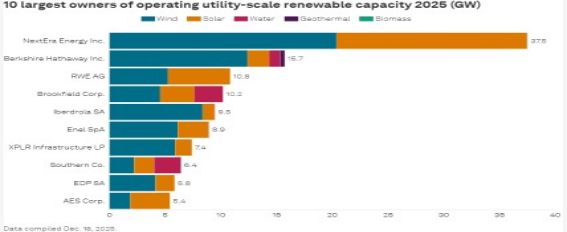
NextEra Energy remains the dominant U.S. renewables developer, currently owning 37.5 GW and planning 71–90 GW of new wind, solar, and storage through 2032 (wind 9–15 GW, solar 32–42 GW, storage 32–43 GW). At its December 2025 Analyst Day, NEE outlined a broader long-term development opportunity of ~285 GW, spanning renewables, storage, gas, and nuclear, highlighting “bring-your-own-generation” solutions for hyperscalers managing affordability. Berkshire Hathaway Energy is the second-largest renewables owner at 15.7 GW.
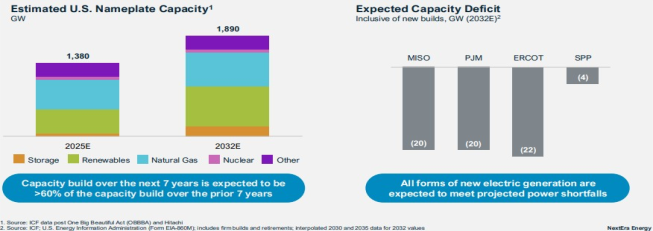
Exhibit 11 Planned New Renewable and Natural Gas Capacity
Source: NextEra Energy December 2025
U.S. Power Supply Outlook
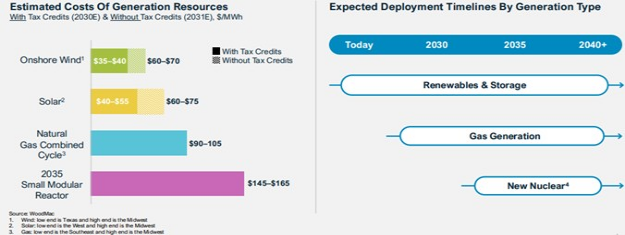
Political and economic realities suggest the U.S. will expand power supply in three phases over the next decade:
- 2024–2030: Renewables and battery storage dominate new build.
- 2029–early 2030s: Gas-fired capacity expands as turbines come online.
- Early–mid 2030s: Next-generation nuclear emerges as costs and policy improve.
Recent Trump administration policies—extending coal plant life, expanding gas infrastructure, and supporting nuclear—slow the net-zero trajectory but improve near-term reliability and affordability. Offshore wind has been particularly affected; in late 2025, the U.S. Interior Department paused five projects (Vineyard Wind 1, Revolution Wind, Coastal Virginia Offshore, Sunrise Wind, Empire Wind) due to radar interference. Completion is expected eventually, but near-term construction is limited.
Exhibit 12 Planned New Renewable and Natural Gas Capacity
Source: NextEra Energy December 2025
After years of underinvestment, natural gas-fired generation is regaining momentum. U.S. planned fossil capacity additions have risen to 106 GW by 2030, with nearly 200 gas plants in development across ERCOT, MISO, PJM, and SPP. Gas appeals to data centers for its reliability, scalability, and relatively low cost.
In December 2025, GE Vernova, a major manufacturer of power generation equipment, expects to secure contracts for 80 gigawatts of combined-cycle gas turbines by the end of 2025 compared to 14 GW in 2024. company’s gas turbine production capacity is fully booked through 2028, with only limited availability remaining for 2029 as supply constraints—including multi-year backlogs, rising costs, and extended delivery times. Notable large scale gas projects include Homer City (4.5 GW) and Bruce Mansfield (3.0 GW), both converting retired coal plants to gas to serve hyperscale campuses.
Nuclear power provides 24/7 zero-carbon generation, and highly valued by policymakers and hyperscalers. While new large-scale reactors are unlikely before 2035, momentum is building through restarts, life extensions, and small modular reactors (SMRs). Policy support—including NRC permitting streamlining, domestic fuel supply measures, and international partnerships—is provides confidence and backing the future of nuclear for long-term capacity growth. Corporate demand is reshaping the market: Amazon, Microsoft, Google, and Meta are pursuing PPAs to meet 24/7 carbon-free targets. Landmark deals include:
- Amazon/TLN/Susquehanna (PA): 1,920 MW through 2042, transitioned to front-of-the-meter for PJM delivery.
- Microsoft/CEG/Three Mile Island (PA): 20-year PPA for the 820 MW restart by 2028.
- Meta/CEG/Clinton Nuclear (IL): 1,092 MW PPA starting 2027, a 30 MW uprate, and SMR potential.
- GOOG/NEE/Duane Arnold (IA): 630-MW PPA starting in 2028
Most U.S. nuclear plants (94) are regulated, limiting hyperscaler procurement to 23 merchant reactors in deregulated markets like PJM. Rising demand and limited unregulated supply are increasing their strategic value. Restarts include Palisades, MI (800 MW, restarted 2025); Duane Arnold, IA (600 MW/2028 restart); Three Mile Island Unit 1, PA (820 MW/2028 restart).
Key unregulated operators positioned to benefit include Constellation Energy (22 GW, 14 plants), Vistra Corp (6.4 GW, 4 plants), NextEra Energy (2.9 GW, 3 plants), Talen Energy (2.6 GW, Susquehanna), and PSEG (5.9 GW, 3 plants). These assets provide scarce, carbon-free generation as electricity demand and corporate procurement accelerate.
NERC ONGOING WARNING: POWER DEMAND TO EXCEED SUPPLY
More than one-half of North America faces a risk of energy shortfalls in the next 5-10 years as data centers and electrification drive electricity demand higher and retirements threaten resource adequacy, according to the North American Electric Reliability Corp 10-year outlook (2024 Long-Term Reliability Assessment – December 2024) and further reinforced by its May 2025 Summer Assessment and November 2025 Winter 2025-26 Assessment.
Exhibit 13 North American Reliability Council (NERC) Raises Concern About Supply
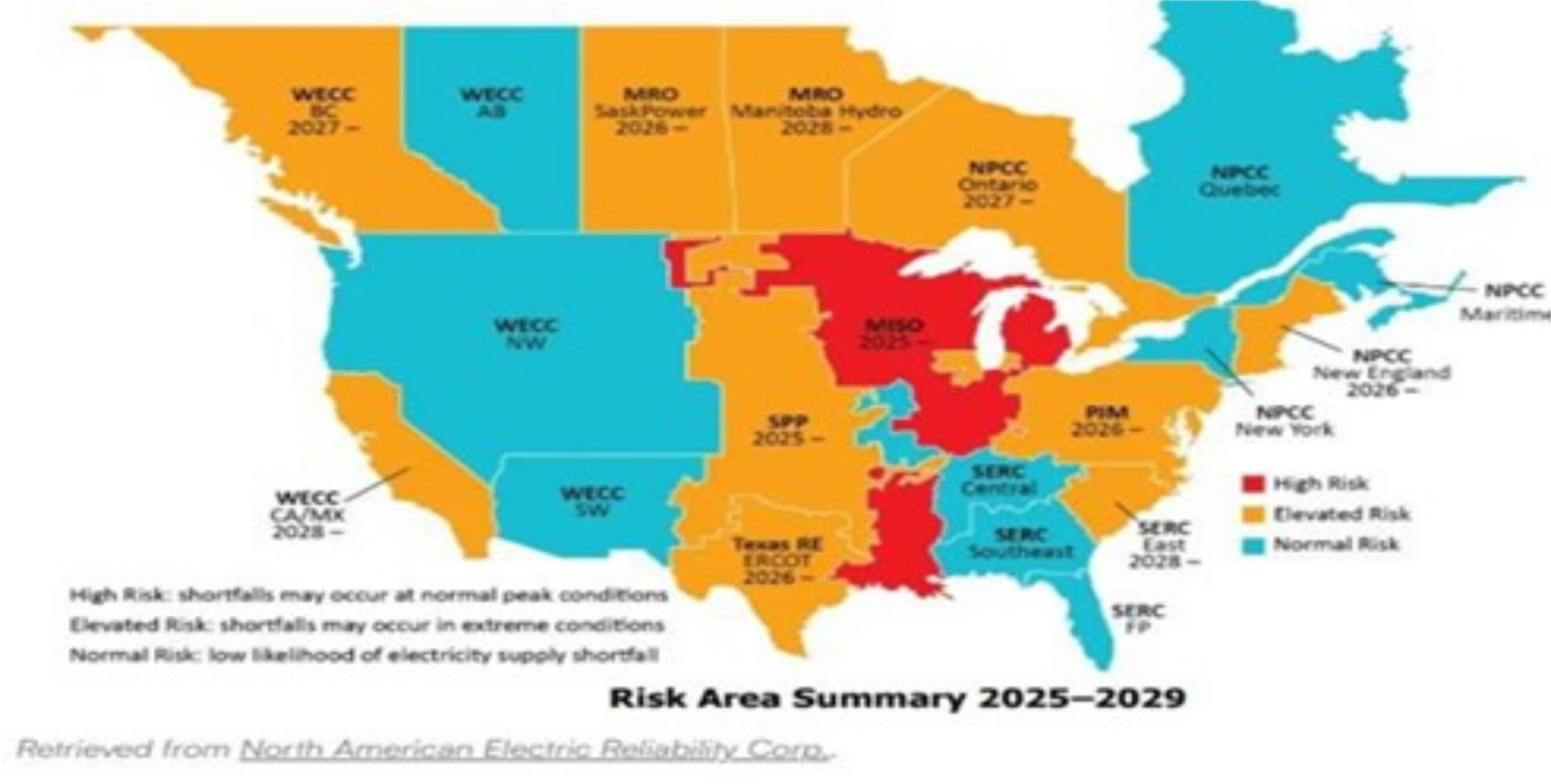
NERC’s forecast peak reserve margins (the cushion between supply and peak demand) fall to concerning levels across the US. Further, more frequent and extreme weather events impact record peak demands in many regions. NERC notes that significant solar and battery storage have been added recently, but lack the flexibility and dependability needed during peak demand hours. NERC warns that many regions, including MISO, PJM, and SPP, face mounting reliability risks as dispatchable resources decline and extreme weather events become more frequent.
THE MERCHANT POWER PLAYERS– CEG, VST, TLN, NRG
Regulated electric utilities are actively adding generation—primarily gas, renewables, and battery storage. Supported by state regulators and rate recovery mechanisms, regulated utilities can build new capacity with more certainty than merchant generators. Over the 5-to-10 years, US regulated utilities have filed resource plans with the intention of adding significant amounts of renewables and gas-fired power and the investment has led to higher forecasted EPS CAGRs.
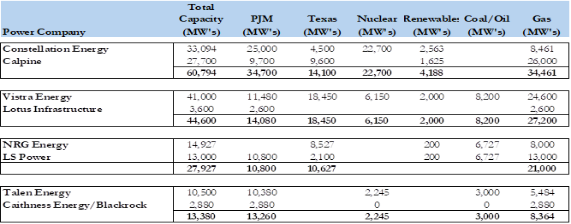
However, non-regulated states include major markets like Texas, Illinois, New York, and Pennsylvania. The four pure-play publicly-traded independent power producers (IPPs), or merchant generators, (Constellation Energy, Vistra, NRG Energy & Talen) own power plants in non-regulated markets like PJM (Northeast/MidAtlantic), ERCOT (Electric Reliability Council of Texas), and CA. See Table 11 These companies are the most leveraged to power supply shortages. Capacity ownership is shown below and includes pending acquisitions.
Table 11 Largest Publicly-Traded Merchant Power Plant Owners (And Pending Acquisitions)
Source: Thomson One Consensus estimates, Company documents
PJM Auction Would Have Been Higher Than Price Caps-Need More Power Built
On December 17, 2025, PJM concluded its 2027/2028 Base Residual Auction (BRA) at the $333.44/MW-day price cap for its 13-state region (planning year: June 1, 2027 – May 31, 2028). The deregulated portion (IL, IN, OH, PA, NJ, KY, WV, VA, DE, RI) is short on power amid rising demand. PJM cleared 134,479 MW to serve over 67 million people, with a reserve margin of 14.8% (6.6 GW below the 20% target). Forecast peak load is 5,250 MW higher than the 2026/27 auction, nearly 5,100 MW of which is due to data center demand. PJM estimates the uncapped price would have been $530/MW-day, and recommended raising the 2028/29 cap to ~$550/MW-day.
Table 11 PJM Auction Prices Sky Rocket From $29/MW-day to $333/MW-day Over Two Years
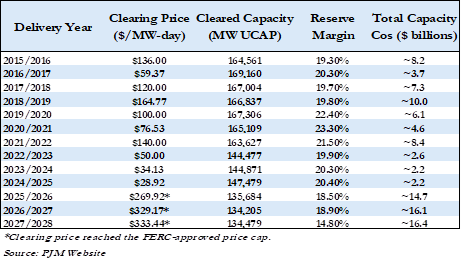
PJM capacity prices have surged dramatically—from $28.92/MW-day in 2024/25 to $269.92 in 2025/26, and $329.17 in 2026/27—raising region-wide capacity costs from $14.7B to $16.1B. Key drivers: growing data center/AI demand and delays in PJM’s interconnection queue, which has stalled many new generation projects, particularly renewables. The cleared capacity mix: 43% natural gas, 21% nuclear, 20% coal, 5% demand response, 4% hydro, 2% wind, 2% oil, 1% solar. Merchant power beneficiaries included Constellation Energy (18 GW), Talen Energy (8.8 GW), Vistra (11 GW), and NRG. Distribution utilities passing PJM costs to consumers include Exelon, First Energy, PPL, Eversource, and Unitil.
Interconnection updates: Since 2023, PJM has processed over 170,000 MW of generation requests, with 30,000 MW remaining in the 2026 transition queue. FERC directed PJM to establish a framework allowing data centers and other large users to colocate at generation sites. The order clarifies transmission options, updates behind-the-meter rules, and outlines safeguards to prevent cost shifts to other customers. It provides independent power producers (IPPs) more flexibility to serve co-located loads, including both existing and new generators, helping integrate high-growth data center demand while managing reliability.
Texas is Also Growing
ERCOT is experiencing record electric demand, with total load through November 2025 reaching 450.3 TWh, up 5.5% year over year, and demand expected to continue setting new records into 2026, including a forecast summer 2026 peak of 94.2 GW—10% above the August 2023 record. Texas regulators project ERCOT peak demand rising to 130–148 GW by 2030, even as intermittent renewables now account for more than 30% of installed capacity, placing increasing pressure on reserve margins. Large-load growth is driving this trend, as reflected in interconnection queues showing 33.6 GW scheduled for energization in 2026 and 225.8 GW queued through 2030, largely attributable to approximately 164 GW of data-center demand.
In response, the state established the Texas Energy Fund to support new dispatchable generation, approving roughly 10 GW across 17 gas-fired projects, though some have since withdrawn or been replaced. ERCOT’s December 2025 Capacity, Demand, and Reserves report indicates reserve margins tightening materially, with potential deficits emerging by 2028, partially mitigated by policies allowing emergency curtailment of large loads, updated demand assumptions that moderate net peak growth, and growing reliance on battery storage—now exceeding 12 GW, the largest in the U.S.—alongside other dispatchable resources, while large-load developers face stricter interconnection and curtailment requirements.
MORE RATE CASES TO SUPPORT HIGHER CAPEX-MEDIAN ROE 9.7%
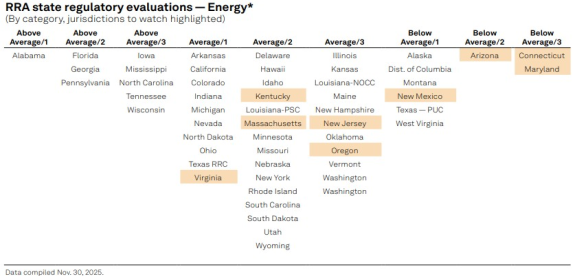
As utility capital spending reaches record levels, a utility’s ability to grow earnings increasingly depends on how its state’s Public Utility Commission (PUC) regulates rates—and whether the utility is given a fair opportunity to earn its authorized return on equity (ROE). Because PUCs are political bodies, rate decisions are shaped not only by financial metrics but also by public pressure to keep customer bills affordable. To help evaluate this dynamic, we provide a Regulatory Research Associates (RRA’s) ranking of electric and gas rates across utilities (Appendix and Exhibit 13), along with an assessment of how constructive each state’s regulatory environment is—specifically, how effectively it supports utilities in earning their allowed ROE.
Exhibit 14 State PUC Rankings – AL, FL, GA, PA Constructive; CT, MD Not So Much
Source: Regulatory Research Associates: December 2025
Since June of 2025, RRA lowered the ranking of California (Average/2 from Average/1), Nebraska (Average/2 from Average/1), New Hampshire (Average/3 from Average/2) and Oregon (Average/3 from Average/2). RRA raised the ranking of Mississippi (Above Average/3 from Average/1), Missouri – (Average/2 from Average/3), Ohio (Average/1 from Average/2) and South Carolina (Average/2 from Average/3).
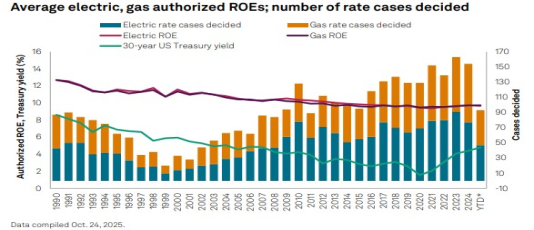
In recent years, utilities have needed to file more rate cases due to higher capital investment, higher interest rates and greater policy demands. In addition, utilities have implemented more riders or inter-period adjustments. In the first nine-months of 2025, the median ROE authorized in all electric utility rate cases was 9.70% versus 9.70% in full year 2024. For gas utilities, the median was 9.75% in the first nine-months of 2025 and 9.70% in full year 2024.
Exhibit 14 Heavy Rate Case Activity – Allowed ROE’s ~9.75% Over Past Twelve-Months
Source: S&P Global; RRA
In the second half of 2025, the highest authorized ROE was 10.95% for Florida Power & Light (FPL) in Florida, awarded November 2025 and the lowest was Yankee Gas 9.32% (53.9% equity ratio) in CT also in November of 2025. Other late 2025 rate decisions, included LNT-Wisconsin P&L) – 9.8% (55%); AES-Dayton P&L (10.0% (53.9%); DUK-South Carolina – 9.99% (53%), EXC-NJ (Atlantic City Electric)-9.6% (50.2%). Important fourth quarter rate decisions outlined below:
NextEra Energy/Florida Power & Light (FPL): On November 20, 2025, FPL received approval for a four-year rate plan effective through 2029. Key features:
- Rate increases: $945 million in January 2026 and $705 million in January 2027.
- Authorized ROE: 10.95% (range 9.95–11.95%) with a 59.6% equity ratio.
- Additional base rate increases for solar projects entering service in 2027–2029 and battery storage in 2028–2029
- New large-load tariff for customers adding >50 MW with an 85% load factor.
- Despite significant increases, the plan yields only a ~2% impact on residential bills.
California – CPUC Cost of Capital Decisions: On December 18, 2025, the California Public Utilities Commission lowered allowed ROEs to ~10.0% for the state’s major investor-owned utilities (PG&E: 10.03%, SCE: 9.98%, SDG&E: 9.93%, SoCalGas: 9.78%), maintaining a 52% equity ratio. In CA, utilities must file a full cost-of-capital (COC) application every three years with annual ROE adjustments if the Moody’s utility bond index changes by more than 100 basis points.
Illinois – ICC Decisions: In November 2025, Northern Illinois Gas (SO) and AEE-Illinois were authorized ROEs of 9.6% (equity ratio 50%). Utility investors viewed these as favorable following the historically low ROEs (8.72–8.94%) issued for Ameren and Exelon electric utilities in late 2023.
Virginia – SCC Decisions: On November 25, 2025, VA regulators approved Dominion Energy’s Virginia Electric Power biennial 2026-27 rate case: Rate increases: $566M (7.5% monthly bill impact) in 2026 and $256M (1.5%) in 2027. Authorized ROE: 9.8% (up from 9.7%).
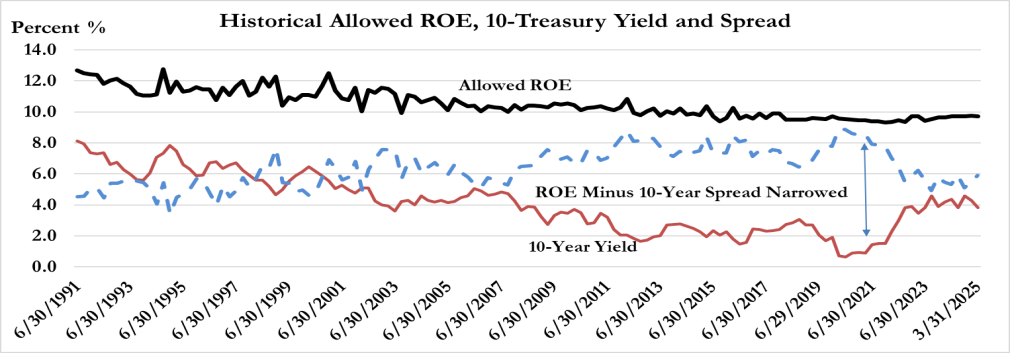
Exhibit 15 PUC’s Reluctant to Raise Profits Despite Higher Treasury Yields
Source: S&P Global; RRA; US Treasury
Authorized returns have generally followed the overall direction of interest rates, with a lag. However, the magnitude of the year-over-year change in authorized ROEs is generally much smaller than interest rate changes. Between 1990 and 2020, interest rates declined faster than authorized ROEs leading to a widening spread between authorized ROEs and the average yield on 30- year US Treasurys. This spread increased from just over 400 basis points in 1990 to nearly 800 basis points in 2020 when rates were near 1.0%. Since 2020, allowed ROE’s have ticked up modestly, but regulators are more reluctant to raise profit levels given affordability issues. The current spread is 550 basis points (9.7% vs 4.2%)
Large Load Tariffs To Protect Existing Customers. Utilities are increasingly using specialized large-load tariffs and long-term electric service agreements to serve hyperscale data centers while protecting existing customers from bill increases and counterparty risk. A single data-center project can equal 20% or more of a utility’s system load, often requiring substantial new investment in transmission, distribution, and generation; however, these “mega-loads” also expand the sales base, helping spread fixed costs and moderate rate impacts for other customers. To ensure existing customers and shareholders are insulated from stranded costs or customer exit risk, regulators are approving dedicated large-load tariffs and bilateral agreements that typically include 15–20 year terms, collateral requirements, minimum demand or take-or-pay provisions, cost-based pricing, and make-whole termination fees. While affordability concerns persist, regulators generally support these structures because they directly assign costs and risks to new customers, reduce exposure to counterparty default, and deliver economic development and reliability benefits without shifting undue risk onto existing ratepayers.
Affordability Becomes a Political Issue But More So in Some States Than Others
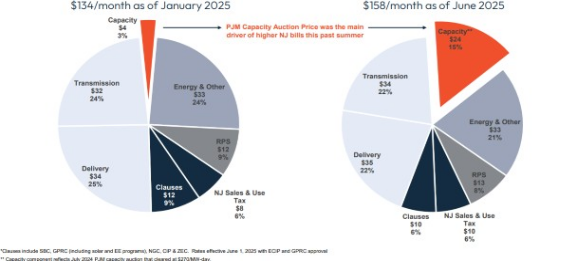
After years of flat real electricity prices, some regions experienced material bill increases in 2024 -2025. The recent PJM capacity auction spikes made headlines, helped create a national affordability narrative, and turned power into a political issue. PA Governor Josh Shapiro filed a complaint with FERC and secured a price cap, while nine governors across the PJM footprint raised concerns over record prices and governance. Electricity prices played a pivotal role in the New Jersey governor’s race this past fall as well as PUC Commissioner election in GA. As an example, NJ’s largest electric utility, PSEG, highlights that the June 2025 average electric bills rose to $158 per month, from $134 in Janaury2025 with $20 of the $24 increase due to the PJM capacity auction.
Exhibit 16 NJ Customer Bills Rise 18% (January to June 2025) – $20 of $24 Increase BC of PJM Auction
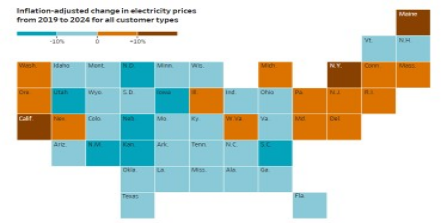
From 2019-2024, national inflation-adjusted (real) electricity prices were flat (23% increase nominally) with many states experiencing flat or falling prices but some saw increases. In 2024, electricity prices varied from a low of $0.08/kwh in ND to $0.27 in CA. Lower-cost regions such as the Midwest, Southeast, and Pacific Northwest benefit from less restrictive regulation, lower-cost fossil fuels, and legacy hydro resources.
Exhibit 17 Most Regions Saw Inflation Adjusted Prices Fall Over 2019-2024
Source: WSJ article December 29, 2025: Be Prepared to Keep Paying More for Electricity
Higher-cost regions—CA, HI, and the Northeast—face aggressive climate mandates, higher renewable penetration, wildfire mitigation, greater political/regulatory risk and expensive transmission investments. Over 2019-2024, the CA inflation-adjusted increase (35%) was driven mainly by wildfire mitigation, insurance costs, and rooftop solar subsidies that shifted system costs to other customers. In ND, residential rates fell on an inflation-adjusted basis partially due to higher sales to cryptocurrency companies, data centers and oil-and-gas projects that helped spread costs over a greater volume of electricity sales.
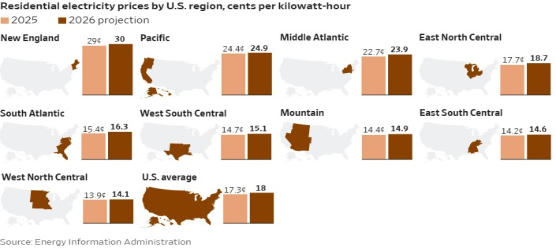
EIA expects the U.S. average residential electricity rate to rise around 4% next year following a 4.9% increase in 2025. While data centers are getting the headline blame for rising power costs, customer bills are driven by infrastructure investment, fuel prices, interest rates (cost-of-capital), grid replacement, storm and wildfire damage, and state energy and environmental mandates. In many cases, large new customers have actually helped spread fixed costs and moderate rates. EIA December Short-term Energy Outlook forecast Henry Hub gas prices to average $4.01/MMBtu in 2026, higher than the roughly $3.56/MMMBtu in 2025 and the $2.19 MMBtu in 2024.
Exhibit 18 Affordability is a Greater Issue Where Prices are High
Source: WSJ article December 29, 2025: Be Prepared to Keep Paying More for Electricity
Affordability has always been a consideration to utility investors, including during COVID, the Great Recession, and periods of high inflation, such as 2023. Recent price increases in the Northeast—driven by PJM capacity auctions, supply constraints, and AI-related power contracts—have heightened this concern. Keeping customer bills affordable remains a core utility priority, but it is inherently political. High bills or reliability issues quickly generate scrutiny from consumers, advocates, and elected officials, and the complexity of rate-setting often makes utilities easy political targets. Utilities operating in lower-rate jurisdictions typically face less opposition from regulators and customers, reducing regulatory risk and facilitating approval of rate increases and capital investment. In contrast, when rates are already high, commissions are more reluctant to allow full cost recovery. Low-cost utilities in growing service territories with constructive regulatory frameworks benefit from a virtuous cycle of lower cost of capital, stronger credit metrics, and higher valuations.
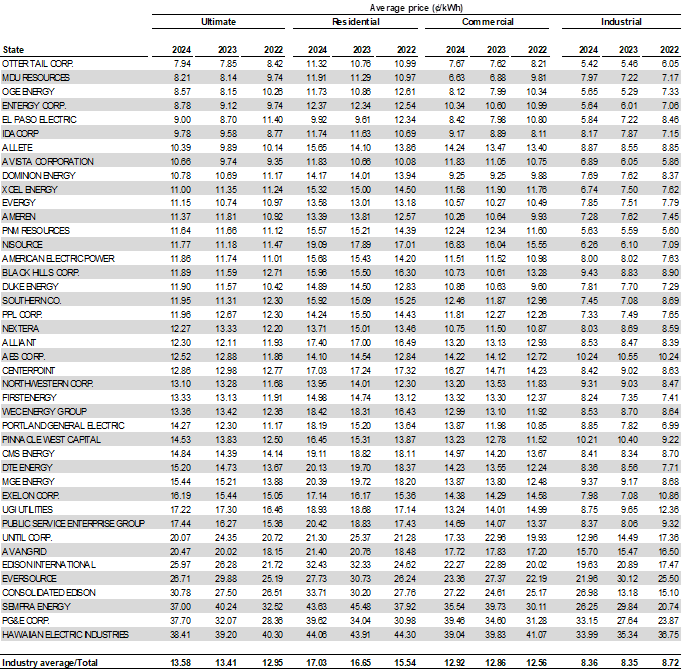
In Table 8, RRA ranks the publicly-traded electric utilities from lowest ultimate (or average retail) rate per kWh. Ottertail Power has the lowest rate followed by MDU, OGE, ETR, AVA, IDA, and ALE. All tend to serve rural population centers and benefit from low-cost hydro or gas generation,
Table 13 Ranking Electric Utilities by Affordability
Source: S&P Global; RRA
Utility and Energy Infrastructure Becoming More Valuable!
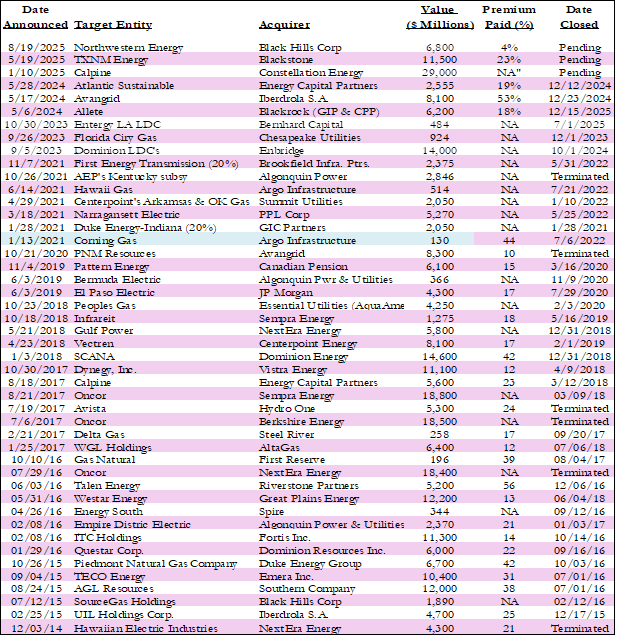
Since 1995, the U.S. electric and gas utility sector has seen over 155 acquisition announcements and 124 completed deals. Consolidation is driven by higher capital investment budgets and economies of scale, as accelerated energy demand and decarbonization create double-digit rate base growth and require significant debt and equity issuance. Smaller utilities with limited balance sheets need partners to finance larger projects. Large global infrastructure players see acquisitions as a way to access valuable existing assets and participate in growth.
Many large private equity funds, including Blackrock (owns Global Infrastructure Partners) highlight infrastructure as one of the most exciting investment opportunities owing to structural shifts, including de-carbonization, energy independence, domestic industrial capacity and on-shoring. Given accelerated power demand, energy infrastructure, (power generation, renewables, transmission, gas pipelines) has become increasingly valuable and development opportunities abound. Some recent announcements:
Exhibit 19
Source: Company reports, Gabelli Funds
Recent Announcements:
- ALLETE (ALE): On December 15, 2025, GIP and Canada Pension Plan Investment Board acquired ALE for $67/share (18% premium to May 5, 2024 closing price), or $6.2B including debt. ALE owns and develops renewables and transmission assets
- Black Hills Corp/NorthWestern Energy to Merge: On August 19, 2025, Black Hills Corp. (BKH) and NorthWestern Energy (NWE) announced an all-stock merger of equals (0.98x exchange, 4% premium). The combined utility will serve 2.1M customers across eight contiguous states, double rate base to $11.4B ($7.0B electric, $4.4B gas), and target 5–7% long-term EPS growth. The deal, expected to close in 12–15 months pending shareholder and regulatory approvals, highlights renewed sector consolidation after slowing during COVID and rising interest rates. Both stocks traded at discounted multiples due to wildfire risk and limited data center exposure, but scale and synergies are increasingly critical.
- TXNM Energy: On May 19, 2025, TXNM Energy agreed to be acquired by Blackstone Infrastructure for $11.5B ($61.25/share, 23% premium), at 11.8x EV/EBITDA, 20.4x 2026 EPS, and 1.8x rate base.
- Calpine: On January 10, 2025, Constellation Energy (CEG) agreed to acquire Calpine (27 GW gas-fired capacity) for $29.1B ($4.5B cash, $16.4B stock, $12.7B assumed debt). Adjusted multiple: 7.9x 2026 EV/EBITDA. Calpine was previously taken private in 2017 by Energy Capital Partners for $17B (9.1x EV/2017 EBITDA).
- Avangrid (AGR): On December 23, 2024, Iberdrola (Spain) acquired the remaining 18.5% stake in AGR for $35.75/share.
- Atlantica (AY): On December 12, 2024, Energy Capital Partners acquired Atlantica Sustainable Infrastructure PLC for $2.56B.
The implication is that other smaller companies will consider opportunities to be part of a larger utility, including AES, IDA, POR, OGE, AVA, MDU, OTTR, AQN, UTL, PNW, MGEE, and SWX.
Utility Stocks Trade at Reasonable Valuations
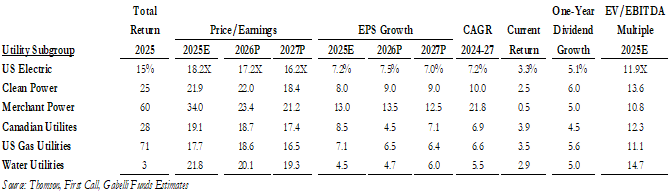
In 2024 and 2025, the merchant power producers, CEG, VST, NRG and TLN, have been absolute “rock stars” rising on average 59% and 71%, respectively. The company’s are highly leveraged to the power supply shortage theme. We believe the thesis has considerable runway given electric demand growth through at least 2030 and the challenges bringing new supply on-line. We also believe many electric and gas utility stocks will benefit from the infrastructure build out with above historical average EPS and dividend growth. In addition, their defensive characteristics could appeal in the event of an economic slow-down. Please see Table 10 for Utility Subgroup Metrics and appendix for more utility stock financials.
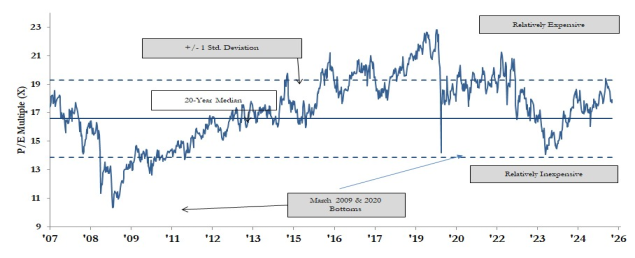
- Electric utility valuation multiples have declined from 23x forward earnings in early 2020 and trade at 17.2X 2026 earnings estimates. Over the past twenty-five years, utility forward multiples have ranged between 10x and 23x earnings with a median of 16.8x.
- Independent Power Producers (IPPs), or merchant power companies, are highly leveraged to potential supply shortages. IPPs/merchants own power plants in non-regulated power markets, including PJM (Northeast/MidAtlantic), ERCOT (Electric Reliability Council of Texas), and CA, and provide marketing/power management services to customers. In 2023-25, the share prices of CEG, NRG, VST and TLN rose dramatically and driven by electric power demand and power shortages.
- Gas utility performance reflects improved investor sentiment and ongoing consolidation but likely does not reflect potential increased gas demand. Gas utilities currently trade at 18.6x 2026 earnings estimates.
- Water utility two-year under-performance reflects the impact of higher interest rates on higher multiple stocks. Water utilities trade at the highest multiples due to their scarcity, small size, takeover premium, ESG value, and long-term growth potential through consolidation and
- Canadian electric and gas utilities have lower growth rates and higher current returns, but Fortis, Emera and Algonquin have more assets and earnings power in the US than Canada. Canadian provincial regulatory environments are more challenging (lower allowed ROEs and equity ratios) than many US utility jurisdictions.
Table 14 Utility Subgroup Statistics
Valuation
Over the past twenty years,electric utility multiples climbed from roughly 10x forward earnings to over 23x, driven by improving fundamentals, higher growth rates and lower interest rates from 2000-2022 (Exhibit 19). Electric utilities trade at ~17.5x consensus forward earnings estimates which is above (but near) the historical median (16.8x).
Exhibit 19 Absolute P/E Multiple Range Near Historical Median Despite Stronger EPS CAGR
Source: Thomson One, Company documents
Interest Rates and the Fed
Utility stocks are not bond proxies, and share prices are a function of earnings and dividend growth rates, but higher (lower) rates negatively (positively) impact stocks, given that future cash flows are impacted by the discount rate. In addition, current utility dividend returns become less compelling when returns on other investments increase, including Treasury yields. Short-term Treasuries yield 3.5-4.0% and US Treasuries hold even greater defensive appeal than utilities. The factors below mitigate the negative impact of higher rates.
- Annual dividend hikes: Utilities target annual dividend increases, which serve to mitigate the negative impact of higher rates. In 2025, electric utilities increased the annual dividend by a median of 5.1%.
- ROE is set based on interest rates: A utility’s cost-of-capital, including equity returns (ROEs), is set by state PUCs and increases (decreases) as interest rates rise (fall).
- Annual riders minimize inflation risk: State PUCs and FERC regulatory principles have improved to include more frequent rate adjustments, which mitigate inflation risk.
- Utility stocks pay higher dividends than other sectors: The present value of a higher near-term dividend stream is less impacted by changes in interest rates than a lower near-term dividend stream.
While utility dividend yields and 10-year U.S. Treasury yields are highly correlated and will likely remain so in the future, utility dividends have risen over time (most on annual basis) while the Treasury yield remains fixed. Utility stock prices, unlike Treasury bond prices, are likely to rise should earnings and dividends grow over time.
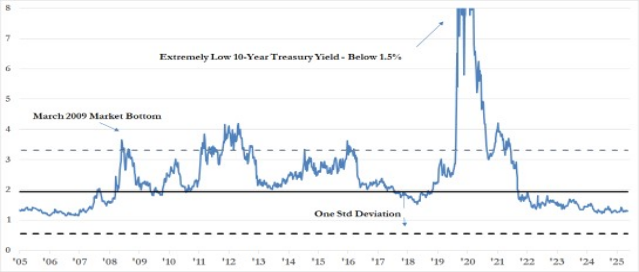
We consider the multiple attractive given higher utility earning growth rates and strong fundamentals. Given that long-term interest rates (specifically the 10-year Treasury yields) have risen to 4.2% following a long-term secular decline since the late 1980’s, we measure the earnings yield (1/P/E) as a percentage of the 10-Year T- Bond Yield to gauge interest rate adjusted valuations. As can be seen in Exhibit 20 the current ratio of 135% indicates the sector P/E is modestly higher than its historical median relationship (190%) with the 10-Year T-Bond Yield.
Exhibit 20 Utility Earnings Yield as a Percent of 10-Year T-Bond Yield (near Historical Median)
Source: Thomson One, Company documents
Conclusion
The utility sector offers a 3.3% current return and many utilities managements target 6-8% annual earnings and dividend growth. The utility business model represents a safer haven in the face of an economic slowdown, tariffs and/or inflation fears. In addition, accelerated electric demand provides support for EPS CAGR and the potential for even higher growth. We believe that the combination of strong utility fundamentals, and the potential for accelerated electric demand bode well for the relative performance of utilities.
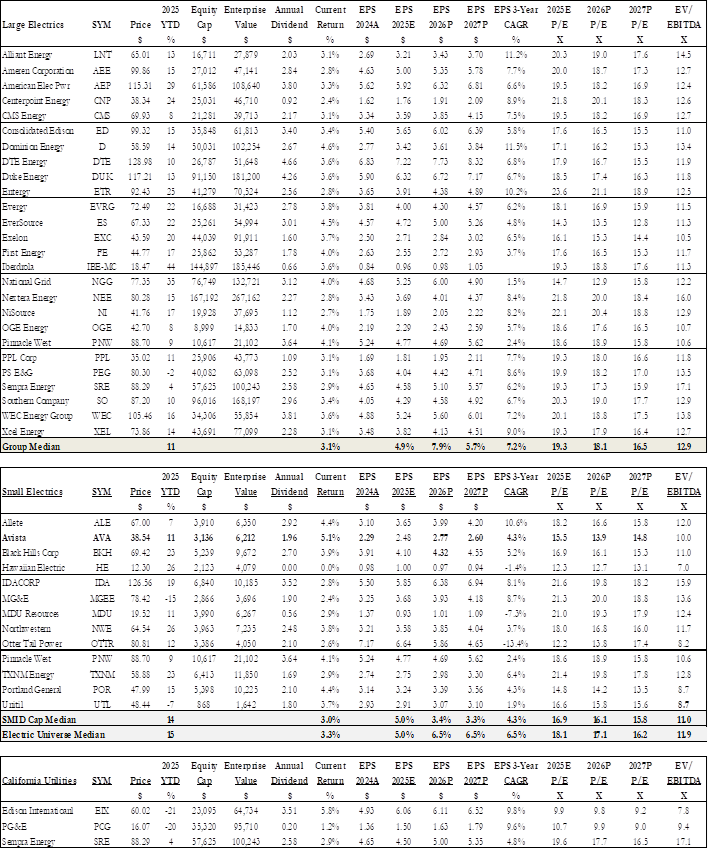
Appendix 1 Electric Utilities Selected Statistics
Source: Public data, Gabelli Funds estimates
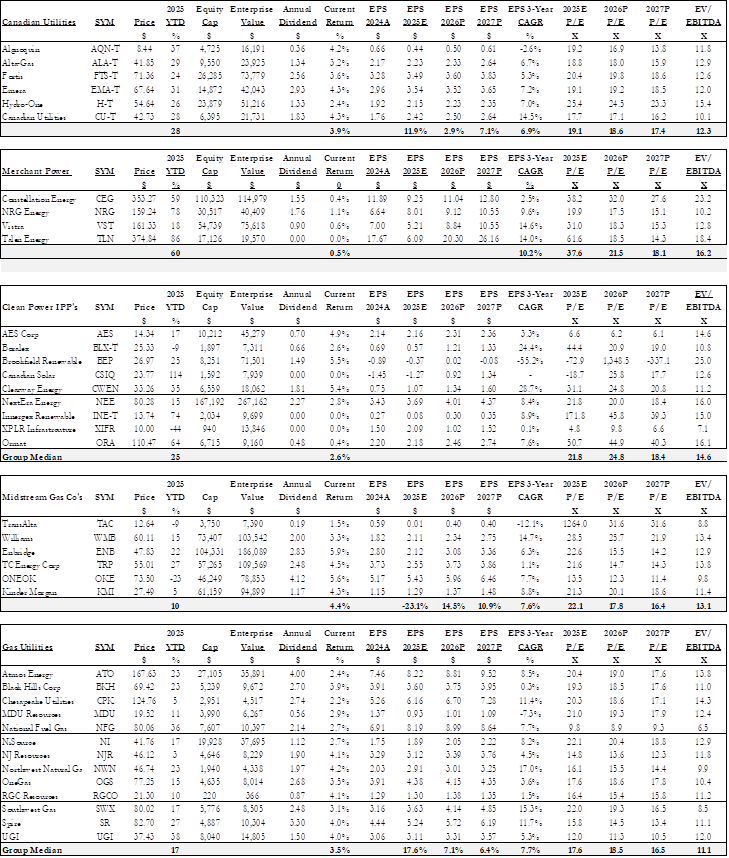
Appendix 2 Canadian, Power, Midstream, & Gas Utilities Selected Statistics
Source: Public data, Gabelli Funds estimates
Appendix 3 Water Utility & Utility Construction Selected Statistics
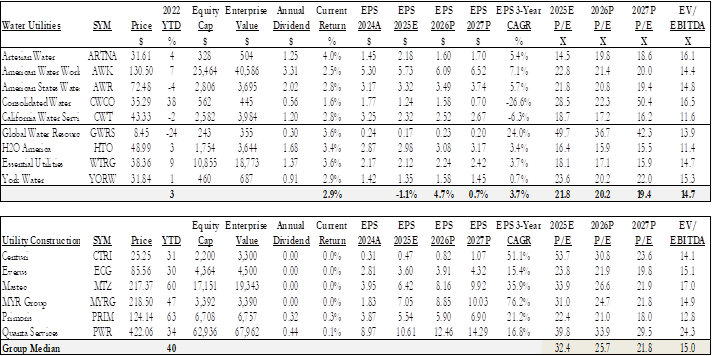
Source: Thomson One
191 MASON STREET, GREENWICH, CT 06830 Gabelli Funds TEL (914) 921-5100
This whitepaper was prepared by Timothy M. Winter, CFA. The examples cited herein are based on public information and we make no representations regarding their accuracy or usefulness as precedent. The Research Analysts’ views are subject to change at any time based on market and other conditions. The information in this report represent the opinions of the individual Research Analysts’ as of the date hereof and is not intended to be a forecast of future events, a guarantee of future results, or investments advice. The views expressed may differ from other Research Analyst or of the Firm as a whole.
As of September 30, 2025, affiliates of GAMCO Investors, Inc. beneficially owned 7.17% of RGC Resources, 4.39% of National Fuel Gas, 2.68% of Southwest Gas, 2.19% of Northwest Natural, 1.58% of TXNM Energy, 1.48% of York Water, 1.03% of Black Hills, and less than 1% of all other companies mentioned.
Funds investing in a single sector, such as utilities, may be subject to more volatility than funds that invest more broadly. The utilities industry can be significantly affected by government regulation, financing difficulties, supply or demand of services or fuel and natural resources conservation. The value of utility stocks changes as long-term interest rates change
Investors should carefully consider the investment objectives, risks, charges and expenses of the Fund before investing. The prospectus, which contains more complete information about this and other matters, should be read carefully before investing. To obtain a prospectus, please call 800 GABELLI or visit www.gabelli.com
Returns represent past performance and do not guarantee future results. Current performance may be lower or higher than the performance data quoted. Investment return and principal value will fluctuate so, upon redemption, shares may be worth more or less than their original cost. To obtain the most recent month end performance information and a prospectus, please call 800-GABELLI or visit www.gabelli.com
Distributed by G.distributors, LLC., a registered broker dealer and member of FINRA.
This whitepaper is not an offer to sell any security nor is it a solicitation of an offer to buy any security.
For more information, visit our website at: www.gabelli.com or call: 800-GABELLI
914-921-5000 • Fax 914-921-5098 • info@gabelli.com
Gabelli Funds, LLC is a registered investment adviser with the Securities and Exchange Commission and is a wholly owned subsidiary of GAMCO Investors, Inc. (OTCQX: GAMI).
Sentiment weakened late in the year as investors reassessed several emerging risks. Utilities We believe the pause and reassessment makes sense given the tremendous amounts of capital that the hyperscalers are investing and the potential for winners and losers in the AI space and data-center market. Further, the public is struggling to understand AI and data centers and given the sheer size and number there will be backlash in some communities. As power hogs, data centers impact the supply-demand dynamics in non-regulated markets which could lead to higher power prices.
While nobody knows how long the electric demand growth runway is or if more efficient AI chips will offset the demand growth, but we do know that over the next few years numerous megasize data centers are phasing in at larger sizes and that the electric demand growth is likely there for these phase ins and that electric utility capital investment is increasing to meet the increased infrastructure demands and that utility earnings power is increasing. Further, we believe that the hyperscalers Microsoft Meta amazon and google are high quality and financially strong and do not see counterparty risk. Same with the new chip fabrication facilities. The way we see it is that utilities just filled their plate and are sitting down and now must execute. They took the good pieces meaning the high quality strong hyperscalers and developers first. The build out will last through 2026-2029 and then phase or the next round. So what happens next – still in the early innings and more investment. Worst case scenario is the utilities convert to cash flow positive but refocus on clean energy and nuclear or carbon capture or reliability.
Utilities that can maintain higher growth and play defense if an AI bubble pops. Higher growth names will trade at higher multiples. Vertically integrated utilities will be able to respond to the affordability “narrative” more easily than their wires-only counterparts since they control the whole bill, and they typically have lower rates (WEC, CNP) And utilities still be a defensive stock in a market reaction. Several utility stocks that are viewed in an AI basket and not defensive
had been viewed as a stable, regulated way to participate in the AI‑driven data‑center build‑out, which requires massive incremental power demand and supports sustained rate‑base expansion. However, concerns surfaced around potential counterparty risk among newer data‑center developers, affordability debates highlighted in the 2025 gubernatorial campaigns in New Jersey and Virginia, and uncertainty around the trajectory of interest rates as inflation remained sticky. These factors contributed to a temporary “wait‑and‑see” posture across the sector.
A key source of affordability anxiety stems from deregulated power markets—particularly PJM, a 13‑state region that includes New Jersey and Virginia. Merchant generators have benefited from tight supply conditions, with recent capacity and energy auctions clearing at higher prices. These elevated wholesale costs ultimately flow through to electric distribution utilities in PJM, creating political pressure around customer bills. Importantly, this dynamic is largely isolated to deregulated markets. Traditional vertically integrated regulated utilities outside PJM are not exposed to merchant price volatility and are instead benefiting directly from the surge in data‑center‑driven load growth.