March 2026
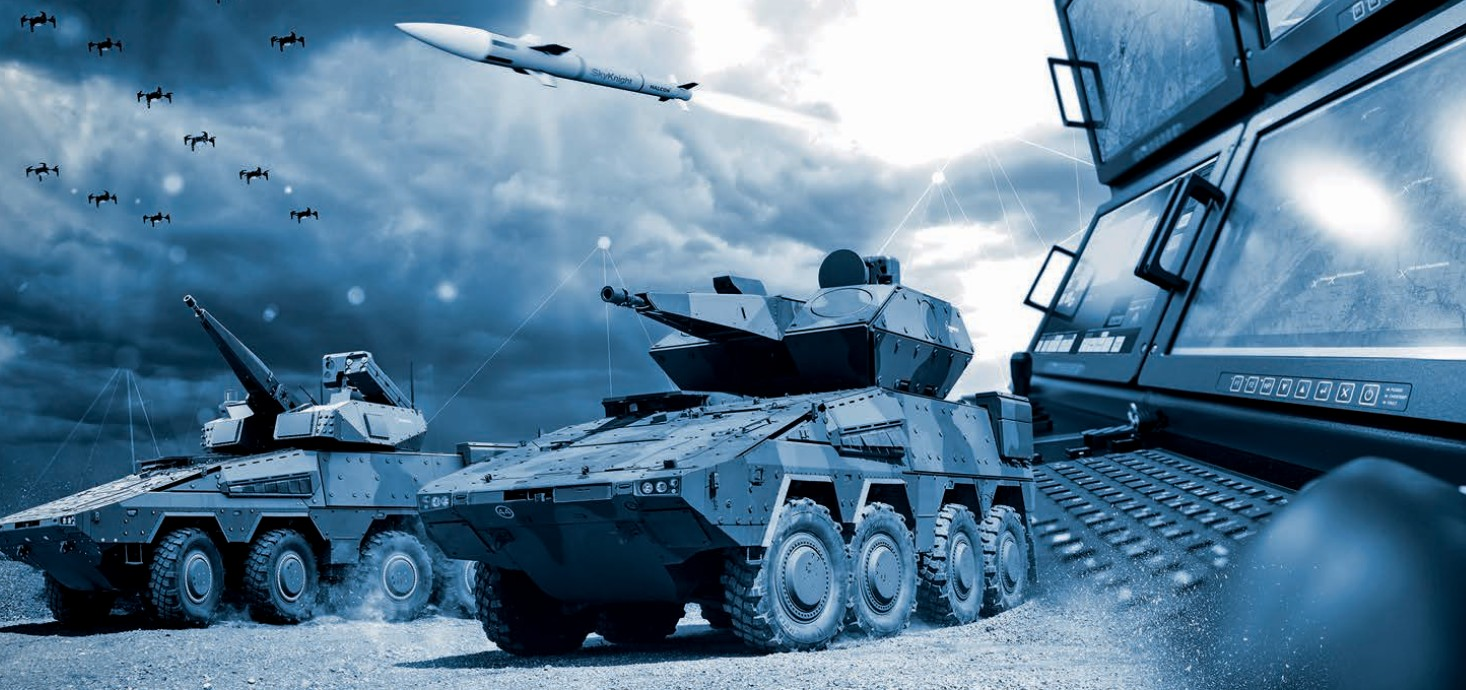
The recent surge in Middle East tensions is accelerating defense spending. This note summarizes initial takeaways from management commentary on the potential financial implications. We focus on defense companies that have already held analyst calls following the late-February events. Executives highlighted both immediate operational demand (low-cost drone air defense, precision munitions, and rapid platform deployment) and longer-term structural tailwinds (replenishment of depleted stockpiles, program acceleration, and sustained investment in advanced capabilities). Overall, the message is clear: urgent demand for immediate delivery, but importantly also durable growth opportunities for companies with scalable production, advanced systems, and strong positioning in key regions:
AeroVironment (AVAV) – Q3 2026 earnings call (10 March 2026), Investor update (18 March 2026)
CEO Wahid Nawabi framed the Iran conflict as a structural demand catalyst strengthening the economic case for drone air defense systems. He argued that the cost-per-kill economics of directed energy (such as the in-house LOCUST laser weapon system), with costs as low as $3-$5 per shot, and radio-frequency counter-drone systems will prevail over air-defense missiles that cost millions per interceptor. Just as Ukraine validated offensive drone warfare and drove multi-year demand, he argued that Iran is now doing the same for defensive counter-drone systems – even if the conflict stopped tomorrow. He noted that AV’s systems are already battle-proven in Ukraine and that the company can produce them at volume today. As a result, he expects incremental sales beginning in fiscal year 2027 and beyond.
Elbit Systems (ESLT) – Q4 2025 earnings call (17 March 2026)
CEO Bezhalel Machlis explained that for many countries, intercepting drones and cruise missiles with air-defense missiles is very expensive and ultimately unsustainable. Elbit’s high-power laser would present a cost-effective alternative and, because it is airborne, would overcome challenges faced by ground-based systems, such as clouds, dust, and turbulence. It would also provide greater operational range. and development would be already very advanced. Machlis also highlighted that, in the wake of the Iran conflict, the Israeli government approved an additional ILS 39 billion ($13 billion) in total for the defense budget. Elbit has made significant investments in its production capacity over the past five years. The company will continue investing abroad and is operating three shifts to meet demand.
Rheinmetall (RHM) – Q4 2025 earnings call (11 March 2026)
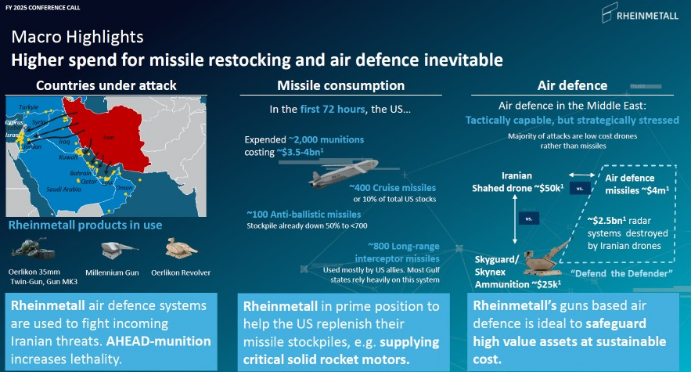
Rheinmetall expects two major business opportunities from the conflict: first, an incremental demand for gun-based air defense systems; and second, the replenishment of missile stockpiles. CEO Armin Papperger stated that nearly all countries currently under attack in the Middle East would use Rheinmetall’s gun-based air defense systems. He further explained that missile-based air defense to counter Iranian drones would be cost-inefficient: the drone would cost $20,000-$50,000, while an air defense missile would cost $0.5-$4 million. In contrast, a gun-based air defense system could engage the same drone with five rounds, costing only $5,000 (see Exhibit 1). Rheinmetall’s Middle Eastern customers therefore would have requested more gun-based systems urgently.
Rheinmetall currently forecasts up to 25% year-over-year sales growth in 2026 for its new Air Defense segment. With the first deliveries to the Middle East now expected as early as August, this forecast could prove conservative. Papperger also explained that in the first 72 hours of the conflict, the U.S. and its allies expended 2,000 munitions at a cost of approximately €4 billion. If the conflict continued at that pace for 2-4 weeks, Western stockpiles would be depleted. He stated this would collide with a global production capacity shortage, with even U.S. companies having capacity for only around 70 missiles per year for certain types. At Rheinmetall, missile production would be ramping up, with only a limited sales impact expected in 2027 and full production readiness scheduled for 2028.
Leonardo (LDO) – Investor update (12 March 2026)
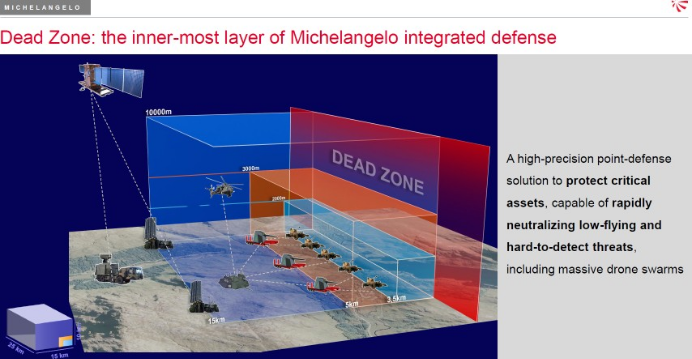
CEO Roberto Cingolani stated that, on the Saturday prior to the call, Italy’s defense minister convened a meeting with more than 100 defense operators. The minister reportedly urged all companies to collaborate and propose solutions that could be delivered short-term to the Middle East. Leonardo would have spent the week identifying platforms, including radars and missile systems, that could be transported by special aircraft. This would not be easy, as the platforms are not readily available off the shelf; instead, Leonardo would rely on available components. Cingolani also stressed that it is not cost-effective to counter drone swarms using missiles that can cost millions each. As an alternative, Leonardo proposes the use of high-precision guns as part of its Michelangelo integrated defense dome (see Exhibit 2).
RENK (R3NK) – Q4 2025 earnings call (5 March 2026)
As a result of the conflict, CEO Alexander Sagel expects rising defense spending in the region, not only on air-domain capabilities, ammunition, and air defense, but also on land-based systems. Just the day before the call, RENK received its first orders for prototype components for a new IFV (Infantry Fighting Vehicle) from a Gulf state, to be developed over the next 2-3 years. Sagel also pointed to Israel’s expanded armored vehicle investment program including Merkava tanks, as well as the potential FMS (Foreign Military Sales) repowering program for M1A2 Abrams tanks in Egypt and new tanks in Saudi Arabia, which could benefit suppliers such as RENK. RENK does not expect Germany to reinstate military export restrictions to Israel and therefore plans for more normalized deliveries in 2026.
Thales (HO) – Q4 2025 earnings call (3 March 2026)
CEO Patrice Caine confirmed that the recent Middle East events reinforced the strategic importance of air defense, validating demand for the SAMP/T NG missile-based air-defense system. Without naming specific countries, at their request, Caine indicated that the SAMP/T NG order pipeline remains strong across Europe and the Middle East. Compared with the Patriot system, SAMP/T NG would offer competitive performance and, importantly, faster lead times, with system availability projected for 2028–2029. This could position SAMP/T NG well to secure large orders in the coming years.
Dassault Aviation (AM) – H2 2025 earnings call (4 March 2026)
CEO Éric Trappier acknowledged that the Middle East conflict would inevitably impact the aerospace industry if prolonged. Dassault’s immediate priorities are protecting personnel and supporting operations for Rafale aircraft in Qatar and the UAE, where 80 aircraft remain to be delivered. Trappier highlighted that ammunition stockpiles are under pressure and there would be a true willingness and need to step up production in ammunition. He also reiterated the link between heightened regional threats and potential demand for additional nuclear-capable Rafale aircraft.
Exhibit 1:
Source: Rheinmetall
Exhibit 2:
Source: Leonardo
THE GABELLI AEROSPACE AND DEFENSE ETF
As of December 31, 2025 affiliates of GAMCO Investors, Inc. beneficially owned less than 1% of all companies mentioned.
For investors seeking exposure to this evolving defense landscape, the Gabelli Commercial Aerospace and Defense ETF (GCAD) offers targeted access to companies developing the advanced capabilities that define modern military operations. GCAD focuses on defense technology companies at the intersection of building stealth aircraft, precision munitions, unmanned systems, and advanced sensors essential to maintaining strategic advantage in contested environments. As geopolitical tensions drive sustained defense spending and procurement modernization, GCAD provides a way to participate in the growth of the defense technology sector shaping military operations for decades to come.
Click here to learn more about GCAD
Important Disclosures
Shares of this ETF are bought and sold at market price (not NAV) and are not individually redeemed from the fund.
Buying or selling ETF shares may require additional fees such as brokerage commissions, which will reduce returns.
These additional risks may be even greater in bad or uncertain market conditions.
You should consider the ETF’s investment objectives, risks, charges, and expenses carefully before you invest. The ETF’s Prospectus is available from G.distributors, LLC, a registered broker-dealer and FINRA member firm, and contains this and other information about the ETF, and should be read carefully before investing. To obtain a Prospectus, please visit https://www.Gabelli.com/funds/etfs or call 800-GABELLI.
Distributed by G.Distributors, LLC, a registered broker-dealer and FINRA member firm.
One Corporate Center, Rye, NY 10580