
Our Visit to the Western Australian Mines
In 2025, equity market volatility stemming from tariffs, sustained inflation, and geopolitical uncertainty pushed an increasing number of investors to rotate their portfolios towards gold. This rotation led the gold price to rise +65% in 2025 to over $4,500/oz[1]; on a two-year basis, gold prices have more than doubled from $2,015/oz.
A major beneficiary of this surge in gold prices is the state of Western Australia, a desert region three times the size of Texas with a higher population of kangaroos than people. The state has a resource-focused economy that provides gold miners with access to excellent physical infrastructure, a highly skilled labor force, and a supportive banking system offering reliable access to capital. Currently, Australia is the third largest gold producing country in the world; Western Australia accounts for over 70% of the national total.
Exhibit 1 Annual Gold Production by Country (tons)

Source: National Minerals Information Center, 2025
Western Australia’s mining industry extends beyond gold, as the state is also the world’s largest iron ore and lithium producer; in total, the mining industry is responsible for over 50% of the export value and over 40% of the capital investment in the region while employing almost 10% of the labor force[2].
Chris Mancini, Associate Portfolio Manager of the Gabelli Gold Fund (GLDIX), and I recently traveled to Western Australia for an investor tour of six mines and additional meetings with company managements.
GLDIX has approximately 16% of holdings in Australian mine operators. Compared with miners in other regions, these companies take a differentiated approach to operations and free cash flow management:
- Bootstrapping culture: Aussie miners favor internal cash generation to drive incremental organic growth, as management teams often develop projects with limited upfront capital. This differs from the North American model, where large mining projects raise most capital prior to any construction.
- Immediate cash deployment: Due to the lower reserve lives in Australian mines compared with global counterparts, Aussie operators are forced to quickly identify and mine viable gold deposits with less flexibility on project timelines.
- Nearly all excess cash is allocated towards three activities (aside from dividend growth):
- Exploration (locating the ore)
- Mine development (accessing the ore)
- Plant expansion (processing the ore)
Of the six mines that we visited, four stood out as examples of how this newly available cash is being actively reinvested to extract more gold out of the ground and surface value for shareholders.
Exhibit 2 Timeline of Western Australia Mine Tour

Northern Star Resources (NST.AX – 28.60 AUD)
KCGM
Northern Star is the largest Australian mine operator with a market cap of $23.9bn. For FY25 ending June 30th, NST generated $536mm of free cash flow and shares traded up +58% over the calendar year. While the company’s asset base extends throughout Australia (as well as a mine in Alaska), the highlight of our visit was the KCGM open pit, known colloquially as the Super Pit, and underground mine in Kalgoorlie that was acquired in 2020. The Super Pit is one of the world’s largest open pit mines and is responsible for 1% of all gold ever mined on the planet since the deposit was discovered in 1893.
Aerial View of the KCGM “Super Pit”

Source: The Australian, 2019
KCGM produced 419k ounces of gold in FY25 (26% of company total) and management has noted current reserves and resources as 14 million ounces (Moz) and 39Moz, respectively. Management is guiding to 550-600koz for FY26 ending June 30th, 2026. The most recognizable section of the mine, the Fimiston Open Pit, is stated by management to have 173 million tons (Mt) of ore at a grade of 1.5 grams (gold) per ton (g/t) for overall gold reserves of 8.3Moz and resources of 20.8Moz. The remaining gold production comes from the 144Mt ore stockpile at 0.6 g/t and the growing underground mine, which is being targeted for expansion due to the higher grades at depth. Since August 2024, Northern Star has constructed seven new underground portals to increase accessibility of the mine, which will see the higher-grade ore mixing positively in overall production. This is one example of how the company is putting their recent influx of free cash to work.

Photo: Chris Mancini touring KCGM plant expansion
While the underground development has proven to be a positive use of cash, Northern Star’s strategic priority has been investing in KCGM’s Fimiston Plant expansion. The company has limited constraints on the amount of ore they can mine, though the processing capacity of the existing plant has proven to be a bottleneck at 12Mt per annum (Mtpa). In 2023, Northern Star announced that they would be undertaking a ~$1bn plant expansion project to be completed in three years that they expect to more than double the processing capacity to 27Mtpa in FY29. At the same time, the modular design of the plant will reduce the labor requirement by an expected 35%, generating additional cost savings. At the time of our visit, the new plant’s design, procurement, and engineering have all been completed, leaving assembly and commissioning as the final steps to complete the expansion on schedule.
Gold Fields (GFI – $61.51)
St. Ives
Gold Fields (GFI) is a leading global miner with a presence in Western Australia that, similarly to Northern Star, has generated record free cash flow that they are determined to put back into the ground. The company has a market cap of $40.4bn and shares appreciated +211% in 2025 driven largely by their Western Australian operations. We toured the company’s St. Ives mine, which consists of four open pit and three underground mines. Acquired in 2001, St. Ives has an estimated mineral reserve of 3.3Moz and management has guided gold production of 383koz for 2025.
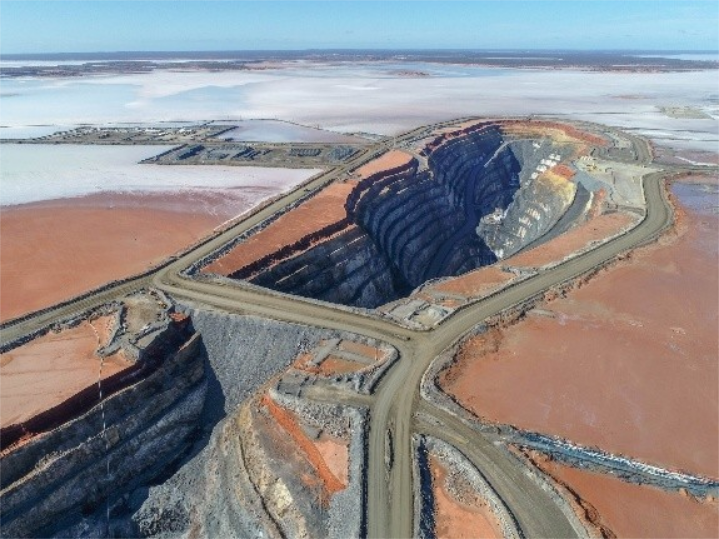
Invincible Mine Surface Operations
Source: Gold Fields, 2024
The most notable piece of the St. Ives land package is the Invincible deposit discovered in 2012. Located beneath one of the local salt flats, this previously unexplored deposit represents one of the largest discoveries in the region. Gold Fields began developing the Invincible mine in 2017 and is now pulling 65-70% of St. Ives production feed from this one underground; out of the 3.35Moz reserve reported for St. Ives in 2024, Invincible accounted for 2.5Moz. Given the size of the deposit, the company is focused on further mine development as a primary use of cash. Gold Fields is planning to invest in a second decline down to the ore body as well as underground crushers and conveyers, all highly capital-intensive projects, that management expects to drive a step function change in production. Management explained that the new material handling system is estimated to increase Invincible underground production from 2Mtpa to 3.4Mtpa when this dual decline is completed in 2030.
Chris and I also met with the company’s geologists who indicated that after exploration, the area below the Invincible South zone, named the Fremantle deposit, has an even higher-grade ore body that will be a target for future underground mining. Over the next three years, the company is planning to drill an additional ~300km. Between the exploration and the considerable mine development at Invincible, Gold Fields has plans to meaningfully deploy cash to drive greater production and efficiency within a premier Australian asset.
Westgold Resources (WGX.AX – 7.69 AUD)
Beta Hunt
Westgold Resources is another top five Australian gold producer ($4bn market cap) that owns and operates a handful of mines throughout central and southern WA with a processing capacity of 6Mtpa.
We went on an underground tour of Beta Hunt, which is a 50-year-old nickel mine located right next to Gold Fields’ St. Ives site. Gold Fields had acquired this mine in 2001 before gold production began in 2014; as of 1Q25, Westgold has a significant sublease of the mine that extends deep below the surface. While Beta Hunt has no surface operations, Westgold sees the underground ore bodies as having very high potential beyond the previously explored mine sections.
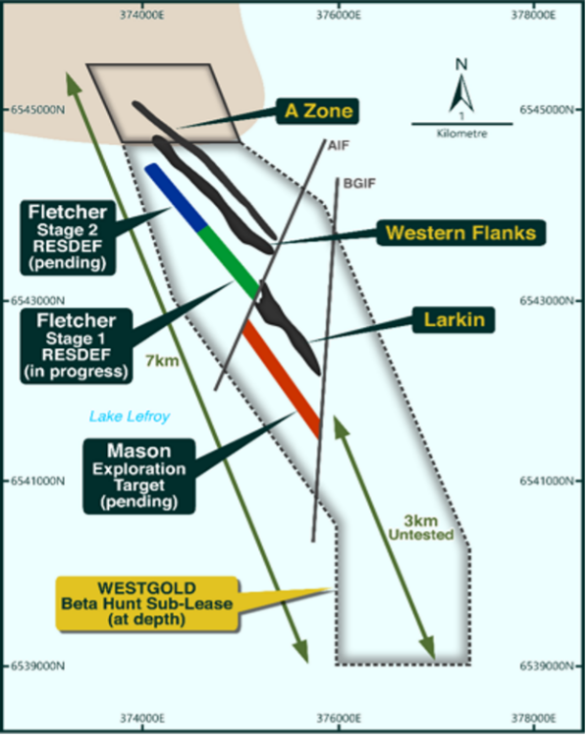
Beta Hunt Underground Zone Map
Source: Westgold Resources, 2025
Since Westgold became owner and operator under the sublease, they have achieved a step change in quarterly ore extraction from 280 thousand tons (kt) to 407kt at a grade of 2.4g/t. According to management, this will enable them to eventually reach their goal of 2Mtpa from Beta Hunt. Currently, the mine holds gold reserves of 7.5Moz and resources of over 13Moz. The success of the operation in the existing mining sections has proven the Beta Hunt investment lucrative for Westgold, though this 2Mtpa goal doesn’t even include the highest potential ore body. Currently, Westgold has been mainly producing from two zones – Western Flanks and A Zone (see chart on left) – while the most significant opportunity is the development of a third mineralization zone called Fletcher. Exploration of the Fletcher zone is where the company is planning to invest considerable cash moving forward; presently, Stage 1 drilling is underway with a 400-500m width while 3km of depth remains untested. The potential of Fletcher combined with the success of Beta Hunt and the other Australian operations drove Westgold share gains of +134% in 2025.
Ramelius Resources (RMS.AX – 4.97 AUD)
Mt. Magnet & Dalgaranga

Photo: Chris Mancini at entrance to Dalgaranga’s underground portal
Ramelius Resources is a $5.6bn market cap gold miner that has been in production since 2006. Chris and I visited two of the company’s sites: Mt. Magnet, a mine site with one of the two processing hubs, and Dalgaranga, a recently acquired underground mine with impressive geology. Ramelius boasted share gains of over +116% in 2025. The bolt-on acquisition of the Dalgaranga property in July 2025 brings Ramelius an easily accessible underground with a large, higher-grade ore body. In numbers, the underground reserves and resources for the mine are reported to be 7Mt at a 7.3g/t grade and 14.3Mt at a 5.7g/t grade, respectively. The geometry of the ore body also lends itself to easy and efficient extraction, which will further support the mining process as Dalgaranga’s higher grade ore mixes positively with the existing mill feed. This ore will be processed ~70km away at Mt. Magnet’s facility, which will help increase production and drive down unit costs. Management expects to spend roughly $10-12 million on exploration of the Dalgaranga deposit in FY26 (ending June 30th, 2026), which geologists estimate to fall along a 6km mineralization trend.
The Australian Advantage
Underappreciated and Undervalued Relative to Global Peers
This investor tour shed light on the high degree of opportunity that gold miners in Western Australia have to meaningfully deploy their excess free cash. Through exploration, mine development, and plant expansion, these operators are strategically investing for the future and working to drive increased gold production and unit cost savings.
Elevated gold prices have benefited global mine operators just the same as those discussed here. At the same time, valuations have remained relatively low across the board. For example, over the past 40 years, the average price to earnings ratio of gold mining companies is 25x, according to Scotiabank. Today, we estimate that the large cap miners are trading at approximately 12x. Even if the gold price were to dive to $3,500/oz, the average price to earnings ratio of the four largest holdings in the Gabelli Gold Fund would be 14x.
This then begs the question – why Australia?
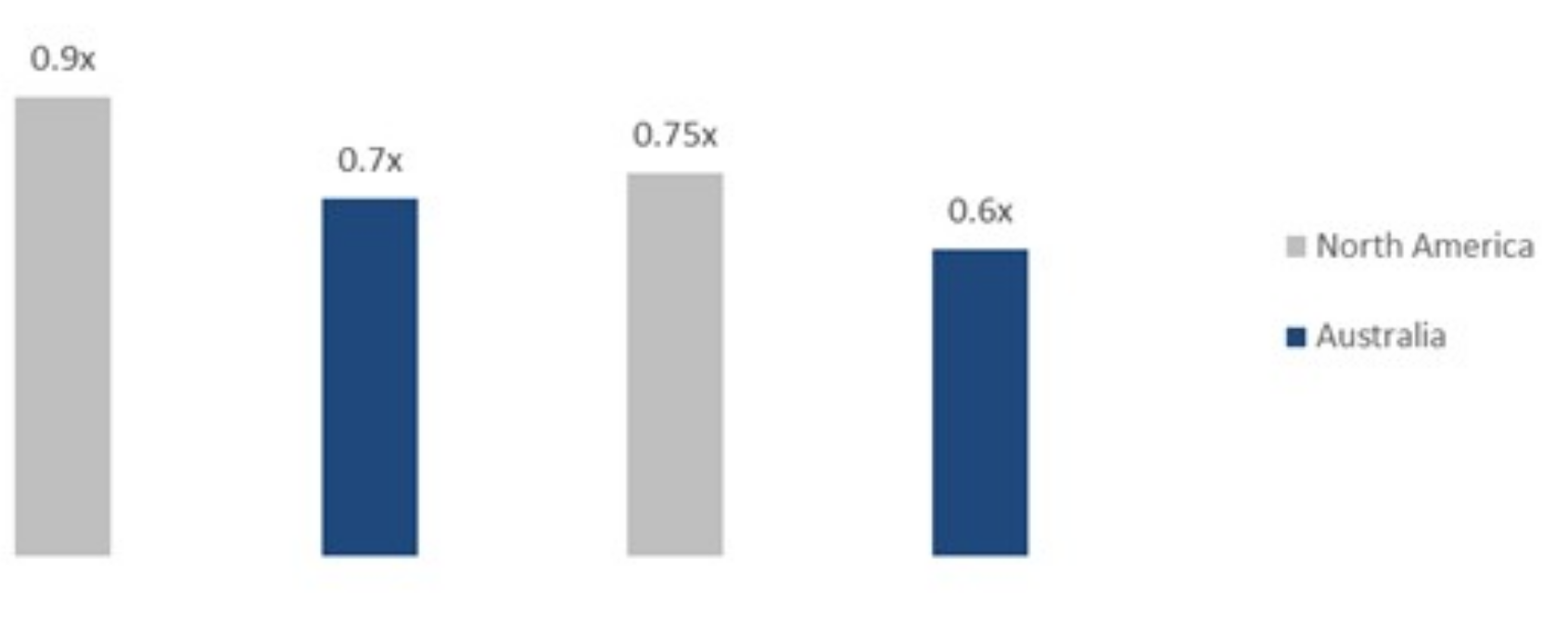
Exhibit 3 Average NAV Multiple – North America vs. Australia
Source: Gabelli estimates, Nov. 2025
While the large-scale global gold miners are historically undervalued, Australian miners have remained underappreciated and undervalued to an even greater extent. We estimate that large-cap Northern Star is trading at 0.7x its net asset value (NAV) assuming current gold prices, while North American peers are trading at an average of 0.9x NAV. This is compared to the 1.5x 40-year historical average according to Scotiabank. A similar disconnect is seen with the small and mid-cap Australian miners, which are trading at 0.6x NAV compared to 0.75x NAV for North American peers. We believe that as the market pays more attention to the sector, the Western Australian miners will see this valuation gap narrow and will benefit from the presently unappreciated potential of their operations.
Gold ETF Flows and Performance
Uncovering Value in Gold Equity Products
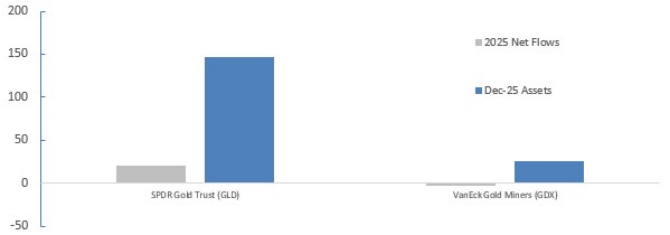
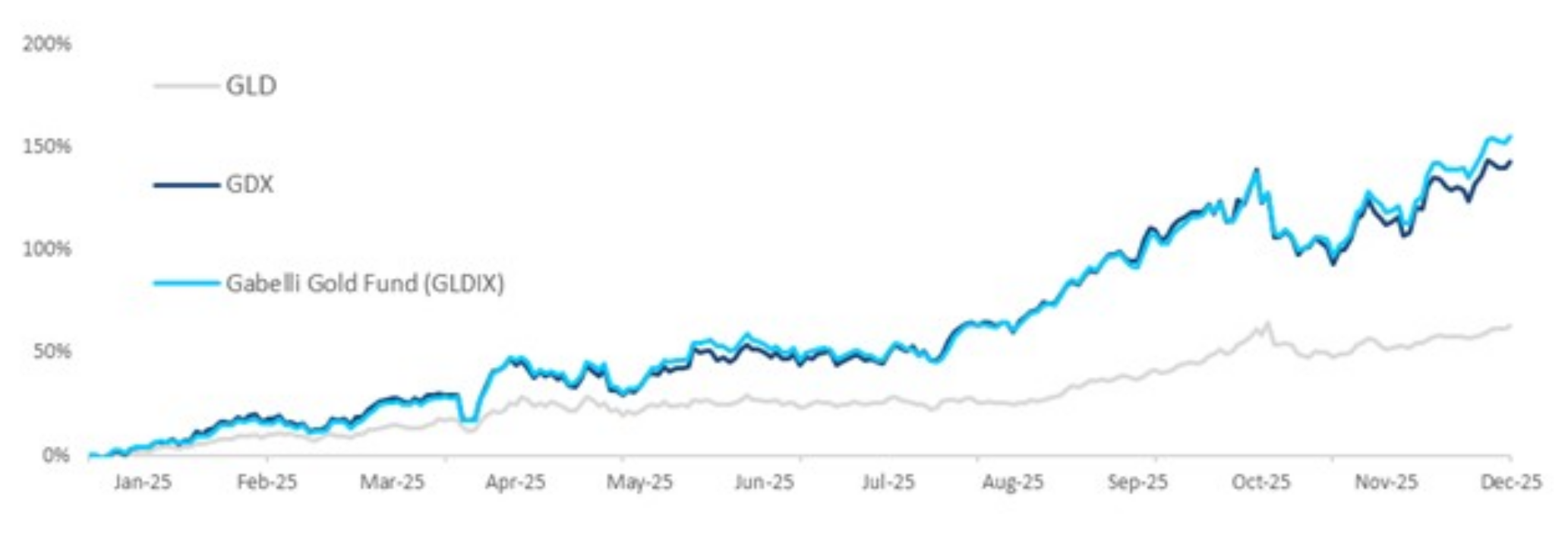
The SPDR Gold Trust (GLD) – the largest gold ETF by assets ($147.5bn) – experienced net inflows of over $23bn in 2025 (Exhibit 3). Despite the surge of investments in gold bullion, the largest gold miner ETF – VanEck Gold Miners (GDX – $25.8bn in assets) – experienced net outflows of $3bn in 2025. Over this same period, GDX comfortably outperformed GLD by growing over +140% (Exhibit 4). This dynamic has presented value investors the opportunity to own the underappreciated mining companies at historically cheap valuations while they generate record free cash flow, which has been driven by soaring gold prices and stable all-in sustaining costs per ounce (AISC/oz). In fact, gold equities have historically grown at roughly 2x the pace of gold prices.
Exhibit 3 2025 Net ETF Flows and Assets – GLD vs. GDX ($bn)
Source: etf.com
Exhibit 4 2025 Gold ETF Performance vs. GLDIX (%)
Source: etf.com.
The Gabelli Gold Fund (GLDIX)
Investing in Strategic Gold Mining Companies
To capitalize on these trends in the market, our portfolio managers seek exposure to gold through the mining equities rather than directly owning the asset. Investors can own physical gold to maintain purchasing power, though holding high quality gold stocks allows investors to own reserves in the ground while also receiving income from dividends and benefiting from potential earnings and dividend growth over time. We find that investing in the mine operators themselves unlocks exciting opportunities in an uncertain macro environment by granting us positive exposure to gold prices while maintaining our bottom-up, fundamental approach to value investing. This is the investment philosophy behind the Gabelli Gold Fund (GLDIX) run by portfolio managers Caesar Bryan and Chris Mancini, CFA, which returned +167% in 2025 (Exhibit 4).
[1] All figures in USD unless otherwise stated in AUD.
[2] Western Australia Department of Treasury and Finance, 2025
This whitepaper was prepared by Benjamin Pontious with the assistance of Chris Mancini. The examples cited herein are based on public information and we make no representations regarding their accuracy or usefulness as precedent. The author’s views are subject to change at any time based on market and other conditions. The information in this report represents the opinions of the individual author as of the date hereof and is not intended to be a forecast of future events, a guarantee of future results, or investments advice. The views expressed may differ from other Portfolio Managers or of the Firm as a whole.
The Gabelli Gold Fund’s share price will fluctuate with changes in the market value of the Fund’s portfolio securities. Investments related to gold and other precious metals and minerals are considered speculative. The Fund may be subject to significant volatility and investors may experience substantial loss of value in a short period. Investing in foreign securities involves risks not ordinarily associated with investment in domestic issues. Fund’s concentrating in specific sectors may experience greater fluctuations in value than funds that are more diversified. Consequently, you can lose money by investing in the Fund.
Investors should carefully consider the investment objectives, risks, charges and expenses of the Fund before investing. The prospectus, which contains more complete information about this and other matters, should be read carefully before investing. To obtain a prospectus, please call 800 GABELLI or visit www.gabelli.com, or email info@gabelli.com.
Distributed by G.distributors, LLC One Corporate Center, Rye, New York 10580. G.distributors is a registered broker-dealer and a member of FINRA.
As of September 30, 2025, The Gabelli Gold Fund and affiliates of GAMCO Investors, Inc. beneficially own on behalf of their investment advisory clients or otherwise less than 1% of the shares outstanding of all of the companies mentioned in this report.
As of September 30, 2025, the Gabelli Gold Fund held the following position sizes: Northern Star Resources: 6.4% Westgold Resources: 3.4%; Gold Fields Ltd.: 1.3%; Ramelius Resources: 1.0%.
The author of this report owns 1,000 shares of Ramelius and 800 shares of Westgold and no shares of Northern Star or Gold Fields.
We prepared this report as a matter of general information. We do not intend for this report to be a complete description of any security or company and it is not an offer or solicitation to buy or sell any security. All facts and statistics are from sources we believe to be reliable, but we do not guarantee their accuracy. We do not undertake to advise you of changes in our opinion or information. Additional information is available on request.